Guest post: “Sniffing Out An Agent” by Huskyteer

Sniffing Out An Agent

by Huskyteer


Everyone seems to be a writer, these days, and everywhere – at least, every town in the UK – seems to be having a Literary Festival. The second week in September, it was the turn of Battersea, in South London, and among the many events offered to readers and writers in the area was an ‘Agent-Led Dog Walk’.

Approaching a literary agent can feel intimidating. It’s a relationship that may last the whole of an author’s writing career, so it’s important to get things off to a good start. Yet agents are busy people who may not have time to spare for answering questions while they’re at work, and may not feel like it during their leisure hours. Nobody wants to come across as pushy, or be That Writer who backs an agent into a corner at a party and shoves a manuscript under their nose, but many of us have things we’d like to find out.

The dog walk was a chance to chat with an agent in a less formal environment, while also getting some exercise and having some fun. There’s nothing like a dog for creating an informal atmosphere and a topic of lively conversation. The £5 event fee would go to Battersea Dogs & Cats Home.

As a dogless writer, I’d happily have signed up for a charity dog walk even without the additional carrot (or bone) of chatting with an agent. Besides, perhaps dog-friendly agents would be more receptive than the average to my talking-animal stories? I went along to find out.

The Sunday of the walk turned out to be a beautiful morning, and a couple of dozen literary hopefuls gathered in Battersea Park. We were introduced to the four dogs and their agents, then we split into groups for an hour of walking and talking.

I had checked the agents’ websites beforehand, but none of them stood out as the perfect match for my writing, so I went by dog. My pick was Maisie, who had brought Jo Unwin of the Jo Unwin Literary Agency. She (Maisie) was a medium-sized brown dog with setterish ears who looked like a bundle of high energy fun. Sure enough, I was to spend much of the next hour throwing an increasingly soggy and ruptured tennis ball and remembering every now and then that I probably ought to be networking or something.

Jo very fairly made time to talk to each of us individually, and we also sat down as a group to drink coffee, ask questions and receive advice. I also seized the chance to bestow some scritches on Maisie, who was initially glad of the rest after jumping in and out of the duck pond but quickly grew bored with all this talking.

Some of what we were told was familiar to me from my obsessive reading around the submissions process, but it made a big difference hearing it in person. I might not be able to reproduce that experience, but here’s what we learned:


  • Be professional. Find an agent who works with your genre, and address them by name in your cover letter.
  • Identify what’s unique about your book. Imagine you’re in the pub, talking about a book whose title you can’t quite remember; what’s your book’s “that one with the…”?
  • Sell yourself – but be relevant. List publications, prizes, and any background information that shows you’re especially qualified to write the book you’ve written, but don’t talk about your lifelong dream of being a writer, or how much your kids loved the book.
  • Should you say your book has series potential? That depends if it does; is what you’re planning a true sequel, or are you too lazy to think of a new scenario, or too fond of your characters to let them go?
  • Only submit when you think your manuscript is as good as it can be. It won’t be, but don’t send a draft you know is flawed and expect an agent or editor to leap at the chance of sorting it out for you.


As well as a deeper knowledge of what agents might be looking for, and how they like to be approached, I’ve gained an opening should I ever have a project I feel would be a good fit for Jo (“It was so lovely to meet you on the Battersea dog walk. I was the one who threw the ball for Maisie over and over and over again”). It was also lovely to swap notes with other local writers on works in progress and how far we’d come.

You might not be lucky enough to find a similar event in your own neighbourhood, but if you’re involved in a local arts festival, why not try setting one up? And if you’re a literary agent with a canine friend, consider turning your daily dog walk into an opportunity to help up and coming authors while also publicising your agency. The writers will thank you, and so will your dog.


Member Spotlight: Donald Jacob Uitvlugt

1. Tell us about your most recent project (written or published). What inspired it?

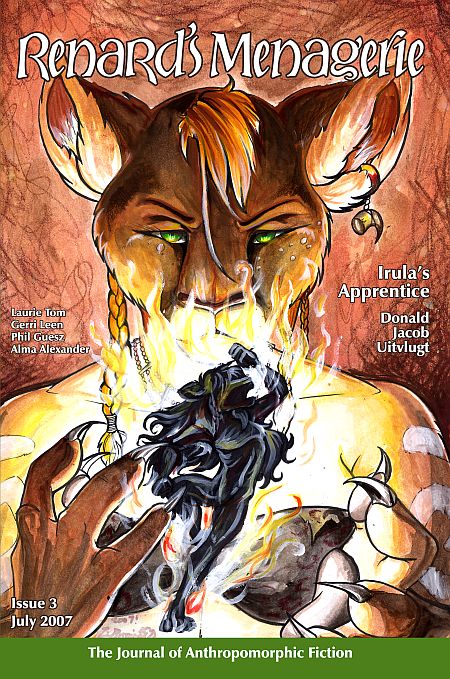
renards coverFor my furry writing, I’m in the process of revising a novel set in the same fantasy world as my short story “Irula’s Apprentice,” but a couple of generations later. In this world, I envision what a society of intelligent lions might look like if one takes existing lion behavior as a given. It’s also been interesting to see how a leonine society might take on different dimensions depending on the setting.

The novel is in a lot rougher shape than I’d like it to be, but I’ll be looking for a publisher when I get it in a shape that I like.

With my non-furry work, I recently had a piece of flash fiction accepted for publication that combines aspects of the Cthulhu mythos with the legend of the Pied Piper of Hamelin. A science fiction story will soon be released by the Wily Writers podcast.

2. What’s your writing process like? Are you a “pantser,” an outliner, or something in between?

Most of my stories have a fairly long period of rumination, where I’m working out story issues in my head. I tend to do a lot of research, which I may or may not use in my writing. I try to write a first draft as quickly as I can; sometimes I have a broad outline, sometimes I know what I want to do in the next couple of sections. And sometimes I just write to see where the characters and concept will take me. I try to revise as best as I can, and then try to get beta readers involved before I make a submission-ready draft — although deadlines don’t always allow me to exercise the full process.

3. What’s your favorite kind of story to write?

Most of my stories tend to be speculative fiction of one sort or another, with horror and dark fantasy predominating lately. Often my stories focus on individuals thrust into extreme situations and how their choices wind up making or breaking them. World creation is important, and I hope I do it reasonably well, but in the end I want the characters to be most important.

4. Which character from your work do you most identify with, and why?

I would probably say Raalfarinoor from my lion novel. While I don’t think he’s a Mary Sue/Gary Shrew, there are a lot of ways he represents an idealized version of myself. His courage, his integrity, his humor and his curiosity are all something I strive for.

Continue reading “Member Spotlight: Donald Jacob Uitvlugt”

Guest post: “Common Mistakes Among Writers” by Sarina Dorie

Common Mistakes Among Writers

by Sarina Dorie


When we go to a job interview, we wear our best suit, come with a list of references, and might even remember to put on deodorant. At least, we do if we want the job. When we format a manuscript, self-edit a novel, or polish a book before sending it off to an agent or editor, we strive to present it as though we are professional writers who know what we are doing. At least, we do if we want to be published. Whether a seasoned writer, or someone just starting out in the writing process, there are weaknesses we don’t always recognize in our skills. We get into ruts with grammar, formatting or stylistic “rules” we learned early on in high school writing classes that are bad practices in professional writing. Learn the common mistakes so you can recognize when you make these in your writing so you can avoid them.


Five Common Mistakes

  1. The manuscript isn’t in manuscript format

Short stories have a particular format and novels have different requirements. Additionally, some publishers have very specific variations from the standards that a submitter must be aware of. The number one cause listed on editor, agent and magazine websites for writing to be rejected is not reading the guidelines.

2. Grammar errors and inconsistencies

Sometimes a simple spell check will suffice. Other times, one needs to look up rules that are unfamiliar. Some rules of grammar are meant to be broken, but it is important to start with foundational knowledge and break a rule consistently if one chooses to do so. Classes, critique groups, peers and beta readers can help.

3. The mechanics of the story are broken

Sentence structure is unvaried, past and present tense rules are not consistently followed, or there are various typos not covered under grammatical errors that make the manuscript a chore to read. It is common to find long sections of dialogue without dialogue tags, setting information lumped together, chunks of unbroken interior monologue or sensory information in one section, and long expanses of exposition in others. The story might be all, or large sections of, telling.

4. The story itself is broken

The premise is unbelievable, the idea is trite or overdone, or the plot has no story arc. Maybe the characters are so unsympathetic the reader can’t get into the story or the writer has gotten a vital piece of information wrong that affects the story. This can be pretty important if an author is writing a paranormal romance with werewolves and the characters and plot don’t reflect accurate, wolf-like traits.

5. The story is boring

This usually means it lacks conflict. It might also be because there is no hook in the beginning, or it could be because the reader doesn’t understand or care about the characters’ motivations, feelings or situation. The reader needs to be emotionally invested. Sure, it might just be because the reader isn’t the author’s target market, but even romance readers can be persuaded to read a mystery if they care about the characters or a mystery reader can read a romance if they are invested in the plot.


Sarina Dorie brings to her writing background experience working as an English teacher in South Korea and Japan, working as a copyeditor and copywriter, and reading countless badly written stories. Sarina’s published novel, Silent Moon, won second place in the Duel on the Delta Contest, second place in the Golden Rose, third place in the Winter Rose Contest and third in the Ignite the Flame Contest. Her unpublished novel Wrath of the Tooth Fairy won first place in the Golden Claddagh and in the Golden Rose contests. She has sold short stories to over thirty magazines and anthologies including Fantasy and Science Fiction Magazine, Daily Science Fiction, Cosmos, Penumbra, Sword and Laser, Perihelion, Bards and Sages, Neo-Opsis, Flagship, Allasso, New Myths, Untied Shoelaces of the Mind, and Crossed Genres, to name a few.

Silent Moon is currently available as an ebook through Amazon and will be released in print next month.

For more story problems remedies, editing tips and short story writing advice, go to Sarina Dorie’s website at: www.sarinadorie.com/writing

Book of the Month: PULP! Two-Pawed Tales of Adventure, edited by Ianus J. Wolf

pulp coverOctober’s Book of the Month is edited by FWG member Ianus J. Wolf and includes stories from members Ocean Tigrox, Bill “Hafoc” Rogers, Renee Carter Hall, Tarl “Voice” Hoch, Roland Jovaik, and Huskyteer.

“Keep your dials tuned as we join the RVO Radio Theatre for adventure, mystery, and danger!  Dive deep into the jungles of South America where the temple’s gift may not bring what you wish in The Ruins.  Then, jump to the Wild West of America as a badger determines who is the predator and who is Prey.  But don’t go too far as a group of intrepid Army Rangers battle a foreign threat to America more dangerous than the evil mastermind’s ‘robots’ in Rocket Canyon. And this next tale of an Aussie gal with a heart of gold and fists of iron battles the Nazis in The Bouncer and the Didgeridoo of Awakening. And join our poster girl, the rough and tumble Tesla Mae and the Lost Tribe. Don’t take too long to dock your airship, because evil cultists are trying to destroy Boston in Jericho Tanner and the Ebon Star. Find out who is the destroyer of worlds and who is the fox that can save us all in Savior.  And finally wrap it all up with a trip across the pond and the high flying aces in Flight of the Fire Dragon! Stay tuned, listeners, for more adventure!”

Featuring stories from:

  • Tym Greene
  • Ocean Tigrox
  • Bill “Hafoc” Rogers
  • T.S. McNally
  • Renee Carter Hall
  • Tarl “Voice” Hoch
  • Roland Jovaik
  • Huskyteer

Cover by Quel.

Order from Rabbit Valley.


Guild News: October

New Members

Welcome to our new members Nathanael “Friday” Gass, Mars, Jess E. Owen, Tony Greyfox, and Ocean Tigrox!

Member News

Tristan Black Wolf took first place in SoFurry’s “Summer Adventures” writing contest with his story “Solstice.”

Renee Carter Hall‘s “The Bear with the Quantum Heart” was reprinted in Allegory, and her ebook “Real Dragons Don’t Wear Sweaters” is now just 99 cents at Amazon and Smashwords.

The first FWG anthology, Tales From the Guild Volume 1: Music to Your Ears, was published this month by Rabbit Valley, featuring stories from members Michael H. Payne, Mary E. Lowd, Huskyteer, Sean Rivercritic, Mark Neeley, Mars, Nathanael Gass, and Jess E. Owen, and in Rabbit Valley’s new anthology Pulp!: Two-Pawed Tales of Adventure, you’ll find stories from members Ocean Tigrox, Bill “Hafoc” Rogers, Renee Carter Hall, Tarl “Voice” Hoch, Roland Jovaik, and Huskyteer. You’ll also find work by our members in this year’s Rainfurrest charity anthology, Furtual Horizons, which includes stories from Tarl “Voice” Hoch, Ocean Tigrox, Kyell Gold, and Friday, among others.

With a title like “Pegacornus Rex,” how can you not check out Mary E. Lowd’s latest story in Daily Science Fiction? She’s also the new editor for ROAR #6 (more about that in Market News).

New releases from FurPlanet for Rainfurrest also include Kyell Gold’s Dude, Where’s My Fox? and Rose LaCroix‘s Escape from St. Arned.

Finishing up this month’s news, Michael H. Payne’s Morning, Noon & Night is now available for Kindle, Dwale has posted a new poetry bundle to FA, and our associate member Jay has been confirmed as a special guest at FurDU 2015.

(Members: Want to make sure your news gets included here? Start a thread in the Member News forum!)

Market News

Upcoming deadlines: Get submissions in to World Weaver Press’ Corvid anthology by October 31, and the deadline is November 1 for submissions to The Furry Future. (Full info and links to guidelines at our Paying Markets page.) The Midwest FurFest conbook also has a November 1 deadline (details at our conbook page).

Just opened: Two new anthologies forthcoming from FurPlanet — ROAR #6 with a theme of “scoundrel,” and an untitled noir anthology. Rainfurrest has also announced next year’s charity anthology theme, “Sword and Sorcery.” (Remember to keep an eye on our Calls for Submissions thread and our Publishing and Marketing forum for the latest openings and news!)

Guild News

In case you’ve been under a rock (any rock-dwelling fursonae out there?) or just weren’t paying attention under Member News, our first anthology, Tales From the Guild Volume 1: Music to Your Ears, is now available from Rabbit Valley. Support the guild and pick up your copy here! (Ebook coming soon.)

The Cóyotl Awards for 2012 and 2013 were announced at Rainfurrest this past weekend. You can see the list of winners (and links to the nominee lists) here. Congratulations to all our winners and nominees — and remember, if you know of something published this year that deserves our attention for next year’s awards, come tell us about it in this thread!

We remain open to guest blog posts from members! See the guidelines here.

Want to hang out and talk shop with other furry writers? Come join us for the Coffeehouse Chats, Tuesday evenings at 7 p.m. Eastern and now Saturday nights at 8 p.m. Eastern — both held right in the forum shoutbox.

And if you’ve got something you need a beta for, we have a critique board in our forum (you’ll need to be registered with the forum in order to view it).

That’s all for this (very busy) month! As always, send an email to furwritersguild (at) gmail.com with news, suggestions, and other feedback, or just comment here.

One last question…

If a coyote howls and there’s no one there to hear it, does it make a sound?


Cóyotl Award winners announced

The Cóyotl Awards ceremony was held last night at Rainfurrest. Congratulations to all the winners!

2012 winners:
(Full list of nominees at http://coyotlawards.org/2012-2/)

Best Novel: By Sword and Star by Renee Carter Hall
Best Novella: Reach for the Sky (The Battle of Britain – a novel of Lt. Corn Book 1) by Vixyy Fox
Best Short Story: “Chasing the Spotlight” by Tim Susman (published in ROAR Volume 4)

2013 winners:
(Full list of nominees at http://coyotlawards.org/2013-2/)

Best Novel: God of Clay by Ryan Campbell
Best Novella: Indigo Rain by Watts Martin
Best Short Story: “Fox in the Hen House” by Mary E. Lowd (published in Dancing in the Moonlight)
Best Anthology: Hot Dish #1 edited by Alopex

And if you’ve read something great so far this year that you think members should take a look at for the 2014 awards, come tell us about it in this thread:
http://www.anthroaquatic.com/forum/index.php?topic=326.0


Member Spotlight: Elijah Lapso

1. Tell us about your most recent project (written or published). What inspired it?

My most recent publication was the pair of poems featured in the anthology Will of the Alpha. They were sort of an on-the-fly kind of pair but I think they came out nicely.

Current projects include a piece that I am going to submit for Heat that I’m hopeful about. I’ve had it proofread by a friend who adored the piece. Inspiration for that actually came from a role-playing game of all places but definitely took on a mind of its own after I began.

I’ve also got a set of novels I’m brainstorming about right now. One of them I’ve started and restarted probably seventeen times now. I just start getting into it and then hating all of it. Hopefully that will rectify itself soon though.

The theme behind it is acceptance. It’s going to have a lot of self-doubt for the main character to work through and the environment itself will help set the stage for key events in the plotline. Without giving too much away now I will say it’s about a woman named Rachel, otter, and her relationship with a mysterious woman whose name I haven’t nailed down yet. She’s a possum. The working title for the project is “Storm Warning” so take that how you will.

2. What’s your writing process like? Are you a “pantser,” an outliner, or something in between?

A lot of getting frustrated and starting over. Random fits of creativity where I actually produce something halfway decent and planning that just sits around until I remember it exists.

3. What’s your favorite kind of story to write?

Poetry, by far, is one of my favorite things to write. I love dark romance as well. Something about tapping into the darker aspects of human nature that people deny themselves is just exciting. Looking into the primal, the brutal, the things that make you really empathize with the main character.

Not to be all doom and gloom I do quite enjoy writing lighthearted pieces. While not my best written piece my favourite tale to date is “Fitting Roles.” It’s silly but nice.

4. Which character from your work do you most identify with, and why?

Can I point out the stories involving my own sona? Those aside, however, I do relate to a few characters. I’d rather not say who though and let others figure it out for themselves.

5. Which authors or books have most influenced your work?

Watership Down was a big one for me. The way Richard Adams conveyed the supernatural aspect while maintaining this world where you genuinely want the main characters to survive was fantastic.  I have looked at books like Silverwing as well. Oh, and the novel Blood and Chocolate is one of my favourite sources when dealing with the idea of shapeshifters.

6. What’s the last book you read that you really loved?

That’s a tough one honestly. I’ve taken up reading a lot of creepypastas lately as well as several short stories. In terms of actual books I have recently been reading through Bewitching the Werewolf. I’ve also been rereading the Out of Position series by Kyell Gold.

7. Besides writing, how do you like to spend your free time?

I help run a werewolf game with friends and do other LARP games as well! It’s a great creative exercise.

8. Advice for other writers?

Keep writing. Write anything; even if you think it sucks. The more you write the better you get. You will write hundreds and hundreds of lackluster pieces before finally getting to the point where you start getting really good. Just keep working on it.

9. Where can readers find your work?

The easiest place is on FurAffinity under the username Lapso.

10. What’s your favorite thing about the furry fandom?

The diversity and ability to be whoever and whatever you want.


Check out Elijah Lapso’s member bio here!

Cóyotl Awards ceremony at Rainfurrest

Just a reminder for those of you headed to Rainfurrest this weekend that the Cóyotl Awards ceremony will be held Friday night at 7 PM, where winners will be announced for 2012 and 2013. (And for those of you getting to the con on Thursday, there’s also going to be an FWG meet Thursday night at 7 PM – all are welcome, so come find out more about who we are and what we do, and just get a chance to hang out with other writers.)

Thanks to Mary E. Lowd for hosting both events!


Guest post: “Anthropomorphic Diversity” by Lauren Rivers

Anthropomorphic Diversity

by Lauren Rivers


When writing anthropomorphic fiction, one of the major elements is determining the species and the variety of your cast members. One of your first decisions is should they all be of the same race. While it may be to your fancy to have an entire cast of foxes, the positive side to this is that you can delve into the variations of the species. You can discuss the habits of different types of foxes such as fennecs versus the red fox, as well as highlight cultural differences much in the way that science fiction does with aliens and racial situations. An example would be a story where fennec foxes are considered exotic and used for slave labor, or a case where arctic foxes are racially profiled and perhaps have a unique ability the others do not, such as the creation and manipulation of ice. This also comes with a downside for people that don’t like how foxes tend to be overused within the fandom.  They could be turned off by the fact that your characters are all variants of the same species. Additionally, one should consider that in a situation where the entire cast ‘looks the same’ from a general perspective, individual characters may have a harder time standing out.

Another possibility is centaurs or any characters with a humanoid torso and animal lower half. The positive side to this addition is that you can more or less make up your own rules as to the species and what they are like. For one, they are capable of more physical action than most normal anthropomorphic characters, though most of the issues with centaurian species are logistical. If you include centaurs, then cars, furniture, group travel, everything must be modified for the existence of centaurs. Adding an extra two feet to some of your characters can slow you down if you do not have a plan in mind for your four-footed cast members.

Let’s not forget about humans themselves. The plus side to the involvement of humans in furry stories is that non-furries may enjoy the story simply for its own merits. Humans are easiest for people outside of the fandom to understand, and logically so. If you want your story to be more broadly accepted, consider a partly human cast. Be wary of using the humans only on the side of evil though, as the ‘evil humans versus good anthropomorphic characters’ plot line is a frequent staple in furry fiction. It may be seen as ‘one of those stories’ in the same way that comas on soap operas are often not taken seriously.

Finally, a species-diverse cast is yet another option. If you have every cast member a different species, or at least no more than two of any one type, you maximize the chances that every reader will find at least one species they enjoy. Additionally, it gives you more variety in descriptions. For example, if there is only one bovine character in your story, they will be easily recalled and will more quickly establish themselves in the reader’s mind. The pitfall with this approach is that you may have more characters than you can handle, if you attempt to fit too many species into your zoological odyssey.

As a writer, you clearly have many choices for how to populate your world. The choice is of course, up to you. However, bear in mind that you must know what kind of story you want to tell before you begin the casting process. Being aware of this will often do most of the work for you. Think of the characteristics each type of anthropomorphic being will add to your story and then decide if they’re the right one for you. If you’ve done your planning properly, it should seem as if most of the decisions have been made all by themselves.


Member Spotlight: Heath Pfaff

1. Tell us about your most recent project (written or published). What inspired it?

Crown coverMy current project is a three part fantasy series called Chaos Awakens.  Book one, Servant of Steel, and book two, Crown of Steel, have already been published and I’m hacking away at the third book currently (SOMETHING of Steel).  My goal is to have it published by the end of the year.

This series was inspired by my love of dark anti-heroes and epic conflicts.  I really wanted to create a world that was gripped in the late stages of its own demise, and to tell the story of the people who became heroes not out of choice, but out of necessity.

2. What’s your writing process like? Are you a “pantser,” an outliner, or something in between?

I’m the sort of writer who likes to dive right into a project.  I’ve tried outlining in the past, but I find that the process of outlining causes me to fall into formulaic story arcs.  It’s far too easy to become systematic when you’re basically making a list of key elements of your plot.  Instead, I build the story up in my mind, take notes on key points I want to include, and then start writing from the beginning. While I’m working I’ll reference my notes here and there, change them, rework plot details, and often scrap large portions of my original plans.  Everything in service to the story.

When you’re reading one of my books you should never be bored.  If I re-read something and it’s dull, I throw it out.  It’s actually a chaotic process.  I wouldn’t recommend it at all.

3. What’s your favorite kind of story to write?

I’m a huge fan of fantasy, but I really like to throw in elements of horror.  I like to be scared, and I like to scare other people.  It’s intoxicating.

4. Which character from your work do you most identify with, and why?

This is a difficult question.  I’m always tempted to pick the current lead from my long-term project because, at any given moment, that is the one character I need to identify with the most.  For my current series I’ve spent a lot of time in the head of my lead character, Xandrith.  We share a degree of dark humor and bitterness, but he also differs from me in a lot of ways.  The lead from my previous trilogy, The Hungering Saga, was probably closer to my actual personality.  He could be a real bastard at times.   He tended to let his emotions lead his actions, and I have to admit I do that more than I should.  I guess I identify with him, Lowin, the most.

Continue reading “Member Spotlight: Heath Pfaff”