Member Spotlight: Dark End

1. Tell us about your most recent project (written or published). What inspired it?

My most recent published story was “Da Capo al Fine” in the latest issue of Heat. It is from my Hotel at the End of the Road setting, a distant future where humanity have created artificial lifeforms called “metas” that live for only three years but can pass their memories on from generation to generation. When I wrote my first story in this setting, I created a lot of rules to make the story work, not really thinking too hard about the greater implications of each rule. Later, I found myself going back to those rules and wondering if they could be broken, or what would happen when they did. One such rule said that metas could not just copy their memories into a near identical body in order to preserve their identity. “Da Capo al Fine” was inspired by wondering how I could break this rule. So I had to figure out both why the rule would be broken (the main character is a famous meta actress, and the Hotel wants her fame to continue past one three-year lifespan) and what impact breaking this rule would have (she begins to have trouble distinguishing between the present and her memories).

2. What’s your writing process like? Are you a “pantser,” an outliner, or something in between?

I’ve done both ways. It really depends on the story. “Da Capo al Fine” was pantsed, because I wanted to really be in the moment with my protagonist, seeing what she saw and letting her attention drift into her memories in an organic way. “The Moment at Eternity”, my first published story, had to be carefully outlined, because it jumped between three different timelines, and I needed to be sure that the order of the scenes made sense.

3. What’s your favorite kind of story to write?

Cerebral, “what if” sci-fi.

4. Which character from your work do you most identify with, and why?

Laika. She was originally created for a bit part in the story “Unnecessary Monsters”, but she burst into the plot and made it all about her. She’s a cruel, conniving, sadistic monster who knows that if she stops being a monster, even for a moment, it could destroy her family and everything she loves. I don’t identify with her because I am similar to her, but I understand where she is coming from and why she does what she does far better than any other of my characters.

After all the crap I’ve put her through, I really just want to give her a hug.

5. Which authors or books have most influenced your work?

Within the fandom, Nathan Cowan was a big influence on my writing. His Foxforce novels directly inspired my Hotel at the End of the Road stories, and it was seeing him get published in Will of the Alpha that convinced me to send “The Moment at Eternity” to Sofawolf. I’d also point to Gene Breshears and M.C.A. Hogarth.

Outside the fandom…wow that’s hard to say. I read a bunch of sci-fi and fantasy novels as a teen that have kept my imagination churning ever since. Books like Foundation, Fahrenheit 451, The Dispossessed, and Redwall.

Continue reading “Member Spotlight: Dark End”

Guest post: “The Art of Writing Flash Fiction” by Sarina Dorie

The Art of Writing Flash Fiction

by Sarina Dorie


If a short story falls under a thousand words (1500 words in some markets), it is considered “flash fiction” or “micro fiction.” With a number of new markets out there publishing flash fiction: Penumbra, Daily Science Fiction and Flash Fiction Online being a few among many, it is a plentiful market to send to. Because writing short, succinct stories is a skill I wanted to develop, there is a high demand for flash fiction, and it takes less time to write flash fiction than a long story (in theory), I decided I wanted to take a stab at it. When Daily Science Fiction opened about three years ago, Wordos, my speculative fiction writing critique group in Eugene, Oregon, decided we wanted to dissect flash fiction in order to hone our skills and see what makes a short-short story work. It isn’t surprising that because of our critiques and dissections, quite a few writers from our critique group went on to sell flash to Daily Science Fiction.

What we noticed about these stories is that they were tightly written, limited details, often had an interesting idea, a twist or punch line at the end, and were emotionally powerful or shocking or funny. The format these stories had been written ranged from someone was telling a story to a friend, in the form of a letter or letters in an epistolary fashion, were written like a fable, joke or essay, or used some other unusual writing device to tell a story. Many of these stories weren’t even traditional stories in the sense that there was a character arc, plot or conflict. Still, there was something that happened in each “story” that made it a catchy, edgy or worthwhile. These are just my observations, as well as some that I remember from members of Wordos. My advice to someone genuinely interested in breaking into the flash fiction market is to read and analyze lots of flash fiction and decide what it is about each piece that made the editor choose it.

As a result of studying the market and trying to think in the “short” mindset, I wrote about twenty flash fiction stories in a few months. Some of them I submitted to my critique group and got feedback on, some of them I later turned into slightly longer short stories, and some of them I left unfinished because there wasn’t enough there to create a story—but I didn’t feel guilty about not finishing because they were so short and I considered them experiments. Though I had been submitting stories to magazines for several years, it was my flash fiction stories that first sold. The four pieces I first sold in 2011 were “Zombie Psychology” to Untied Shoelaces of the Mind, “A Ghost’s Guide to Haunting Humans” (which won the Whidbey student choice award), “Losing One’s Appetite” to Daily Science Fiction and “Worse than a Devil” to Crossed Genres. From there, I went on to sell slightly longer short stories as well as more flash. After building up my resume with short stories, I sold my novel, Silent Moon, and then my novella, Dawn of the Morning Star.

Whether it was the short format that enabled me to practice my writing skills more often, or the feedback I got that helped me improve before going on to longer pieces, this process worked well for me. Is your process working for you? Would writing something shorter help you become more succinct in your skills?


Sarina Dorie brings to her writing background experience working as an English teacher in South Korea and Japan, working as a copyeditor and copywriter, and reading countless badly written stories. Sarina’s published novel, Silent Moon, won second place in the Duel on the Delta Contest, second place in the Golden Rose, third place in the Winter Rose Contest and third in the Ignite the Flame Contest. Her unpublished novel Wrath of the Tooth Fairy won first place in the Golden Claddagh and in the Golden Rose contests. She has sold short stories to over thirty magazines and anthologies including Daily Science Fiction, Cosmos, Penumbra, Sword and Laser, Perihelion, Bards and Sages, Neo-Opsis, Flagship, Allasso, New Myths, Untied Shoelaces of the Mind, and Crossed Genres, to name a few.

Her science fiction novella Dawn of the Morningstar is due to be published with Wolfsinger Press next year. Silent Moon is currently available through Soul Mate Publishing and Amazon.

For more story problem remedies, editing tips and short story writing advice, go to Sarina Dorie’s website at: www.sarinadorie.com/writing


Member Spotlight: Patrick “Bahumat” Rochefort

1. Tell us about your most recent project (written or published). What inspired it?

My most recently published anthropomorphic project is the short story “Prospero” for Tarl “Voice” Hoch’s horror anthology, Abandoned Places. I’m really fond of taking genre tropes and subverting them. In this case, I started with the common trope of “furries through genetic engineering” and went further than humanity. It’s a cautionary tale about the consequences of humanity trying to use science to distance itself from nature, and how you can’t out-think instinct.

The story is presented as a letter home from a pygmy marmoset, the titular Prospero. He’s genetically engineered to be hyper-intelligent, and was sent out into space to function more or less as a biological component of a larger computer system. Just a piece of the machinery that’s more efficient and economical to launch and operate than silicon for the tasks anticipated. So humanity casts a hyper-intelligent social primate out into the void, alone, and neglects to ask him if he even wanted to go, or for that matter, if he’d want some company along the way. And humanity pays the price for this.

With a theme being “Abandoned Places”, I can’t think of anywhere more lonely and abandoned than the silence of deep space.

2. What’s your writing process like? Are you a “pantser,” an outliner, or something in between?

I’m a “seeder”. Stories tend to come to me with a climactic scene popping into my head fully formed. From there, I have to outline, plot, and write forward and backward from that point, to understand both the circumstances that led to the dramatic scenario I envisioned, and its consequences.

I’m trying to get better about starting my stories from the beginning, once I have the climactic scene in mind. In fact the project I just finished for SofaWolf’s Hot Dish anthology is the first I set out to to rigorously write from the beginning.

Before writing, I’ll play music I consider relevant to the pieces I’m working on, as I envision scenes. Once the writing starts, though, I work in silence and solitude as much as possible. My typical writing window is ninety minutes to two hours. Chemically, one to two standard drinks of alcohol, three to five of caffeine, in that time period, keeps the words flowing. On a good day I can turn out five thousand words in those two hours.

3. What’s your favorite kind of story to write?

Pornography for the heart. In a past life I’m pretty sure I wrote soap operas and melodramas. I delight in making my beta readers bawl their eyes out in a reading, and then laugh out loud, or otherwise react unconsciously. A room full of beta readers being silent? That’s a story without punch.

My goal is to move my readers emotionally. I write stories about flawed protagonists who earn their scars, and not all of them are worn with pride. Some are just worn because they were wounded. I like my villains to be the protagonists of their own stories; everyone brings their own stakes and reasons to the table.

I also love taking cliches and common tropes and twisting them in on themselves, subverting them, taking the reader on uncomfortable journeys they’re glad to have taken.

Continue reading “Member Spotlight: Patrick “Bahumat” Rochefort”

Guest post: “Aesop Continues To Inspire” by Carmen K. Welsh, Jr.

Aesop Continues To Inspire

by Carmen K. Welsh, Jr.


Why are we driven to use non-humans in our stories? Why do we create characters based on inanimate objects? Why do we feel the need to personify, or, anthropomorphize ideals and abstractions? Why was I driven to animal cartoons? Why did public TV nature shows become an influence? Why did the struggle between life and death fascinate me as a six-year-old? Why would popular shows such as “Wild America” foster in me the need to tell stories?

My answers came during the formative junior high years, when, isolated from the rest of my classmates for having interests they did not share, and thus, bullied, I found refuge in a collection of Aesop tales in the school library. Yet, the significance of the fables never rang more true than when I spent hours reading the volume each time in my junior high’s library. I was so enthused by these fables on complex human ideas; I immediately created a booklet of my own, penning and illustrating notebook paper before binding the little pages with a stapler.

Now, I was already familiar with the great philosopher of animal fables showcasing human folly. For voracious readers, we will see the same stories pop up, over and over, ‘The Fox and the Grapes’, ‘Dog in the Manger’, ‘Spider to the Fly’, and the ‘Crow who needed to quench his thirst’ as well as ‘The Goose That Laid the Golden Eggs’. There was also ‘The Wolf in Sheep’s Clothing’ and ‘The Shepherd’s Boy and the Wolf’, or what many know as ‘The Boy Who Cried Wolf’. We understand these tales because they tackle moral issues: greed, lust, desire, humility, and arrogance.

Last, but certainly not least, Aesop’s influences continue to surprise me. For several years, I’ve been listening to different East Asian and some South Asian music. Years ago, it was Japanese pop tunes. Nowadays, it’s Korean-pop. While watching a Korean news program, they ended the segment with two music videos. I fell in love with the song called Oops! By G.NA and featuring Ilhoon of BTOB.

Since the news showed the video in the middle and most of the end, my curiosity was piqued and I jumped to YouTube.com to watch it in its entirety.

It is a wonderful song, G.NA is a fun vocalist to listen to, and Ilhoon, the rapper, is fast and furious. While watching the video, I learned from other YouTube commentators that it is the story about a young handsome man who has a silver tiger cat. When he leaves her for the day, the cat crawls under his bed sheets and emerges as a woman (G.NA)!

After luxuriating in her human form, she eventually puts on new clothes and goes clubbing. Her owner is there, and their eyes meet. She sidles up to him, and they touch noses, before she flits home, leaving him dazed and confused.

Once back in the house, she gets back into the nightclothes she first emerged as a human before the owner comes home.

Can’t tell who is more surprised, but, she grins at him like a minx, and he is more than thrilled to find the mysterious girl from the club in his house. The next morning, he’s in bed and his hand is seen stroking the cat.

Wow, this reminds me of an Aesop fable! I thought.

When I shared the video and my comment, one of my Facebook friends sent back that “C, you are special”. But who could blame me? I flipped through my modern edition of Aesop, and found the story I compared to the K-Pop video. It was “Venus and the Cat”!

Another YouTube commentator ‘liked’ my comment and told me she/he enjoyed Aesop fables too. Is it any wonder many of us enjoy anthropomorphic stories? In the act, we create new tales that are updates of ancient myths and weave new lessons for new generations.

In conclusion, I cannot choose a single Aesop favorite, or 10 favorites. I will, however, choose a particular tale that probably has more adaptations and incarnations than many of the other fables, and that is “City Mouse, Country Mouse”, or, originally known as “The Town Mouse and the Country Mouse”. Why this fable? Well, Aesop’s use of animals as symbols appears to have made huge impressions on its readers, or the stories would not have lasted for thousands of years.

A country cousin leaves his rural home to visit his slicker city kin. Mayhem ensues, with the country mouse rushing back to a world that, though no less dangerous, is familiar and makes sense. This appears to run rampant in the amount of ‘fish out of water’ themes prevalent in many films and books. Please do yourself a favor, and read “City Mouse, Country Mouse” in any adaptation. As with this and many other Aesopic tales, you will appreciate its message more with each reading and/or retelling.


Book of the Month: Improbable… Never Impossible by Vixyy Fox

November’s Book of the Month, Improbable… Never Impossible, is written by FWG member Vixyy Fox and illustrated by Cara Bevan.

improbable coverImprobable… Never Impossible is a gentle story about love. It is a children’s story of old with a life lesson of good morals, good reading, and beautiful art like you have never seen. In a crazy mixed up hardened asphalt world it is also a reminder to adults that they were once young with an imagination that could envision anything they wished. Worlds where animals could speak and dressed like people were common place to their hearts. Within the mind’s eye they found a wonderful and safe place where a cat and a mouse could come together in only a way that two hearts were meant to join.

“Come know this place again and find the child you were… never really grew up at all.”

Order from Rabbit Valley.


Guild News: November

New Members

Welcome to our new members Arcane Reno, Yannarra Cheena, and Andres Cyanni Halden!

Member News

Trick or Treat Volume Two: Historical Halloween is now available from Rabbit Valley, edited by member Ianus J. Wolf and featuring horror “tricks” from Huskyteer, Jason “Houston” Walther, NightEyes DaySpring, Slip-Wolf, Bill “Hafoc” Rogers, and Tarl “Voice” Hoch, as well as erotic “treats” from Whyte Yoté, Chris “Sparf” Williams, Roland Jovaik, and Ianus J. Wolf.

Vixyy Fox has teamed up with artist Cara Bevan to bring us the children’s book Improbable… Never Impossible, also now available from Rabbit Valley.

Renee Carter Hall will be the writer Guest of Honor at Rainfurrest 2015. (And she still find it weird talking about herself in third person in the newsletter.)

Check out Paul Kidd‘s Indiegogo campaign for the GeneStorm RPG.

Associate member Jay was interviewed over at The Dragons’ Geas.

Feel like listening to a werewolf love song? (Who doesn’t?) Check out Daniel Lowd’s “Walking in the Moonlight” on YouTube.

(Members: Want your news here? Start a thread in our Member News forum!)

Market News

Upcoming deadlines: Further Confusion’s conbook has a deadline of November 15 (details at our conbook page), and the Rabbit Valley anthology Fur to Skin: Ladies First closes to submissions on November 30 (details at our Paying Markets page).

Just opened: Furry sports anthology to be published by Jaffa Books – see the guidelines here. (Remember to keep an eye on our Calls for Submissions thread and our Publishing and Marketing forum for the latest openings and news!)

Guild News

Doing NaNoWriMo this month? We’ve got a thread for that. And if you’ve got something you need a beta for at any time of year, we have a critique board in our forum (you’ll need to be registered with the forum in order to view it). Remember, our forums are open to everyone, not just FWG members. Come register and join the conversation!

Want to hang out and talk shop with other furry writers? Come join us for the Coffeehouse Chats, Tuesday evenings at 7 p.m. Eastern and now Saturday nights at 8 p.m. Eastern — both held right in the forum shoutbox. More info here. (On a related note, we have new conduct guidelines for the shoutbox; please be sure to have a look here before you chat.)

Members — want to write a guest blog post for us? See our guidelines.

That’s all for this month! As always, send an email to furwritersguild (at) gmail.com with news, suggestions, and other feedback, or just comment here.


Member Spotlight: Rahne Kallon

1. Tell us about your most recent project (written or published). What inspired it?

My most recent story is a little something I’ve been working on called Vancouver Midnight. A lot of my stories are set in Toronto in my Lakeshore Universe, but for this I wanted to do something a little different. Since Vancouver is my favorite city, I wanted to write something that really showcases the love I have for traveling, what it’s like to be in such a wonderful place, and the sort of…grief you feel about having to leave. It’s a special kind of story, one that I haven’t really written before.

2. What’s your writing process like? Are you a “pantser,” an outliner, or something in between?

I’d definitely say an outliner. I plan almost everything out before I get to writing. Sometimes stuff just comes to me spontaneously while I’m actually writing (and that’s an amazing feeling), but the majority of the story is stuff that I actually plan out. I do this, because I like to have some direction, and I like to know where I’m going. Otherwise, with me being the easily distracted kind of person I am, I can end up losing sight of what I’m trying to do with this story or that story.

3. What’s your favorite kind of story to write?

Contemporary romance dramas. By far.

4. Which character from your work do you most identify with, and why?

My Border Collie, Ian Morlen. He’s probably my most popular character. I feel like he’s me in so many ways; very down to earth, but stubborn, often conflicted, sometimes at odds with himself or his friends. The relationship he has with his boyfriend Jamie Readon (Golden Retriever) is something I wish I had.

5. Which authors or books have most influenced your work?

Within our fandom, probably Kyell Gold, by far. He writes exactly the kind of stuff I like to read. I mean in terms of just subject matter, he nails it. Romantic dramas are a huge part of his repertoire as an author, and the way he writes them is mesmerizing. If I have to cite books specifically, I would say Out Of Position and Bridges impacted (and influenced to an extent) me the most. Continue reading “Member Spotlight: Rahne Kallon”

Guest post: “Sniffing Out An Agent” by Huskyteer

Sniffing Out An Agent

by Huskyteer


Everyone seems to be a writer, these days, and everywhere – at least, every town in the UK – seems to be having a Literary Festival. The second week in September, it was the turn of Battersea, in South London, and among the many events offered to readers and writers in the area was an ‘Agent-Led Dog Walk’.

Approaching a literary agent can feel intimidating. It’s a relationship that may last the whole of an author’s writing career, so it’s important to get things off to a good start. Yet agents are busy people who may not have time to spare for answering questions while they’re at work, and may not feel like it during their leisure hours. Nobody wants to come across as pushy, or be That Writer who backs an agent into a corner at a party and shoves a manuscript under their nose, but many of us have things we’d like to find out.

The dog walk was a chance to chat with an agent in a less formal environment, while also getting some exercise and having some fun. There’s nothing like a dog for creating an informal atmosphere and a topic of lively conversation. The £5 event fee would go to Battersea Dogs & Cats Home.

As a dogless writer, I’d happily have signed up for a charity dog walk even without the additional carrot (or bone) of chatting with an agent. Besides, perhaps dog-friendly agents would be more receptive than the average to my talking-animal stories? I went along to find out.

The Sunday of the walk turned out to be a beautiful morning, and a couple of dozen literary hopefuls gathered in Battersea Park. We were introduced to the four dogs and their agents, then we split into groups for an hour of walking and talking.

I had checked the agents’ websites beforehand, but none of them stood out as the perfect match for my writing, so I went by dog. My pick was Maisie, who had brought Jo Unwin of the Jo Unwin Literary Agency. She (Maisie) was a medium-sized brown dog with setterish ears who looked like a bundle of high energy fun. Sure enough, I was to spend much of the next hour throwing an increasingly soggy and ruptured tennis ball and remembering every now and then that I probably ought to be networking or something.

Jo very fairly made time to talk to each of us individually, and we also sat down as a group to drink coffee, ask questions and receive advice. I also seized the chance to bestow some scritches on Maisie, who was initially glad of the rest after jumping in and out of the duck pond but quickly grew bored with all this talking.

Some of what we were told was familiar to me from my obsessive reading around the submissions process, but it made a big difference hearing it in person. I might not be able to reproduce that experience, but here’s what we learned:


  • Be professional. Find an agent who works with your genre, and address them by name in your cover letter.
  • Identify what’s unique about your book. Imagine you’re in the pub, talking about a book whose title you can’t quite remember; what’s your book’s “that one with the…”?
  • Sell yourself – but be relevant. List publications, prizes, and any background information that shows you’re especially qualified to write the book you’ve written, but don’t talk about your lifelong dream of being a writer, or how much your kids loved the book.
  • Should you say your book has series potential? That depends if it does; is what you’re planning a true sequel, or are you too lazy to think of a new scenario, or too fond of your characters to let them go?
  • Only submit when you think your manuscript is as good as it can be. It won’t be, but don’t send a draft you know is flawed and expect an agent or editor to leap at the chance of sorting it out for you.


As well as a deeper knowledge of what agents might be looking for, and how they like to be approached, I’ve gained an opening should I ever have a project I feel would be a good fit for Jo (“It was so lovely to meet you on the Battersea dog walk. I was the one who threw the ball for Maisie over and over and over again”). It was also lovely to swap notes with other local writers on works in progress and how far we’d come.

You might not be lucky enough to find a similar event in your own neighbourhood, but if you’re involved in a local arts festival, why not try setting one up? And if you’re a literary agent with a canine friend, consider turning your daily dog walk into an opportunity to help up and coming authors while also publicising your agency. The writers will thank you, and so will your dog.


Member Spotlight: Donald Jacob Uitvlugt

1. Tell us about your most recent project (written or published). What inspired it?

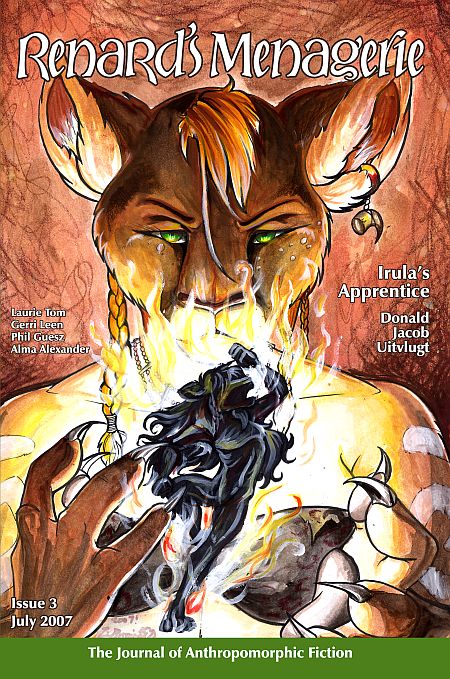
renards coverFor my furry writing, I’m in the process of revising a novel set in the same fantasy world as my short story “Irula’s Apprentice,” but a couple of generations later. In this world, I envision what a society of intelligent lions might look like if one takes existing lion behavior as a given. It’s also been interesting to see how a leonine society might take on different dimensions depending on the setting.

The novel is in a lot rougher shape than I’d like it to be, but I’ll be looking for a publisher when I get it in a shape that I like.

With my non-furry work, I recently had a piece of flash fiction accepted for publication that combines aspects of the Cthulhu mythos with the legend of the Pied Piper of Hamelin. A science fiction story will soon be released by the Wily Writers podcast.

2. What’s your writing process like? Are you a “pantser,” an outliner, or something in between?

Most of my stories have a fairly long period of rumination, where I’m working out story issues in my head. I tend to do a lot of research, which I may or may not use in my writing. I try to write a first draft as quickly as I can; sometimes I have a broad outline, sometimes I know what I want to do in the next couple of sections. And sometimes I just write to see where the characters and concept will take me. I try to revise as best as I can, and then try to get beta readers involved before I make a submission-ready draft — although deadlines don’t always allow me to exercise the full process.

3. What’s your favorite kind of story to write?

Most of my stories tend to be speculative fiction of one sort or another, with horror and dark fantasy predominating lately. Often my stories focus on individuals thrust into extreme situations and how their choices wind up making or breaking them. World creation is important, and I hope I do it reasonably well, but in the end I want the characters to be most important.

4. Which character from your work do you most identify with, and why?

I would probably say Raalfarinoor from my lion novel. While I don’t think he’s a Mary Sue/Gary Shrew, there are a lot of ways he represents an idealized version of myself. His courage, his integrity, his humor and his curiosity are all something I strive for.

Continue reading “Member Spotlight: Donald Jacob Uitvlugt”

Guest post: “Common Mistakes Among Writers” by Sarina Dorie

Common Mistakes Among Writers

by Sarina Dorie


When we go to a job interview, we wear our best suit, come with a list of references, and might even remember to put on deodorant. At least, we do if we want the job. When we format a manuscript, self-edit a novel, or polish a book before sending it off to an agent or editor, we strive to present it as though we are professional writers who know what we are doing. At least, we do if we want to be published. Whether a seasoned writer, or someone just starting out in the writing process, there are weaknesses we don’t always recognize in our skills. We get into ruts with grammar, formatting or stylistic “rules” we learned early on in high school writing classes that are bad practices in professional writing. Learn the common mistakes so you can recognize when you make these in your writing so you can avoid them.


Five Common Mistakes

  1. The manuscript isn’t in manuscript format

Short stories have a particular format and novels have different requirements. Additionally, some publishers have very specific variations from the standards that a submitter must be aware of. The number one cause listed on editor, agent and magazine websites for writing to be rejected is not reading the guidelines.

2. Grammar errors and inconsistencies

Sometimes a simple spell check will suffice. Other times, one needs to look up rules that are unfamiliar. Some rules of grammar are meant to be broken, but it is important to start with foundational knowledge and break a rule consistently if one chooses to do so. Classes, critique groups, peers and beta readers can help.

3. The mechanics of the story are broken

Sentence structure is unvaried, past and present tense rules are not consistently followed, or there are various typos not covered under grammatical errors that make the manuscript a chore to read. It is common to find long sections of dialogue without dialogue tags, setting information lumped together, chunks of unbroken interior monologue or sensory information in one section, and long expanses of exposition in others. The story might be all, or large sections of, telling.

4. The story itself is broken

The premise is unbelievable, the idea is trite or overdone, or the plot has no story arc. Maybe the characters are so unsympathetic the reader can’t get into the story or the writer has gotten a vital piece of information wrong that affects the story. This can be pretty important if an author is writing a paranormal romance with werewolves and the characters and plot don’t reflect accurate, wolf-like traits.

5. The story is boring

This usually means it lacks conflict. It might also be because there is no hook in the beginning, or it could be because the reader doesn’t understand or care about the characters’ motivations, feelings or situation. The reader needs to be emotionally invested. Sure, it might just be because the reader isn’t the author’s target market, but even romance readers can be persuaded to read a mystery if they care about the characters or a mystery reader can read a romance if they are invested in the plot.


Sarina Dorie brings to her writing background experience working as an English teacher in South Korea and Japan, working as a copyeditor and copywriter, and reading countless badly written stories. Sarina’s published novel, Silent Moon, won second place in the Duel on the Delta Contest, second place in the Golden Rose, third place in the Winter Rose Contest and third in the Ignite the Flame Contest. Her unpublished novel Wrath of the Tooth Fairy won first place in the Golden Claddagh and in the Golden Rose contests. She has sold short stories to over thirty magazines and anthologies including Fantasy and Science Fiction Magazine, Daily Science Fiction, Cosmos, Penumbra, Sword and Laser, Perihelion, Bards and Sages, Neo-Opsis, Flagship, Allasso, New Myths, Untied Shoelaces of the Mind, and Crossed Genres, to name a few.

Silent Moon is currently available as an ebook through Amazon and will be released in print next month.

For more story problems remedies, editing tips and short story writing advice, go to Sarina Dorie’s website at: www.sarinadorie.com/writing