Cóyotl Awards reminder and links to nominees

Just a reminder that voting for the Cóyotl Awards closes in just over a month now, on August 15. If you haven’t read all the nominated works, here are links to check them out. (Please note that some of these may be accessible only to FWG members who are registered on our forums.)

Best Novel

The Bees by Laline Paull (purchase link)
http://www.amazon.com/Bees-Novel-Laline-Paull/dp/0062331175/

Bête by Adam Roberts (purchase link)
http://www.amazon.com/Bete-Adam-Roberts/dp/0575127694/

Off the Beaten Path by Rukis (free to read on FA)
http://www.furaffinity.net/view/11578732

Best Novella

Going Concerns by Watts Martin (free to read on website)
http://cprints.ranea.org/going-concerns/

Huntress by Renee Carter Hall (downloadable files)
http://www.anthroaquatic.com/forum/index.php?topic=20.msg7866#msg7866

The Mysterious Affair of Giles by Kyell Gold (downloadable files)
http://www.anthroaquatic.com/forum/index.php?topic=776.msg7935#msg7935

Best Short Story

Cold Scent by Alice Dryden (free to read online)
https://pinkfoxpublications.wordpress.com/cold-scent/

Jackalope Wives by Ursula Vernon (free to read online)
http://www.apex-magazine.com/jackalope-wives/

Pavlov’s House by Malcolm Cross (free to read online)
http://www.strangehorizons.com/2014/20140421/pavlovshouse-f.shtml

Best Anthology

Abandoned Places edited by Tarl “Voice” Hoch (purchase link)
http://furplanet.com/shop/item.aspx?itemid=756

Tales from the Guild:  Music to Your Ears edited by AnthroAquatic (purchase link)
https://www.rabbitvalley.com/item/9169/Tales-From-The-Guild-Music-to-Your-Ears-edited-by-AnthroAquatic


Again, voting closes August 15 and can be done at the Cóyotl Awards website.

Book of the Month: ROAR Volume 6, edited by Mary E. Lowd

July’s Book of the Month, ROAR Volume 6, is edited by member Mary E. Lowd, features stories from several FWG members, and makes its debut at Anthrocon.

ROAR6Lovable scoundrels and scoundrels we love to hate.

From rascals causing harmless mischief to dark lords with evil in their hearts, scoundrels can be found in every world, mundane to fantastical.  We fight them, laugh at them, and sometimes root for them.

The twenty-eight stories in ROAR volume 6 explore scoundrels of every stripe, in every walk of life.  Read stories from celebrated anthropomorphic authors, award-winning science fiction and fantasy authors, and talented newcomers to the furry genre!

Contents:

Squonk the Dragon by Pete Butler
Brush and Sniff by mwalimu
Faithful by Marshall L. Moseley
Gerbil 07 by Huskyteer
CSI: Transylvania by Kevin M. Glover
Hard Scratching In Kittytown by Blake Hutchins
Hold the Moon by Eric M. Witchey
Ernest by Lyn McConchie
Two Crows, Two Wires, and the Moon by Andrew S. Taylor
Ivan and the Black Riders by Kris Schnee
Into the Wind by Rechan
At What Cost by Jeeves the Roo
A City With No Children by James Stegall
Perch by Sarah Doebereiner
The Cat Thief by Laura “Munchkin” Lewis
Food, Feuds and Fake Flora by Ocean Tigrox
Puppy Love by George S. Walker
I Hold My Father’s Paws by David D. Levine
0mega by Garrett Marco
Skinned by Kyell Gold
Relics, Rabbits, and Tuscan Reds by Slip Wolf
Shadows of Horses by Phil Geusz
Coyote’s Voice by Altivo Overo
Prof Fox by Mark Patrick Lynch
Wolves and Foxes by Amy Fontaine
Unexpected Bouquets by Ellen Saunders
Clearance Papers by Fred Patten
Edward Bear and the Very Long Walk by Ken Scholes

Available from FurPlanet.


Guild News: July 2015

New Members

Welcome to our newest member George Squares!

Member News

In book release news: ROAR #6, edited by Mary E. Lowd and featuring many FWG members as contributors, as well as Mary’s new novel In a Dog’s World, are now available for pre-order from FurPlanet. Tempe “Tempo” O’Kun’s latest, Windfall, is also available for pre-order from FurPlanet, and Weasel Press’ first furry anthology, Typewriter Emergencies, is also up for pre-orders. Kris Schnee’s new novel Thousand Tales: How We Won the Game is available from Amazon, and M. C. A. Hogarth has released Either Side of the Strand and a new trilogy that begins with An Heir to Thorns and Steel.

In short fiction, Rechan’s story “TLC” appears in Heat #12, and “Into the Wind” is in ROAR #6. Huskyteer also has stories in both, with “Meena Mae” in Heat #12 and “Gerbil 07” in ROAR #6, and you can also check out Huskyteer’s nonfiction in this piece for Flayrah. Ocean Tigrox’s story from ROAR #6, “Food, Feuds and Fake Flora” has a teaser you can read here, and the same anthology also has a story from Altivo Overo called “Coyote’s Voice” and one from Mwalimu called “Brush and Sniff.” And in anthology news outside the fandom, Mary E. Lowd’s “Shreddy and the Dancing Dragon” appears in The Dragon’s Hoard.

In other news, Renee Carter Hall has launched a new mailing list for her readers (sign up and get a free ebook), Rebecca Mickley has a new website, Patrick “Bahumat” Rochefort is on board with the new visual novel project Laika Dosha (as well as continuing From Winter’s Ashes), and Mwalimu has made a nifty little tool you can use to find your local furry conventions.

Congrats, everyone!

(Members: Want your news here? Start a thread in our Member News forum!)

Market News

Upcoming deadlines: Rocky Mountain Fur Con’s conbook closes on July 15, and the furry anthology Fragments of Life’s Heart closes on August 15.

New markets: Red Ferret Press (a new imprint from Weasel Press) is seeking submissions for Knotted, and ROAR #7 will open for submissions later this summer.

Remember to keep an eye on our Calls for Submissions thread and our Publishing and Marketing forum for all the latest news and openings!

Guild News

Voting is open for the Cóyotl Awards until August 15. If you haven’t read everything on the ballot, we have links to all the nominated works in this thread.

Good luck to all our members participating in Camp NaNoWriMo’s July session! Member George Squares has written about his Camp NaNo project on his blog.

On Goodreads? The FWG now has a Goodreads group, and we also now have a bookshelf featuring books by our members. Feel free to add any members’ books we’ve missed so far (see the instructions here on how to do that).

We’re always open for guest blog post submissions from members — good exposure and a great way to help out fellow writers. See our guidelines for details.

Need a beta reader? Check out our critique board (you’ll need to be registered with the forum in order to view it).

Want to hang out and talk shop with other furry writers? Come join us in the forum shoutbox for the Coffeehouse Chats, Tuesdays at 7 p.m. Eastern and Thursdays at 12 p.m. Eastern. (The Saturday chats have been discontinued until further notice.) More info on the Coffeehouse Chats is here.

As always, our forums are open to everyone, not just FWG members. Come register and join the conversation!

That’s all for this month! Send an email to furwritersguild (at) gmail.com with news, suggestions, and other feedback, or just comment here.

Member Spotlight: Slip-Wolf

1. Tell us about your most recent project (written or published). What inspired it?
I just finished final edits on “Unfading”, which will be in Heat issue 12 coming out at Anthrocon in early July. It’s about a wolf who discovers she’s a different creature on the inside, and begins an arduous physical and mental transition to becoming who she feels — or rather knows — she really is.

While imagining we’re something or someone else is part of every furry’s life in a way, the idea first grew out a private joke I had with myself in which I’d mulled over changing my fursona. I figured rather than just pick another species and twiddle with my name I’d actually get pretend plastic surgery, do an in-between icon that was just a head wrapped in bandages, and tweet in mumbles for a week. While that never happened, I did wonder about the kind of calamity one would have to go through changing species, the surgical stuff, the hormones, the diet. This then elevated to matters of the heart and mind, how one would evolve in the process of adapting to their new selves, how their family would react and how the outer world would see them in their struggle.

The story just evolved from there into a metaphorical look at the plight of transgendered individuals, dealing with obstacles most of us will never face, namely a world that actively resists the person who they know they are. In exploring some of these questions, I found “Unfading” a very satisfying story to write.

2. What’s your writing process like? Are you a “pantser,” an outliner, or something in between?

Something in between. I do like general outlines to give me a sense of direction, but halfway through writing I’ll break away from them as often as I’ll stay the course. Whatever keeps me going without stopping.

3. What’s your favorite kind of story to write?

I try switching it up as often as I can because I get bored of trying the same things. I really love sci-fi and horror as genres, but have messed around with fantasy, mystery and a little bit of satire. The last one is the hardest to do I think.

4. Which character from your work do you most identify with, and why?

I’d have trouble picking just one character, as I try to identify in some way with everybody who gets a voice, the villainous jerks no less than the heroes or every-furs. I find right now it’s a tie between Amar from the story above, who represents the need in all of us to be the person we know we can be and a character from an upcoming tale named Earlan, an eager, enthusiastic explorer in a novella-length piece set to come out in an anthology later this year. He’s seeking to understand his place in the universe and test the boundaries he feels foisted upon him. Can’t say much about that story yet.

5. Which authors or books have most influenced your work?

There are too many to count, really. When I was younger I devoured Stephen King as a horror buff, fantasies and sci-fi’s by Larry Niven, David Gerrold, Arthur C. Clarke, Allan Dean Foster (who introduced to me literary furry with Spellsinger), read classic fantasy from the Narnia novels of C.S. Lewis to the Homeric myths, snacked on Hardy boys, Sherlock Holmes, Phillip Marlowe mysteries and Star Trek novels. Lately I’ve been going to the well of classic twentieth-century authors to learn their tricks and get the feel for different eras. I try really hard to learn little bits reading everything, fiction or fact, in and out of this fandom.

6. What’s the last book you read that you really loved?

I just finished a non-furry classic book with an unintentionally furry name, Rabbit Run by John Updike, another famous author whose work I have just gotten around to. It’s a testament to his prowess as a writer that he can thoroughly engage you with a main character who is an insufferable bastard on so many levels. I wish I could write with such skill, compelling readers to take interest in characters and situations who we can barely stand or see ourselves identifying with, but stick with because their experiences are made so compelling.

7. Besides writing, how do you like to spend your free time?

I love writing as a form of recreation itself, but I also collect records and movies, watching films at the drive-in where I grew up and visiting the gym often for runs or weightlifting. More than anything though, I love reading. I shrivel and die if I go too long without a good book.

8. Advice for other writers?

Don’t be afraid to fail. Be terrified to discover you never tried. Also, listen to your beta readers. The worst thing they can give you is exactly what you want — cold hard honesty. Criticism from betas and your editors will toughen you up for when people are paying for your work and have every obligation to point out where a story is weak, so cherish that.

9. Where can readers find your work?

I’ve got stories in Heat issues 11 and 12, Trick or Treat Volume 2, Roar Volume 6 and Fang Volume 6 (all of which should be out by Anthrocon in July). There are several more anthologies coming out in the next year or so that I will also be featured in but dates aren’t set.

10. What’s your favorite thing about the furry fandom?

It’s a hub of pure creativity with no discernible limits or end game, a place for really friendly people who I keep getting to meet and a great way to get in touch with the ‘other’ inside one’s self. There’s something about being furry that can make us warmer, more open, accepting human beings, and I love that about it.


Check out Slip-Wolf’s member bio here!

Guest post: “A Tale of Two Rejections” by Ocean Tigrox

A Tale of Two Rejections

by Ocean Tigrox


Once upon a time, there were two aspiring writers, Stanza and Prose. Both had aspirations of someday being published, and together they began sending off submissions to various publishers. Stanza was successful, receiving an acceptance on their first story! They quickly began drafting up their second story to send off. Prose, unfortunately, was met with a kind rejection letter. Disappointment hit them hard as they took their lumps, pushed their chin up and tried again. The second round of letters came back with similar results. Once again, Stanza succeeded in having another work accepted. Clearly their first time hadn’t just been just a stroke of luck. Meanwhile, Prose found themself sighing at a second rejection letter. What went wrong this time?

This cycle repeated a few times. Stanza submitted more, being accepted each time; Prose became more disappointed with each new rejection. As this continued, Stanza became empowered, feeling invincible. Anything they wrote was gold and always came back with a happy congratulatory note from the editor. Prose continued to struggle through each deemed failure, learning how to improve with every submission’s iteration.

One day the cycle broke. Upon opening a letter from another editor, Stanza nearly choked on their coffee when they read words that they had never seen before: “We’re sorry, but your story was not selected.” Preposterous, they thought. An editor clearly made a mistake. But, no, that was their story in the explanation below about why it was not selected. The editors had found issues with the main character and decided against accepting the story.

Doubt filled Stanza’s mind. They were invincible. How could this happen? Unless, they thought, the other times really had been flukes. Maybe the accepted stories had just been filler or just barely squeaked in. Maybe Stanza wasn’t as talented a writer as they had originally believed. After all, talented writers don’t get rejected, do they? Lost and confused about their own skill as a writer, Stanza put away their writing, unsure if they should submit another story.

Things were quite the opposite with Prose. They awoke the next day to find their first acceptance letter. Tears overwhelmed them as they read the editor’s glowing notes about the submitted story. After wading through rejection after rejection, continuing to push through and not stop, their hard work and perseverance paid off. Their treasure was well deserved. After telling their friends and family, what better way to celebrate than to write another story?

Prose would go on to find more stories being accepted. Occasionally a rejection letter still found its way to their mailbox, but it never had the same effect on Prose that it once had. They took the criticism and moved on, just like they had done before. Stanza, on the other hand, struggled for a long time before picking the pen back up. It had taken a lot of willpower to pull themselves back together after falling so far. They found the motivation to write again, and although they had their share of rejection letters that still came, acceptance soon returned. Their confidence soon resumed, though this time with a small bit of humility.

Is this just a fairy tale? Some writing allegory? Not quite. This is actually based on a true story (though slightly exaggerated). If you’ve listened to the Fangs and Fonts podcast, you may already know that this happened to two writers in my writing group. Some of you may know them as FWG members Roland Jovaik and Tarl “Voice” Hoch. They both experienced acceptance and rejection, but both ended up handling them differently. Neither of them did anything wrong. Prose, like most new writers, had to struggle and climb higher with each new submission until they finally achieved victory. Stanza on the other side managed to knock it out of the park on the first try. This isn’t common, but it happens. Still, rejection found them both eventually, and they were forced to confront the inevitability that all writers experience. The moral of this story is that although they dealt with their rejections differently, they both pushed through and went back to writing.

The one thing missing from this story is the support of other writers. We need to be there for each other. Something I’ve seen lately is people congratulating new writers on their first rejection. This may be a weird event to see from the outside, but what we’re really saying is “Congrats on taking your first serious step in becoming published” or “Congrats on the achievement”. It takes guts to send your story out into the aether and have an editor you don’t know reject it. It hurts. And recently, I found it hurts being the editor having to reject people, too!

Rejection doesn’t feel good for anyone, but it’s inevitable within our craft. Be ready when it comes. Don’t worry, each one gets easier to take, and it’ll all be worth it when you get that glowing acceptance one day.

Member Spotlight: M. C. A. Hogarth

1. Tell us about your most recent project (written or published). What inspired it?

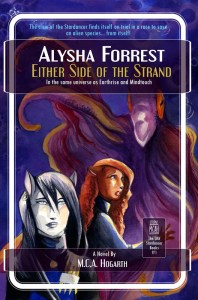
mcah cover alyshaMy most recent book just went up in May! Either Side of the Strand is the first book in a series I’ve been planning for a long time about the career of Fleet captain Alysha Forrest, who has previously appeared in short fiction for years now (one of those stories, “In the Line of Duty,” won an Ursa Major, even). I’m very excited to get Alysha’s first full-length novel out there. It’s a space adventure, and my homage to Star Trek: The Original Series, with its slightly campy but high-minded stories. Also it’s got space octopuses in it, and all the characters are female, so it’s sort of like a pajama party with military uniforms and aliens.

2. What’s your writing process like? Are you a “pantser,” an outliner, or something in between?

For the most part, I’m a pantser. I know the beginning. I know the ending (hazily). I know one or two scenes in the middle. All the rest of it is gelatinous, and I write to find out what’s next. I like that; it keeps me interested! When I write serials, I am often as curious as my readers about what’s about to happen! I post an installment, and everyone comments, “Wow, I wonder–” And I am sitting there at the keyboard, thinking, “Oh my gosh, I do too!” *laugh*

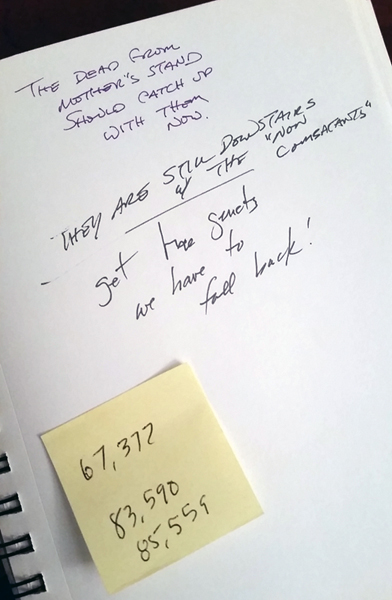
Sometimes, though, my subconscious coughs up 3-4 scenes in a row, and then I obediently jot down a quick flowchart-like thing. This almost inevitably happens in the car. It usually looks something like this:
mcah jottednotes

(Notes are from forthcoming epic fantasy trilogy. Post it is tracking daily word count changes.) I don’t recommend this style of note-taking, no matter how long the lights take to change. Also, please don’t try to analyze my handwriting based on my car scribble. >.>

3. What’s your favorite kind of story to write?

A long time ago, Watts Martin — who is one of fandom’s best writers, I think — said that most of my work revolves around epiphany. He said this to me, mind you, when I was all of 18 or 19 years old? That was… ah, longer ago than I like to think of, but I still think he’s right. No matter what I’m writing, there’s a psychological aspect to everything: people coming to better understandings of themselves, or learning that one thing that galvanizes them to make life changes or momentous choices. It doesn’t matter to me whether that choice is small in the great scheme of things–like Vasiht’h’s choice of major in college in Mindtouch — or enormous, like Asrial’s decision to help stop the literal Apocalypse in A Rosary of Stones and Thorns. What matters to me is how people grow, and how they come to that place where they are vulnerable to life, and feel safe enough in that vulnerability, to be open to change.

4. Which character from your work do you most identify with, and why?

All of them? I give them all a little, vital piece of me, and let them grow around that piece the way a pearl begins with a grain of sand — and a lot of irritation.

It seems to work that way in real life too. The good and polished parts are born from a tiny seed and a lot of discomfort.

5. Which authors or books have most influenced your work?

I’ve had so many influences it’s hard to list them all. But among specifically furry sources, Steve Gallacci’s Albedo and Vicky Wyman’s Xanadu made a big impression.

6. What’s the last book you read that you really loved?

I haven’t been reading as much new work as I wish! But I picked up Castle Hangnail, by Ursula Vernon, and my daughter and I greatly enjoyed that. (I would recommend it for children above 10, probably — the sentences can get a little complex for younger kids.) We loved the message that it’s good to be kind to people, and that kindness is rewarded. I also got to read A Shard of Sun, the latest installment in Jess Owen’s epic Summer King Chronicles, and I kind of want a Kjorn plush of my very own.

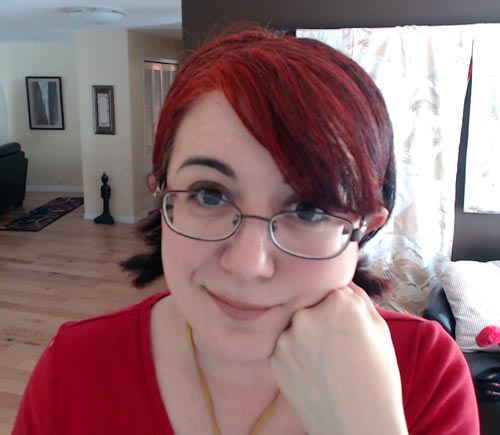
7. Besides writing, how do you like to spend your free time?mcah selfie-for-fwg-spotlight

I don’t actually have a lot of free time, since I work two jobs and have a young child! But I read a lot, and do some painting to relax, and when I have free time I try to do things that are beneficial to my health, like sit in a dry sauna, or go to Church, or take a walk. If I ever arrange my schedule properly, I’d also like to return to fencing, which was my favorite sport.

Also, I like sleep. Sleeping is a fine use of my free time.

8. Advice for other writers?

I think writers need different advice for every stage they pass through, so it’s hard for me to know what to say. When I was a new writer, I needed to hear ‘you’re good, but you need to work hard and write a lot and practice, practice, practice!’ When I was a slightly older writer, I needed to hear ‘you need to read broadly, think critically about your work, and pare down your stories to the bare minimum you need to get your idea across, and you have to work hard and meet your quotas!’ A few years later, I needed to hear, ‘you need to let your stories breathe; there’s nothing wrong with using style as a tool to achieve your ends; and yes, different kinds of stories need different narrative strategies and styles. And you need to practice and write a lot and work, work, work!’

These days, I need to hear, ‘slow down’ and ‘live your life, because your life is what gives your art the authenticity of your experiences.’ And ‘you don’t need to sacrifice your health to meet your deadlines; your readers don’t want your next book more than they want you to de-stress from a toxic level of industry.’

These are all good bits of advice. I received them from others, and for the most part, they came at the right time. It’s matching the advice to the right stage of a writer’s development that’s the sticky bit.

9. Where can readers find your work?

My work’s available where most books are found: Amazon, B&N, the e-book retailers like Kobo and Apple’s iBookstore, and you can get it in most formats (e-book, print, and audio). I believe FurPlanet and Sofawolf are also carrying some of my work to cons in the form of anthologies. I have a nice guide on “where to start” for people who want to figure out how to tackle my catalog, which is over 20 books strong if you count only the novel-length works, and 40+ if you want all of it. You can find that here: http://mcahogarth.org/where-do-i-start/

10. What’s your favorite thing about the furry fandom?

Oh, it would be hard to pick a single thing. I “grew up” in the fandom, having discovered it when I was very young, and it’s always been there in the background for me. There’s a familiarity there that’s comforting. But I think if I had to go with a single thing, it would be that we don’t take ourselves too seriously. There’s a playfulness in furry fandom that I don’t often see in other places. It’s good to have fun, now and then…!


Check out M. C. A. Hogarth’s member bio here!
Guest post: “Getting It Done: What Determines a Writing Quota?” by Franklin Leo

Getting It Done: What Determines a Writing Quota?

by Franklin Leo


Writing is hard, and even for the experienced, it continues to be difficult. Whether it’s editing or drafting, there’s always a point when we find ourselves unable to move forward simply because time is such a huge issue.

I’ve instructed and tutored writing to college students for a few years, and I have only recently started to come out more as a furry author, but the number one thing that I hear from other writers or hopeful-writers is that there’s too much going on in their life.

Stephen King says in his memoir On Writing: A Memoir of the Craft that it’s best for one to get around 1,000 words a day down and written into some piece he or she’s working on. That alone is around four pages, and to some, the idea of doing so much so soon comes off like a triathlon equal to NaNoWriMo.

What matters, however, is that you get something down — anything down. Students tell me that they could only get a paragraph written. In college, that’s quite a bit, I tell them. Some often tell me that they could only get a sentence or two down because they had to do some reading. That’s okay as well. Reading and writing go together. You simply can’t do one without the other, I say.

I also tell them that some days, it’s okay to write more than other days. Some days, it’s okay to write nothing. What’s important is to discipline and let yourself write as much as you can, understand that there is no punishment for writing too little, and being there for yourself when you need it. Writing is part therapy and part communication. Try to write as much as you can, but also allow yourself the freedom that the work demands.

Personally, I stand by the 1,000 word quota, simply because it works for me. I enjoy it, I get good enough results from it, and it makes me feel accomplished. Have I ever questioned my own methods? Of course. Working as a writer is like working as your own personal trainer at the gym. You need to know how much, when, and in what way to push yourself. I continue to keep my quota going as long as I can, but with work and class (as well as different stories going on at the same time in my head), it’s just impossible to do everything that I wish.

What works? Again, it really depends. For someone, writing a couple of sentences before bed can be enough to get him or her going until the next day. For others, they may feel that 2,000 words a day is worthy of any acknowledgement. Working with others, as well, forces you to work as much as you can; several times, I’ve had other writers tell me that I’m just not writing enough, which is nice because they hold me accountable when I myself am unable to do so. Beating yourself up about it, however, is something a writer should never do. By changing writing into something that you have to do rather than what you get to do, you ultimately take the fun out of it. You ruin your chance of wanting to return to a story because it honestly gripped you. For a writer at any level, that there is the kiss of death, whiskers and all.

My students come to me every day when I’m in my school’s lab, and I get to hear how they enjoy writing now because they realize it’s not work — it’s fun when they allow for it.

That’s all you can ever do. Allow for it, and be proud of those moments when you do. That there will build you a quota and keep you pressing forward amidst a hectic schedule and series of setbacks.


Book of the Month: The Book of Lapism, Deluxe Edition by Phil Geusz

June’s Book of the Month, The Book of Lapism, Deluxe Edition is by member Phil Geusz.

lapism cover“If biotech can sculpt the body, can it also shape the mind. . . and soul?

That was the challenge laid before Dr. Aaron Thomas by his latest client, to shape him into a gentler, more loving being, inside and out. But the world is not a kind and gentle place, and as one man’s search for truth inspires a movement, will a kinder, gentler people be able to survive and face the legal, spiritual, and ethical challenges that await them?

The New Book of Lapism contains all of the original short stories, presented in their original order of publication, as well as the new stories ‘Prodigal Son’ and ‘Chosen People.'”

Published by Legion Printing. Available from Amazon.

2014 Cóyotl Award Nominees

The ballot has been announced, and voting for the 2014 Cóyotl Awards is now open! Votes will be accepted through Saturday, August 15.

Congratulations to all the 2014 nominees:

Best Novel
The Bees by Laline Paull
Bête by Adam Roberts
Off the Beaten Path by Rukis

Best Novella
Going Concerns by Watts Martin
Huntress by Renee Carter Hall
The Mysterious Affair of Giles by Kyell Gold

Best Short Story
Cold Scent by Alice Dryden
Jackalope Wives by Ursula Vernon
Pavlov’s House by Malcolm Cross

Best Anthology
Abandoned Places edited by Tarl “Voice” Hoch
Tales from the Guild:  Music to Your Ears edited by AnthroAquatic

 
Vote here.

See lists of previous winners.


Guild News: June 2015

New Members

Welcome to our newest members Rob Baird, Lawrence M. Schoen, John Lynne, Rebecca Mickley, and Amy Fontaine!

Member News

In book release news, you can now purchase J. F. R. Coates’ Reborn, the new deluxe edition of Phil Geusz’ Book of Lapism, the new hardcover edition of Paul Kidd’s A Whisper of Wings, Kidd’s latest novel GeneStorm: City in the Sky (in Kindle and print formats), and John Van Stry’s Interregnum (sequel to his Children of Steel). Online, Patrick “Bahumat” Rochefort’s From Winter’s Ashes has published Chapter 2.2 and Chapter 2.3.

In short fiction news, Mary E. Lowd’s science fiction story “Panda-Mensional” has appeared in Neo-Opsis, and Weasel has furry fiction in Earth is Huge and We’re All On It. And in poetry news, Weasel’s collection The Hell Inside Us is now available.

In other news, Vixyy Fox’s children’s book Improbable… Never Impossible (illustrated by Cara Bevan and published by Rabbit Valley) won the 2015 Indie Excellence Award in the Children’s Fiction – Early Reader category, and our own M. C. A. Hogarth was elected to the office of Vice President of Science Fiction & Fantasy Writers of America.

Congrats, everyone!

(Members: Want your news here? Start a thread in our Member News forum!)

Market News

Upcoming deadlines:  The conbook for Maltese FurCon closes to submissions on June 15, and Rocky Mountain Fur Con’s conbook closes on July 15. The furry anthology Fragments of Life’s Heart closes on August 15.

In non-furry markets, the fantasy anthology Into the Mist seeks dragon stories, deadline July 1.

Remember to keep an eye on our Calls for Submissions thread and our Publishing and Marketing forum for all the latest news and openings!

Guild News

Nominations for the Cóyotl Awards close today! Last chance to recognize the best furry fiction from 2014. If you need a refresher on what’s eligible, check out our 2014 recommended works thread!

On Goodreads? The FWG now has a Goodreads group, and we also now have a bookshelf featuring books by our members. Feel free to add any members’ books we’ve missed so far (see the instructions here on how to do that).

We’re always open for guest blog post submissions from members — good exposure and a great way to help out fellow writers. See our guidelines for details.

Need a beta reader? Check out our critique board (you’ll need to be registered with the forum in order to view it).

Want to hang out and talk shop with other furry writers? Come join us for the Coffeehouse Chats, Tuesdays at 7 p.m. Eastern, Thursdays at 12 p.m. Eastern, and Saturdays at 5 p.m. Eastern — all held right in the forum shoutbox. More info here.

As always, our forums are open to everyone, not just FWG members. Come register and join the conversation!

That’s all for this month! Send an email to furwritersguild (at) gmail.com with news, suggestions, and other feedback, or just comment here.