Book of the Month: The Furry Future, edited by Fred Patten

tff coverFebruary’s Book of the Month, The Furry Future, is edited by FWG associate member Fred Patten and includes stories from several members.

“For the history of the human race we have been locked inside our bodies. Spiritualism, medicine, basic biochemistry and genetic enhancement seek to take us beyond the physical limitations we were born with. The Furry Future is a record of what might become of us once we perfect the methods of reshaping biology.

“Fangs and claws could become just another fashion accessory. We might use our technology to create intelligent and able companions as we spread out to the stars, or else create perfect servants unable to disobey the whims of their masters. We may remake ourselves to attain our future across the galaxy and unlock our spiritual potential, or collapse into war over where the boundaries of humanity lie.

“These nineteen stories take us to these different futures, each one written in the fur we choose to wear.”

Contains the following stories:

Emergency Maintenance by Michael H. Payne
Tow by Watts Martin
Experiment Seventy by J. F. R. Coates
A Bedsheet for a Cape by Nathanael Gass
Hachimoto by Samuel C. Conway
Vivian by Bryan Feir
Family Bonding by Yannarra Cheena
The Future Is Yours by MikasiWolf
Distant Shores by Tony Greyfox
The Analogue Cat by Alice “Huskyteer” Dryden
The Sequence by NightEyes DaySpring
Trinka and The Robot by Ocean Tigrox
Lunar Cavity by Mary E. Lowd
The Darkness of Dead Stars by Dwale
Field Research by M. C. A. Hogarth
The Curators by T. S. McNally
Evolver by Ronald W. Klemp
Growing Fur by Fred Patten
Thebe and the Angry Red Eye by David Hopkins with illustrations by Roz Gibson

Cover art by Teagan Gavet. Parental rating PG.

Available from FurPlanet.


Book of the Month: Spirit Hunters – Book 1: The Way of the Fox by Paul Kidd

January’s Book of the Month, Spirit Hunters – Book 1: The Way of the Fox, is written by FWG member Paul Kidd.

“There is a vessel without sides, ever full, yet ever empty.
There is a river without end. Ever still, yet ever flowing.
Fathomless, it is the origin of all things…”

spirit coverThe Sacred Islands: A medieval land of noble samurai and animal spirits. Of scheming nobles, of magic and ancient mystery.

Kitsune Sura, a wandering fox priestess, assembles a group of would-be monster hunters. Penniless and carefree, they travel from palaces to villages, seeking out dangerous mysteries.

A fox, two samurai and a shy and gracious rat go forth on a career of bizarre adventures. The Spirit Hunters battle ghosts, tangle with magic and delve into terrifying puzzles. They must even survive the horrors of kitsune cuisine.

These are the first three adventures of the Spirit Hunters saga. Bright, funny and exciting – these are tales of cunning monsters, flashing swords, stalwart samurai, faithful rats – and the rather dodgy antics of a fox.

Spirit Hunters:
Delightful romps in a gorgeous magical Japanese otherwhen.

“Trust me – I’m a fox!”

Ebook available from Amazon. Print version available from Lulu.


Book of the Month: Abandoned Places, edited by Tarl Hoch

December’s Book of the Month, Abandoned Places, is edited by FWG member Tarl “Voice” Hoch, features stories from several members, and is being released today at Midwest FurFest.

abandonedplaces coverFrom stories about being abandoned in the heart of civilization to stories about forced abandonment for the sake of science to how abandoned places affect the mind, the stories in this anthology cover a large range of genres and types of abandoned places — each one with their own little piece of personal horror lying among the ruins, ready to strike when you least expect it.

Features the following stories:

Empathy by Rechan
Belief by Bill “Hafoc” Rogers
Stared Too Deeply by T. D. Coltraine
The World Within by John Lynne
Sleepwalking by Adam “Nicodemus” Riggs
All that Glitters by Ianus J. Wolf
One Shot of Happy by Roland Jovaik
Who’s To Say by David Ramirez
Prospero by Patrick “Bahumat” Rochefort
Darwin’s Future by Taylor Stark
Rainfall by Kandrel
Piping by Tarl “Voice” Hoch
World’s Biggest Dragons by Ryan Campbell
Scratch by Ben Goodridge
The Cable by James L. Steele
Under the Mountain by Tonin

Cover art by Kappy. Story illustrations by Silent Ravyn.

Pre-order from FurPlanet.

Guest post: “Aesop Continues To Inspire” by Carmen K. Welsh, Jr.

Aesop Continues To Inspire

by Carmen K. Welsh, Jr.


Why are we driven to use non-humans in our stories? Why do we create characters based on inanimate objects? Why do we feel the need to personify, or, anthropomorphize ideals and abstractions? Why was I driven to animal cartoons? Why did public TV nature shows become an influence? Why did the struggle between life and death fascinate me as a six-year-old? Why would popular shows such as “Wild America” foster in me the need to tell stories?

My answers came during the formative junior high years, when, isolated from the rest of my classmates for having interests they did not share, and thus, bullied, I found refuge in a collection of Aesop tales in the school library. Yet, the significance of the fables never rang more true than when I spent hours reading the volume each time in my junior high’s library. I was so enthused by these fables on complex human ideas; I immediately created a booklet of my own, penning and illustrating notebook paper before binding the little pages with a stapler.

Now, I was already familiar with the great philosopher of animal fables showcasing human folly. For voracious readers, we will see the same stories pop up, over and over, ‘The Fox and the Grapes’, ‘Dog in the Manger’, ‘Spider to the Fly’, and the ‘Crow who needed to quench his thirst’ as well as ‘The Goose That Laid the Golden Eggs’. There was also ‘The Wolf in Sheep’s Clothing’ and ‘The Shepherd’s Boy and the Wolf’, or what many know as ‘The Boy Who Cried Wolf’. We understand these tales because they tackle moral issues: greed, lust, desire, humility, and arrogance.

Last, but certainly not least, Aesop’s influences continue to surprise me. For several years, I’ve been listening to different East Asian and some South Asian music. Years ago, it was Japanese pop tunes. Nowadays, it’s Korean-pop. While watching a Korean news program, they ended the segment with two music videos. I fell in love with the song called Oops! By G.NA and featuring Ilhoon of BTOB.

Since the news showed the video in the middle and most of the end, my curiosity was piqued and I jumped to YouTube.com to watch it in its entirety.

It is a wonderful song, G.NA is a fun vocalist to listen to, and Ilhoon, the rapper, is fast and furious. While watching the video, I learned from other YouTube commentators that it is the story about a young handsome man who has a silver tiger cat. When he leaves her for the day, the cat crawls under his bed sheets and emerges as a woman (G.NA)!

After luxuriating in her human form, she eventually puts on new clothes and goes clubbing. Her owner is there, and their eyes meet. She sidles up to him, and they touch noses, before she flits home, leaving him dazed and confused.

Once back in the house, she gets back into the nightclothes she first emerged as a human before the owner comes home.

Can’t tell who is more surprised, but, she grins at him like a minx, and he is more than thrilled to find the mysterious girl from the club in his house. The next morning, he’s in bed and his hand is seen stroking the cat.

Wow, this reminds me of an Aesop fable! I thought.

When I shared the video and my comment, one of my Facebook friends sent back that “C, you are special”. But who could blame me? I flipped through my modern edition of Aesop, and found the story I compared to the K-Pop video. It was “Venus and the Cat”!

Another YouTube commentator ‘liked’ my comment and told me she/he enjoyed Aesop fables too. Is it any wonder many of us enjoy anthropomorphic stories? In the act, we create new tales that are updates of ancient myths and weave new lessons for new generations.

In conclusion, I cannot choose a single Aesop favorite, or 10 favorites. I will, however, choose a particular tale that probably has more adaptations and incarnations than many of the other fables, and that is “City Mouse, Country Mouse”, or, originally known as “The Town Mouse and the Country Mouse”. Why this fable? Well, Aesop’s use of animals as symbols appears to have made huge impressions on its readers, or the stories would not have lasted for thousands of years.

A country cousin leaves his rural home to visit his slicker city kin. Mayhem ensues, with the country mouse rushing back to a world that, though no less dangerous, is familiar and makes sense. This appears to run rampant in the amount of ‘fish out of water’ themes prevalent in many films and books. Please do yourself a favor, and read “City Mouse, Country Mouse” in any adaptation. As with this and many other Aesopic tales, you will appreciate its message more with each reading and/or retelling.


Book of the Month: Improbable… Never Impossible by Vixyy Fox

November’s Book of the Month, Improbable… Never Impossible, is written by FWG member Vixyy Fox and illustrated by Cara Bevan.

improbable coverImprobable… Never Impossible is a gentle story about love. It is a children’s story of old with a life lesson of good morals, good reading, and beautiful art like you have never seen. In a crazy mixed up hardened asphalt world it is also a reminder to adults that they were once young with an imagination that could envision anything they wished. Worlds where animals could speak and dressed like people were common place to their hearts. Within the mind’s eye they found a wonderful and safe place where a cat and a mouse could come together in only a way that two hearts were meant to join.

“Come know this place again and find the child you were… never really grew up at all.”

Order from Rabbit Valley.


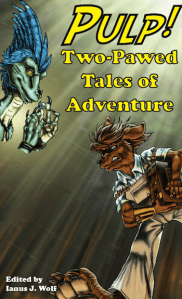
Book of the Month: PULP! Two-Pawed Tales of Adventure, edited by Ianus J. Wolf

pulp coverOctober’s Book of the Month is edited by FWG member Ianus J. Wolf and includes stories from members Ocean Tigrox, Bill “Hafoc” Rogers, Renee Carter Hall, Tarl “Voice” Hoch, Roland Jovaik, and Huskyteer.

“Keep your dials tuned as we join the RVO Radio Theatre for adventure, mystery, and danger!  Dive deep into the jungles of South America where the temple’s gift may not bring what you wish in The Ruins.  Then, jump to the Wild West of America as a badger determines who is the predator and who is Prey.  But don’t go too far as a group of intrepid Army Rangers battle a foreign threat to America more dangerous than the evil mastermind’s ‘robots’ in Rocket Canyon. And this next tale of an Aussie gal with a heart of gold and fists of iron battles the Nazis in The Bouncer and the Didgeridoo of Awakening. And join our poster girl, the rough and tumble Tesla Mae and the Lost Tribe. Don’t take too long to dock your airship, because evil cultists are trying to destroy Boston in Jericho Tanner and the Ebon Star. Find out who is the destroyer of worlds and who is the fox that can save us all in Savior.  And finally wrap it all up with a trip across the pond and the high flying aces in Flight of the Fire Dragon! Stay tuned, listeners, for more adventure!”

Featuring stories from:

  • Tym Greene
  • Ocean Tigrox
  • Bill “Hafoc” Rogers
  • T.S. McNally
  • Renee Carter Hall
  • Tarl “Voice” Hoch
  • Roland Jovaik
  • Huskyteer

Cover by Quel.

Order from Rabbit Valley.


Guest post: “Anthropomorphic Diversity” by Lauren Rivers

Anthropomorphic Diversity

by Lauren Rivers


When writing anthropomorphic fiction, one of the major elements is determining the species and the variety of your cast members. One of your first decisions is should they all be of the same race. While it may be to your fancy to have an entire cast of foxes, the positive side to this is that you can delve into the variations of the species. You can discuss the habits of different types of foxes such as fennecs versus the red fox, as well as highlight cultural differences much in the way that science fiction does with aliens and racial situations. An example would be a story where fennec foxes are considered exotic and used for slave labor, or a case where arctic foxes are racially profiled and perhaps have a unique ability the others do not, such as the creation and manipulation of ice. This also comes with a downside for people that don’t like how foxes tend to be overused within the fandom.  They could be turned off by the fact that your characters are all variants of the same species. Additionally, one should consider that in a situation where the entire cast ‘looks the same’ from a general perspective, individual characters may have a harder time standing out.

Another possibility is centaurs or any characters with a humanoid torso and animal lower half. The positive side to this addition is that you can more or less make up your own rules as to the species and what they are like. For one, they are capable of more physical action than most normal anthropomorphic characters, though most of the issues with centaurian species are logistical. If you include centaurs, then cars, furniture, group travel, everything must be modified for the existence of centaurs. Adding an extra two feet to some of your characters can slow you down if you do not have a plan in mind for your four-footed cast members.

Let’s not forget about humans themselves. The plus side to the involvement of humans in furry stories is that non-furries may enjoy the story simply for its own merits. Humans are easiest for people outside of the fandom to understand, and logically so. If you want your story to be more broadly accepted, consider a partly human cast. Be wary of using the humans only on the side of evil though, as the ‘evil humans versus good anthropomorphic characters’ plot line is a frequent staple in furry fiction. It may be seen as ‘one of those stories’ in the same way that comas on soap operas are often not taken seriously.

Finally, a species-diverse cast is yet another option. If you have every cast member a different species, or at least no more than two of any one type, you maximize the chances that every reader will find at least one species they enjoy. Additionally, it gives you more variety in descriptions. For example, if there is only one bovine character in your story, they will be easily recalled and will more quickly establish themselves in the reader’s mind. The pitfall with this approach is that you may have more characters than you can handle, if you attempt to fit too many species into your zoological odyssey.

As a writer, you clearly have many choices for how to populate your world. The choice is of course, up to you. However, bear in mind that you must know what kind of story you want to tell before you begin the casting process. Being aware of this will often do most of the work for you. Think of the characteristics each type of anthropomorphic being will add to your story and then decide if they’re the right one for you. If you’ve done your planning properly, it should seem as if most of the decisions have been made all by themselves.


Guest post: “Professionalism Among Furry Writers” by Tarl “Voice” Hoch

Professionalism Among Furry Writers

by Tarl “Voice” Hoch


I was reading a review for Children of Steel and overall the review was well done, but at the end the reviewer had the following to say:

On a final note, and I debated on whether or not to bring this up in my review but decided that it was warranted, the book does need some editing for grammatical issues (apostrophes, commas, etc.). While it wasn’t enough to really detract from the story, it did recur enough that I felt it should be mentioned. (source)

What bothers me about this review, is that the reviewer states that they considered not bringing up that the book had editing issues. In something like the Furry Fandom, in published books (electronic or print) editing should be taken seriously. We as writers and editors in this fandom are responsible to try and present the best material possible, especially when people are paying upwards of $20 for a print copy ($10-$15 for ebooks).

Bad editing should not be expected. Nor should bad grammar and punctuation. Nor should they be glossed over. Yes, there will always be those mistakes that are missed by the author, editors, and publisher. However, an effort should be made to produce the best material possible. If there is a problem with the editing, that should be stated in the review, not debated over. We are no less accountable for our works than furry visual artists are to theirs.

I once did a few My Little Pony pieces of art back when that fandom was young. I was very proud of them, despite the fact that I knew the lines were not as clean as they should have been. Still, I posted them and waited for the responses. What I got were a lot of comments about my line work and how I should have vectored them like the show itself did. So what did I do? I looked up vectoring and applied it the next time I did artwork. Clean lines are equivalent to proper grammar/punctuation/spelling.

There is a large debate over furry fiction becoming mainstream. As the fandom continues to garner more and more public interest, we as writers within the fandom should strive to be as professional as possible. If we want our works to stand out and to be presented as OUR works (not our fursona’s), then we should treat our field as professionally as possible.

Just because we are ‘Furry Writers’ does not mean that we should hold ourselves any less accountable to the quality of our work.


This post first appeared on Tarl “Voice” Hoch’s blog on Goodreads.

Book of the Month: Anthropomorphic Aliens, edited by Fred Patten

Anthro Aliens coverSeptember’s Book of the Month is edited by FWG associate member Fred Patten and includes a story co-authored by member C. Alan Loewen.

Anthropomorphic animals have been imagined for as long as stories have been told. This is especially true of science fiction, where the endless possibilities of alien worlds make fertile ground for creativity.

 Contained in these pages are stories from across the spectrum of science fiction, ranging from 1950 to 2013, and featuring feathers, fur, and scales. Each creature is a unique blend of humanity and the alien. Childlike or savage, independent or autocratic, they come in all sizes and shapes. Some are recognizable as reflections of humanity, while others are strange and wild creatures that defy description. All of them ask the same question: What kind of creatures will we find when we go to the stars?

The anthology features eleven stories:

  • “Mask of the Ferret” by Ken Pick & C. Alan Loewen
  • “The Inspector’s Teeth” by L. Sprague de Camp
  • “Specialist” by Robert Sheckley
  • “In Hoka Signo Vinces” by Poul Anderson & Gordon R. Dickson
  • “Point of Focus” by Robert Silverberg
  • “Novice” by James H. Schmitz
  • “What Really Matters” by Elizabeth McCoy
  • “Kings and Vagabonds” by Cairyn
  • “The King’s Dogs” by Phyllis Gotlieb
  • “A Touch of Blue: A Web Shifters Story” by Julie Czerneda
  • “Fly the Friendly Skies” by Bryan Feir

Cover art by Roz Gibson.

Order from FurPlanet.


Now available: Tales From the Guild: Music to Your Ears

tales coverThe first FWG anthology, Tales From the Guild, Music to Your Ears, is now available from Rabbit Valley!

There are few things in this world that can invoke the range of emotions that music can. It can bring its listeners close together; it can drive its listeners apart. It is a core mechanic in what makes us human, but what about in those that aren’t quite human? Tales From the Guild, Music to Your Ears features a collection of stories from veteran and newcomer authors alike that span several universes but show that no intelligent creature is immune to the power of music.

Featuring stories by Furry Writers’ Guild members:

  • M.H. Payne
  • Mary E. Lowd
  • Huskyteer
  • Sean Rivercritic
  • Mark Neeley

And soon-to-be members:

  • Mars
  • Nathanael Gass
  • Jess E. Owen

Cover by Ifus

Contents:

  • Echoes From the Consort Box – Mark Neeley
  • Deep Down Among the Dagger Dancers – M.H. Payne
  • Sugar Pill – Mars
  • Nocturne – Nathanael Gass
  • Night of a Thousand Songs – by Jess E Owen
  • Turn On, Tune In, Drop Out – Huskyteer
  • Shreddy and the Silver Egg – Mary E Lowd
  • Melody of a Street Corner – Sean Rivercritic

Available from Rabbit Valley.