Book of the Month: Spirit Hunters – Book 1: The Way of the Fox by Paul Kidd

January’s Book of the Month, Spirit Hunters – Book 1: The Way of the Fox, is written by FWG member Paul Kidd.

“There is a vessel without sides, ever full, yet ever empty.
There is a river without end. Ever still, yet ever flowing.
Fathomless, it is the origin of all things…”

spirit coverThe Sacred Islands: A medieval land of noble samurai and animal spirits. Of scheming nobles, of magic and ancient mystery.

Kitsune Sura, a wandering fox priestess, assembles a group of would-be monster hunters. Penniless and carefree, they travel from palaces to villages, seeking out dangerous mysteries.

A fox, two samurai and a shy and gracious rat go forth on a career of bizarre adventures. The Spirit Hunters battle ghosts, tangle with magic and delve into terrifying puzzles. They must even survive the horrors of kitsune cuisine.

These are the first three adventures of the Spirit Hunters saga. Bright, funny and exciting – these are tales of cunning monsters, flashing swords, stalwart samurai, faithful rats – and the rather dodgy antics of a fox.

Spirit Hunters:
Delightful romps in a gorgeous magical Japanese otherwhen.

“Trust me – I’m a fox!”

Ebook available from Amazon. Print version available from Lulu.


Book of the Month: Abandoned Places, edited by Tarl Hoch

December’s Book of the Month, Abandoned Places, is edited by FWG member Tarl “Voice” Hoch, features stories from several members, and is being released today at Midwest FurFest.

abandonedplaces coverFrom stories about being abandoned in the heart of civilization to stories about forced abandonment for the sake of science to how abandoned places affect the mind, the stories in this anthology cover a large range of genres and types of abandoned places — each one with their own little piece of personal horror lying among the ruins, ready to strike when you least expect it.

Features the following stories:

Empathy by Rechan
Belief by Bill “Hafoc” Rogers
Stared Too Deeply by T. D. Coltraine
The World Within by John Lynne
Sleepwalking by Adam “Nicodemus” Riggs
All that Glitters by Ianus J. Wolf
One Shot of Happy by Roland Jovaik
Who’s To Say by David Ramirez
Prospero by Patrick “Bahumat” Rochefort
Darwin’s Future by Taylor Stark
Rainfall by Kandrel
Piping by Tarl “Voice” Hoch
World’s Biggest Dragons by Ryan Campbell
Scratch by Ben Goodridge
The Cable by James L. Steele
Under the Mountain by Tonin

Cover art by Kappy. Story illustrations by Silent Ravyn.

Pre-order from FurPlanet.

Guest post: “The Art of Writing Flash Fiction” by Sarina Dorie

The Art of Writing Flash Fiction

by Sarina Dorie


If a short story falls under a thousand words (1500 words in some markets), it is considered “flash fiction” or “micro fiction.” With a number of new markets out there publishing flash fiction: Penumbra, Daily Science Fiction and Flash Fiction Online being a few among many, it is a plentiful market to send to. Because writing short, succinct stories is a skill I wanted to develop, there is a high demand for flash fiction, and it takes less time to write flash fiction than a long story (in theory), I decided I wanted to take a stab at it. When Daily Science Fiction opened about three years ago, Wordos, my speculative fiction writing critique group in Eugene, Oregon, decided we wanted to dissect flash fiction in order to hone our skills and see what makes a short-short story work. It isn’t surprising that because of our critiques and dissections, quite a few writers from our critique group went on to sell flash to Daily Science Fiction.

What we noticed about these stories is that they were tightly written, limited details, often had an interesting idea, a twist or punch line at the end, and were emotionally powerful or shocking or funny. The format these stories had been written ranged from someone was telling a story to a friend, in the form of a letter or letters in an epistolary fashion, were written like a fable, joke or essay, or used some other unusual writing device to tell a story. Many of these stories weren’t even traditional stories in the sense that there was a character arc, plot or conflict. Still, there was something that happened in each “story” that made it a catchy, edgy or worthwhile. These are just my observations, as well as some that I remember from members of Wordos. My advice to someone genuinely interested in breaking into the flash fiction market is to read and analyze lots of flash fiction and decide what it is about each piece that made the editor choose it.

As a result of studying the market and trying to think in the “short” mindset, I wrote about twenty flash fiction stories in a few months. Some of them I submitted to my critique group and got feedback on, some of them I later turned into slightly longer short stories, and some of them I left unfinished because there wasn’t enough there to create a story—but I didn’t feel guilty about not finishing because they were so short and I considered them experiments. Though I had been submitting stories to magazines for several years, it was my flash fiction stories that first sold. The four pieces I first sold in 2011 were “Zombie Psychology” to Untied Shoelaces of the Mind, “A Ghost’s Guide to Haunting Humans” (which won the Whidbey student choice award), “Losing One’s Appetite” to Daily Science Fiction and “Worse than a Devil” to Crossed Genres. From there, I went on to sell slightly longer short stories as well as more flash. After building up my resume with short stories, I sold my novel, Silent Moon, and then my novella, Dawn of the Morning Star.

Whether it was the short format that enabled me to practice my writing skills more often, or the feedback I got that helped me improve before going on to longer pieces, this process worked well for me. Is your process working for you? Would writing something shorter help you become more succinct in your skills?


Sarina Dorie brings to her writing background experience working as an English teacher in South Korea and Japan, working as a copyeditor and copywriter, and reading countless badly written stories. Sarina’s published novel, Silent Moon, won second place in the Duel on the Delta Contest, second place in the Golden Rose, third place in the Winter Rose Contest and third in the Ignite the Flame Contest. Her unpublished novel Wrath of the Tooth Fairy won first place in the Golden Claddagh and in the Golden Rose contests. She has sold short stories to over thirty magazines and anthologies including Daily Science Fiction, Cosmos, Penumbra, Sword and Laser, Perihelion, Bards and Sages, Neo-Opsis, Flagship, Allasso, New Myths, Untied Shoelaces of the Mind, and Crossed Genres, to name a few.

Her science fiction novella Dawn of the Morningstar is due to be published with Wolfsinger Press next year. Silent Moon is currently available through Soul Mate Publishing and Amazon.

For more story problem remedies, editing tips and short story writing advice, go to Sarina Dorie’s website at: www.sarinadorie.com/writing


Guest post: “Aesop Continues To Inspire” by Carmen K. Welsh, Jr.

Aesop Continues To Inspire

by Carmen K. Welsh, Jr.


Why are we driven to use non-humans in our stories? Why do we create characters based on inanimate objects? Why do we feel the need to personify, or, anthropomorphize ideals and abstractions? Why was I driven to animal cartoons? Why did public TV nature shows become an influence? Why did the struggle between life and death fascinate me as a six-year-old? Why would popular shows such as “Wild America” foster in me the need to tell stories?

My answers came during the formative junior high years, when, isolated from the rest of my classmates for having interests they did not share, and thus, bullied, I found refuge in a collection of Aesop tales in the school library. Yet, the significance of the fables never rang more true than when I spent hours reading the volume each time in my junior high’s library. I was so enthused by these fables on complex human ideas; I immediately created a booklet of my own, penning and illustrating notebook paper before binding the little pages with a stapler.

Now, I was already familiar with the great philosopher of animal fables showcasing human folly. For voracious readers, we will see the same stories pop up, over and over, ‘The Fox and the Grapes’, ‘Dog in the Manger’, ‘Spider to the Fly’, and the ‘Crow who needed to quench his thirst’ as well as ‘The Goose That Laid the Golden Eggs’. There was also ‘The Wolf in Sheep’s Clothing’ and ‘The Shepherd’s Boy and the Wolf’, or what many know as ‘The Boy Who Cried Wolf’. We understand these tales because they tackle moral issues: greed, lust, desire, humility, and arrogance.

Last, but certainly not least, Aesop’s influences continue to surprise me. For several years, I’ve been listening to different East Asian and some South Asian music. Years ago, it was Japanese pop tunes. Nowadays, it’s Korean-pop. While watching a Korean news program, they ended the segment with two music videos. I fell in love with the song called Oops! By G.NA and featuring Ilhoon of BTOB.

Since the news showed the video in the middle and most of the end, my curiosity was piqued and I jumped to YouTube.com to watch it in its entirety.

It is a wonderful song, G.NA is a fun vocalist to listen to, and Ilhoon, the rapper, is fast and furious. While watching the video, I learned from other YouTube commentators that it is the story about a young handsome man who has a silver tiger cat. When he leaves her for the day, the cat crawls under his bed sheets and emerges as a woman (G.NA)!

After luxuriating in her human form, she eventually puts on new clothes and goes clubbing. Her owner is there, and their eyes meet. She sidles up to him, and they touch noses, before she flits home, leaving him dazed and confused.

Once back in the house, she gets back into the nightclothes she first emerged as a human before the owner comes home.

Can’t tell who is more surprised, but, she grins at him like a minx, and he is more than thrilled to find the mysterious girl from the club in his house. The next morning, he’s in bed and his hand is seen stroking the cat.

Wow, this reminds me of an Aesop fable! I thought.

When I shared the video and my comment, one of my Facebook friends sent back that “C, you are special”. But who could blame me? I flipped through my modern edition of Aesop, and found the story I compared to the K-Pop video. It was “Venus and the Cat”!

Another YouTube commentator ‘liked’ my comment and told me she/he enjoyed Aesop fables too. Is it any wonder many of us enjoy anthropomorphic stories? In the act, we create new tales that are updates of ancient myths and weave new lessons for new generations.

In conclusion, I cannot choose a single Aesop favorite, or 10 favorites. I will, however, choose a particular tale that probably has more adaptations and incarnations than many of the other fables, and that is “City Mouse, Country Mouse”, or, originally known as “The Town Mouse and the Country Mouse”. Why this fable? Well, Aesop’s use of animals as symbols appears to have made huge impressions on its readers, or the stories would not have lasted for thousands of years.

A country cousin leaves his rural home to visit his slicker city kin. Mayhem ensues, with the country mouse rushing back to a world that, though no less dangerous, is familiar and makes sense. This appears to run rampant in the amount of ‘fish out of water’ themes prevalent in many films and books. Please do yourself a favor, and read “City Mouse, Country Mouse” in any adaptation. As with this and many other Aesopic tales, you will appreciate its message more with each reading and/or retelling.
 

Book of the Month: Improbable… Never Impossible by Vixyy Fox

November’s Book of the Month, Improbable… Never Impossible, is written by FWG member Vixyy Fox and illustrated by Cara Bevan.

improbable coverImprobable… Never Impossible is a gentle story about love. It is a children’s story of old with a life lesson of good morals, good reading, and beautiful art like you have never seen. In a crazy mixed up hardened asphalt world it is also a reminder to adults that they were once young with an imagination that could envision anything they wished. Worlds where animals could speak and dressed like people were common place to their hearts. Within the mind’s eye they found a wonderful and safe place where a cat and a mouse could come together in only a way that two hearts were meant to join.

“Come know this place again and find the child you were… never really grew up at all.”

Order from Rabbit Valley.


Guest post: “Common Mistakes Among Writers” by Sarina Dorie

Common Mistakes Among Writers

by Sarina Dorie


When we go to a job interview, we wear our best suit, come with a list of references, and might even remember to put on deodorant. At least, we do if we want the job. When we format a manuscript, self-edit a novel, or polish a book before sending it off to an agent or editor, we strive to present it as though we are professional writers who know what we are doing. At least, we do if we want to be published. Whether a seasoned writer, or someone just starting out in the writing process, there are weaknesses we don’t always recognize in our skills. We get into ruts with grammar, formatting or stylistic “rules” we learned early on in high school writing classes that are bad practices in professional writing. Learn the common mistakes so you can recognize when you make these in your writing so you can avoid them.


Five Common Mistakes

  1. The manuscript isn’t in manuscript format

Short stories have a particular format and novels have different requirements. Additionally, some publishers have very specific variations from the standards that a submitter must be aware of. The number one cause listed on editor, agent and magazine websites for writing to be rejected is not reading the guidelines.

2. Grammar errors and inconsistencies

Sometimes a simple spell check will suffice. Other times, one needs to look up rules that are unfamiliar. Some rules of grammar are meant to be broken, but it is important to start with foundational knowledge and break a rule consistently if one chooses to do so. Classes, critique groups, peers and beta readers can help.

3. The mechanics of the story are broken

Sentence structure is unvaried, past and present tense rules are not consistently followed, or there are various typos not covered under grammatical errors that make the manuscript a chore to read. It is common to find long sections of dialogue without dialogue tags, setting information lumped together, chunks of unbroken interior monologue or sensory information in one section, and long expanses of exposition in others. The story might be all, or large sections of, telling.

4. The story itself is broken

The premise is unbelievable, the idea is trite or overdone, or the plot has no story arc. Maybe the characters are so unsympathetic the reader can’t get into the story or the writer has gotten a vital piece of information wrong that affects the story. This can be pretty important if an author is writing a paranormal romance with werewolves and the characters and plot don’t reflect accurate, wolf-like traits.

5. The story is boring

This usually means it lacks conflict. It might also be because there is no hook in the beginning, or it could be because the reader doesn’t understand or care about the characters’ motivations, feelings or situation. The reader needs to be emotionally invested. Sure, it might just be because the reader isn’t the author’s target market, but even romance readers can be persuaded to read a mystery if they care about the characters or a mystery reader can read a romance if they are invested in the plot.


Sarina Dorie brings to her writing background experience working as an English teacher in South Korea and Japan, working as a copyeditor and copywriter, and reading countless badly written stories. Sarina’s published novel, Silent Moon, won second place in the Duel on the Delta Contest, second place in the Golden Rose, third place in the Winter Rose Contest and third in the Ignite the Flame Contest. Her unpublished novel Wrath of the Tooth Fairy won first place in the Golden Claddagh and in the Golden Rose contests. She has sold short stories to over thirty magazines and anthologies including Fantasy and Science Fiction Magazine, Daily Science Fiction, Cosmos, Penumbra, Sword and Laser, Perihelion, Bards and Sages, Neo-Opsis, Flagship, Allasso, New Myths, Untied Shoelaces of the Mind, and Crossed Genres, to name a few.

Silent Moon is currently available as an ebook through Amazon and will be released in print next month.

For more story problems remedies, editing tips and short story writing advice, go to Sarina Dorie’s website at: www.sarinadorie.com/writing

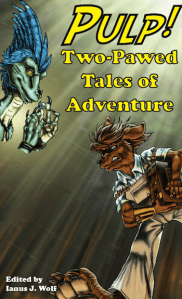
Book of the Month: PULP! Two-Pawed Tales of Adventure, edited by Ianus J. Wolf

pulp coverOctober’s Book of the Month is edited by FWG member Ianus J. Wolf and includes stories from members Ocean Tigrox, Bill “Hafoc” Rogers, Renee Carter Hall, Tarl “Voice” Hoch, Roland Jovaik, and Huskyteer.

“Keep your dials tuned as we join the RVO Radio Theatre for adventure, mystery, and danger!  Dive deep into the jungles of South America where the temple’s gift may not bring what you wish in The Ruins.  Then, jump to the Wild West of America as a badger determines who is the predator and who is Prey.  But don’t go too far as a group of intrepid Army Rangers battle a foreign threat to America more dangerous than the evil mastermind’s ‘robots’ in Rocket Canyon. And this next tale of an Aussie gal with a heart of gold and fists of iron battles the Nazis in The Bouncer and the Didgeridoo of Awakening. And join our poster girl, the rough and tumble Tesla Mae and the Lost Tribe. Don’t take too long to dock your airship, because evil cultists are trying to destroy Boston in Jericho Tanner and the Ebon Star. Find out who is the destroyer of worlds and who is the fox that can save us all in Savior.  And finally wrap it all up with a trip across the pond and the high flying aces in Flight of the Fire Dragon! Stay tuned, listeners, for more adventure!”

Featuring stories from:

  • Tym Greene
  • Ocean Tigrox
  • Bill “Hafoc” Rogers
  • T.S. McNally
  • Renee Carter Hall
  • Tarl “Voice” Hoch
  • Roland Jovaik
  • Huskyteer

Cover by Quel.

Order from Rabbit Valley.


Book of the Month: Anthropomorphic Aliens, edited by Fred Patten

Anthro Aliens coverSeptember’s Book of the Month is edited by FWG associate member Fred Patten and includes a story co-authored by member C. Alan Loewen.

Anthropomorphic animals have been imagined for as long as stories have been told. This is especially true of science fiction, where the endless possibilities of alien worlds make fertile ground for creativity.

 Contained in these pages are stories from across the spectrum of science fiction, ranging from 1950 to 2013, and featuring feathers, fur, and scales. Each creature is a unique blend of humanity and the alien. Childlike or savage, independent or autocratic, they come in all sizes and shapes. Some are recognizable as reflections of humanity, while others are strange and wild creatures that defy description. All of them ask the same question: What kind of creatures will we find when we go to the stars?

The anthology features eleven stories:

  • “Mask of the Ferret” by Ken Pick & C. Alan Loewen
  • “The Inspector’s Teeth” by L. Sprague de Camp
  • “Specialist” by Robert Sheckley
  • “In Hoka Signo Vinces” by Poul Anderson & Gordon R. Dickson
  • “Point of Focus” by Robert Silverberg
  • “Novice” by James H. Schmitz
  • “What Really Matters” by Elizabeth McCoy
  • “Kings and Vagabonds” by Cairyn
  • “The King’s Dogs” by Phyllis Gotlieb
  • “A Touch of Blue: A Web Shifters Story” by Julie Czerneda
  • “Fly the Friendly Skies” by Bryan Feir

Cover art by Roz Gibson.

Order from FurPlanet.


Now available: Tales From the Guild: Music to Your Ears

tales coverThe first FWG anthology, Tales From the Guild, Music to Your Ears, is now available from Rabbit Valley!

There are few things in this world that can invoke the range of emotions that music can. It can bring its listeners close together; it can drive its listeners apart. It is a core mechanic in what makes us human, but what about in those that aren’t quite human? Tales From the Guild, Music to Your Ears features a collection of stories from veteran and newcomer authors alike that span several universes but show that no intelligent creature is immune to the power of music.

Featuring stories by Furry Writers’ Guild members:

  • M.H. Payne
  • Mary E. Lowd
  • Huskyteer
  • Sean Rivercritic
  • Mark Neeley

And soon-to-be members:

  • Mars
  • Nathanael Gass
  • Jess E. Owen

Cover by Ifus

Contents:

  • Echoes From the Consort Box – Mark Neeley
  • Deep Down Among the Dagger Dancers – M.H. Payne
  • Sugar Pill – Mars
  • Nocturne – Nathanael Gass
  • Night of a Thousand Songs – by Jess E Owen
  • Turn On, Tune In, Drop Out – Huskyteer
  • Shreddy and the Silver Egg – Mary E Lowd
  • Melody of a Street Corner – Sean Rivercritic

Available from Rabbit Valley.


Book of the Month: Huvek by James L. Steele

Huvek coverAugust’s Book of the Month is by FWG member James L. Steele.

Humanity has gone to the stars, split and fused the atom, colonized hundreds of worlds, and rejoiced at first contact with alien life. Until the killing started.

Man has been at war with the Kesvek for over forty years. Nearly indestructible, relentless in battle, and unwilling to negotiate, the reptiles constantly push forward. Colony after colony has falls, and the human race can do little but hold them back. Humanity knows very little about their enemy.

The Kesvek plan to change that.

There is much to learn, and the Kesvek are willing to teach.  So long as humans can survive the process, mankind will discover what caused the conflict, and what is required for peace.

No matter the cost.

Order from FurPlanet. (Mature content.)