Calling all furry poets!

There aren’t all that many open calls for poetry among the fandom’s publications, so I thought this deserved an announcement of its own. [adjective][species] is currently seeking animal- or furry-themed poetry to publish on their site, and they’re open to poetry submissions through the end of this month. Submissions must be unpublished (though having been previously posted to FA, SoFurry, or Weasyl is okay).

You can find all the details here:

http://adjectivespecies.com/2015/03/06/call-for-submissions-furryanimal-poetry/


Book of the Month: The Vimana Incident by Rose LaCroix

vimana coverMarch’s Book of the Month, The Vimana Incident, is the latest work from member Rose LaCroix and can be read as either a stand-alone novel or as part five in a five-volume metanovel starting with The Goldenlea and Basecraft Cirrostratus.

“The year is 1939. The nations of the world have given up on war, and now compete in a race to build the first permanent lunar colony.

Edward “Red Ned” Arrowsmith, a British aerospace engineer, finds himself caught up in a cosmic level of intrigue when a secret lunar mission sends him on an unwilling journey six and a half centuries into a bizarre future. But what does this frightening future have to do with Godric of Hereford, a canon who died of ergot poisoning in 1153?

Rose LaCroix is proud to present her most anticipated novel, where psychedelic science fiction, historical fiction, and alternate timelines come together in a suspenseful, mind-bending masterpiece.”

Cover art by NightPhaser. Parental rating R.

Order from FurPlanet.

Check out Huskyteer‘s review of The Vimana Incident at Claw & Quill.

Guild News: March 2015

New Members

Welcome to our newest member Kris Schnee!

Member News

Mary E. Lowd has had stories published in Apex and Daily Science Fiction, Renee Carter Hall’s “The Frog Who Swallowed the Moon” appears in the latest volume of Spark: A Creative Anthology, Patrick “Bahumat” Rochefort’s serial From Winter’s Ashes has posted chapter 1.3, and the latest novel by Rose LaCroix, The Vimana Incident, is now available from FurPlanet.

(Members: Want your news here? Start a thread in our Member News forum!)

Market News

Upcoming deadlines: Anthologies ROAR #6 and Claw the Way to Victory close to submissions on April 1, and submissions to Weasel Press’ Typewriter Emergencies close on May 1. See our Paying Markets page for more info, and get your stories in!

Openings: The third volume of Rabbit Valley’s Trick or Treat anthology series is now open for submissions (deadline June 1).

Remember to keep an eye on our Calls for Submissions thread and our Publishing and Marketing forum for the latest news and openings!

Guild News

Today’s the last day to get your responses in for the 2015 Member Feedback Survey! See this thread in the member forums for the links to the 2-part survey.

We’re still open for guest blog post submissions! Good exposure and a great way to help out your fellow writers. See our guidelines for the details.

Need a beta reader? Check out our critique board (you’ll need to be registered with the forum in order to view it).

Want to hang out and talk shop with other furry writers? Come join us for the Coffeehouse Chats, Tuesdays at 7 p.m. Eastern, Thursdays at 12 p.m. Eastern, and Saturdays at 8 p.m. Eastern — all held right in the forum shoutbox. More info here. Remember, our forums are open to everyone, not just FWG members. Come register and join the conversation!

That’s all for this month! As always, send an email to furwritersguild (at) gmail.com with news, suggestions, and other feedback, or just comment here.
 

Member Spotlight: David Sharp

1. Tell us about your most recent project (written or published). What inspired it?

The Trouble with Furries started off as a project about the 1990’s club scene. The original idea was more of Studio 54 tale of getting lost in the chaos of the time and place. In 2006, I met a furry by chance, in the desert of Phoenix, while working an event security gig. I commented on his fox tail. He was cagey at first, then eventually opened up about what it meant. I learned through our talks about a subculture, while he learned that I was a writer and encouraged me to write about furries. At that time I did not know how to approach the subject since I was an outsider. Flash forward to 2013, and the idea of combining the two projects struck me as an unique option to tell the story. The final book is a dark cautionary tale of the woes of excess and a metaphor for the beast within.

2. What’s your writing process like? Are you a “pantser,” an outliner, or something in between?

I am probably a little in between the total structure of outlines and the dive in philosophy of the pantser. I see a story come together in my head as if I were watching a film unfold. Outlines are guideposts and sometimes change as the story takes on a life of its own. Once on a roll, the process seems to speed up to its conclusion.

3. What’s your favorite kind of story to write?

My favorite kind of story is a journey where the character must travel somewhere on the road and experience strange things on the way to his destiny.

4. Which character from your work do you most identify with, and why?

The one character I identify with most is Lane Bowden from my unpublished manuscript of The Journey of Lane Bowden. The story is set in 1973 with a true crime backdrop. I put a lot of my own mother’s passing into his fictional world as his mom, Ellen, died of cancer.

5. Which authors or books have most influenced your work?

Clive Barker has inspired me not only in fantasy, but as being a role model as a gay author. I also grew up on Stephen King. He is a master of believable characters.

6. What’s the last book you read that you really loved?

I recently finished A Dance with Dragons and am enduring the long wait for The Winds of Winter. George R.R. Martin has created an amazing world from the well-defined characters and geography of the lands to the politics and religions of the realms.

7. Besides writing, how do you like to spend your free time?

I love film, particularly horror films and still have my collection of Fangoria magazines from my youth. I go to the gym regularly. Most importantly, I like to spend time with my partner, Bo.

8. Advice for other writers?

Never give up on your dream. Always write it out no matter what. A little writing a day gets you closer, so do not be overwhelmed.

9. Where can readers find your work?

My books are available at amazon.com/author/sharpdavid, Apple Ibookstores, Barnes & Noble, Kobo ebooks, and other fine retailers.

10. What’s your favorite thing about the furry fandom?

Furry fandom gives an outlet for individuality and freedom to try on a new persona. My favorite part is the creativity.

Check out David Sharp’s member bio here!

Guest post: “Grammar Lesson: Metonymy & Synecdoche” by Anima

Grammar Lesson: Metonymy & Synecdoche

by Anima

Today we’re going to tackle two figures of speech you probably remember from school but may never consciously use in your writing: metonymy and synecdoche.

Metonymy is referring to a noun not by its name, but by something associated with it, whether specifically or just conceptually.

Synecdoche is a more specific type of metonymy in that it uses just a part of something to refer to its whole.

When you say ‘the university would frown upon that’ you’re using metonymy, because you’re really talking about the people who run the place. Similarly, referring to the U.S. government as Washington (a location heavily associated with the government) or reporters collectively as the press (a tool essential to their trade) that’s all metonymy.

As for synecdoche, the most common examples you’ll find are things like ‘all hands on deck,’ but remember it’s not limited to human parts. http://grammar.about.com/od/rs/g/synecdocheterm.htm has some better examples of synecdoche than other sites, including one from Updike, ‘a pair of headlights.’

You may be using synecdoche without thinking about it in situations where your characters can only detect part of something.  ‘The glowing eyes tracked me from the hedge, and more than ever, I wished I’d never clambered out of the carriage.’

Some uses for metonymy or synecdoche include brevity, description, and to help convey a character’s attitude about something. If your character refers to businessmen or investors as ‘suits,’ you can draw some inferences about that. If you add some air quotes or an awkward laugh to the same word, you’ll produce different inferences.

Both can come in handy when working on furry fiction. While even conventional dialogue includes phrases like ‘get your tail in here,’ they’re more relevant in our genre of choice. Don’t be afraid to follow familiar formulas to create new idioms for your anthropomorphic cultures using synecdoche and metonymy; just keep your story’s tone in mind. It can be a fine line to walk between humor and a plausible example of parallel linguistic evolution, and you don’t want one when you intended the other.

Furry characters also offer more visual variety and more opportunities to use synecdoche.  Stripes, spots, antlers, horns, any distinguishing feature can be used as shorthand when referring to respective characters, and can also help convey the fact that the observer only got a vague impression of the character in question, because darkness, motion, or other factors interfered.

These figures of speech help make your writing and dialogue more natural; people use them every day.

Member Spotlight: Austen Crowder

1. Tell us about your most recent project (written or published). What inspired it?

​My most recent finished work is The Painted Cat, and it’s a novel about a teacher in a backwater town who falls in love with a cartoon cat and the city in which she lives. (Trust me, it makes sense in context!) I was inspired to write it after moving to Chicago from small-town Indiana. The impact that move had​ on my happiness and my social life was huge and I wanted to explore the differences between those environments.

​It should come out later this year.​

2. What’s your writing process like? Are you a “pantser,” an outliner, or something in between?

Writing an outline is the kiss of death for any one of my drafts. I come up with a fun concept and plan out some sort of “final scene” to work toward. Then I might put down some one-sentence ideas for the next scene, or things I want characters to say at some point, but those usually get wiped off the notes page. As long as I’m building dramatic tension and working toward my endpoint, writing is seat-of-the-pants all the way.

Besides, why would I write a story if I already know how it ends? There’s no motivation for me there.​

3. What’s your favorite kind of story to write?

Character pieces that take the extraordinary and make it ordinary fascinate me.​
​My stories usually revolve around a group of people with similar but conflicting views of the world learning that their enemies are also human. Lots of small disagreements drive the tension in my stories.

​In other words: “The world is crazy, but how are John and Jane Doe coping with it? Let’s be a fly on their wall.”​

4. Which character from your work do you most identify with, and why?

Oh my, that’s a tough one! My philosophy in writing is that good, honest prose comes from being true to yourself and your experiences. As such, most of my characters have a piece of my personality at their core. Of those pieces I most identify with the ones that point out that we can’t waste our lives worrying about what other people think. Cassia in Bait and Switch was a good example of this.​

5. Which authors or books have most influenced your work?

I grew up a voracious reader of Mercedes Lackey books, which helped me identify the way a novel is constructed. (Most of her stories have the same bones which made identifying patterns a lot easier.) Bradbury taught me the power of prose that had been elevated to poetic heights. Philip K. Dick taught me the power of surrealism and the unreliable narrator.​

6. What’s the last book you read that you really loved?

I finally got down to reading ​Cory Doctrow’s Pirate Cinema ​recently and it’s a fantastic book. Fun characters, a slightly unbelievable premise, and a healthy dose of critique of copyright law come together to create a great narrative.

7. Besides writing, how do you like to spend your free time?

My Day Job, mostly. Girl’s gotta eat!

Beyond that, I play video games, board games, RPGs, and hang out with friends in the area. I’m also planning my wedding with my fiancé, and if I didn’t mention that somewhere in the interview I’m pretty sure she’d throttle me.​

8. Advice for other writers?

Keep writing! You might not be at the level you want to be in the here and now, but the only thing that fixes it is practice.​ ​I wrote enough bad transformation stories, cruddy Sonic fanfics, and shared universe furry stories​ to fill a closet full of shame and regret. Still, those stories made me better.

Also, don’t be afraid to stretch your legs. I did a stint as a political columnist for two years and learned a lot about my writing. Write stuff you’re not comfortable writing. Fail. Look at why you failed. Learn to not fail next time.

9. Where can readers find your work?

You can find my work on Amazon, but beyond that I’m trying to figure out what to do with my stories. For now I have a small collection of pieces at www.furaffinity.net/user/slyford.

10. What’s your favorite thing about the furry fandom?

Furry is a no-judgment zone where people can find their identity. Once you’ve found your place, you can even stay for the great friends you’ve made!

I wrote about my experience with furry in this article for {adjective] [species] that explains the identity-finding bit further.

Guest post: “Behind Red Stone Walls” by Renee Carter Hall

Behind Red Stone Walls

by Renee Carter Hall


Many readers’ experiences with Brian Jacques’ Redwall books began in childhood. I was in my senior year of high school when I first discovered the books, but as with all of my reading, age never mattered, whether it was my age or the intended audience of the books.

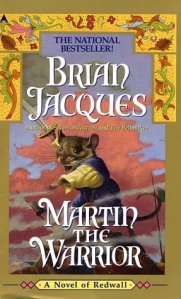
martin coverAt that time, since I didn’t have a good bookstore close to home, I picked up a lot of my casual reading from the book and magazine sections of local grocery stores. One day I found Martin the Warrior on those racks alongside thrillers and romances, and from the first glance at the cover, I was hooked.

It was a while before I realized the book was technically children’s fiction. This paperback edition was mass-market size, not the larger format I was used to for middle-grade fiction, and the bookstore where I bought the later works shelved all of them in the science fiction and fantasy section. To me it just felt like fantasy, with a childlike sense of wonder and its cast of animal characters — some friendly, some fierce — that appealed to me instantly. I’d never read anything quite like it, and as soon as I could, I started tracking down the other books.

Throughout my life, there have been various authors — only one or two at a time — from whom I’m willing to purchase hardcovers without having read the book first. Brian Jacques occupied that honored position for several years. While I quickly caught on to the formula of his plots, I loved inhabiting the world of fairy-tale valor he’d created.

By the time Marlfox was published in 1998, I had recently married and was living in San Diego. While there, I’d had the opportunity to meet more than one of my favorite authors, and I kept hoping for Jacques to visit. I finally got my chance when he came to a children’s bookstore in Riverside, California, in February 1999, while on tour for Marlfox. Because he’d injured his hand at a previous stop, he wasn’t able to personalize books, just sign them, but it was still a chance to say hello — though I think I was the oldest fan there, unless you count the bookstore’s staff.

I’d only ever owned a paperback copy of Redwall, so I bought the hardcover anniversary edition for him to sign. At some point when he was signing the book, either I or my husband mentioned that I’d written a children’s book as well (a middle-grade portal fantasy that remains unpublished and probably always will). He said well, someday he would have to come stand in line for my book. I babbled something inane along the lines of how he wouldn’t read it, though, because I’d heard that he never read other children’s authors. I admit I don’t remember most of the talk he gave that day, but I do remember how much I loved hearing him, how wonderful he was with the children who sat at his feet, and (as I noted in my journal afterward) that “he reminded me of the kind of uncle that all the children look forward to seeing, with stories to tell them and treats hidden in pockets.”

My husband and I left San Diego not long after that, moving back to my home state of Virginia, to an apartment near Dulles Airport. There were planes flying over almost constantly, their contrails marking the daytime skies. And then came a September morning in 2001 when there were suddenly no planes in the sky at all.

Continue reading “Guest post: “Behind Red Stone Walls” by Renee Carter Hall”

Book of the Month: The Furry Future, edited by Fred Patten

tff coverFebruary’s Book of the Month, The Furry Future, is edited by FWG associate member Fred Patten and includes stories from several members.

“For the history of the human race we have been locked inside our bodies. Spiritualism, medicine, basic biochemistry and genetic enhancement seek to take us beyond the physical limitations we were born with. The Furry Future is a record of what might become of us once we perfect the methods of reshaping biology.

“Fangs and claws could become just another fashion accessory. We might use our technology to create intelligent and able companions as we spread out to the stars, or else create perfect servants unable to disobey the whims of their masters. We may remake ourselves to attain our future across the galaxy and unlock our spiritual potential, or collapse into war over where the boundaries of humanity lie.

“These nineteen stories take us to these different futures, each one written in the fur we choose to wear.”

Contains the following stories:

Emergency Maintenance by Michael H. Payne
Tow by Watts Martin
Experiment Seventy by J. F. R. Coates
A Bedsheet for a Cape by Nathanael Gass
Hachimoto by Samuel C. Conway
Vivian by Bryan Feir
Family Bonding by Yannarra Cheena
The Future Is Yours by MikasiWolf
Distant Shores by Tony Greyfox
The Analogue Cat by Alice “Huskyteer” Dryden
The Sequence by NightEyes DaySpring
Trinka and The Robot by Ocean Tigrox
Lunar Cavity by Mary E. Lowd
The Darkness of Dead Stars by Dwale
Field Research by M. C. A. Hogarth
The Curators by T. S. McNally
Evolver by Ronald W. Klemp
Growing Fur by Fred Patten
Thebe and the Angry Red Eye by David Hopkins with illustrations by Roz Gibson

Cover art by Teagan Gavet. Parental rating PG.

Available from FurPlanet.


Guild News: February

New Members

Welcome to our newest member MikasiWolf!

Member News

The latest anthology from editor Fred Patten, The Furry Future, features 19 furry-themed science fiction stories (or science-fiction-themed furry stories, your call), with at least 15 of those stories coming from FWG members.

FurPlanet’s anthology Five Fortunes (also edited by Fred Patten, and featuring novellas from several members) is now available as an ebook from Bad Dog Books, and you can read FWG member Dronon’s review of it here at Claw & Quill. In other review news, you can now find Fred Patten’s reviews posted at Dogpatch Press.

Eduardo Soliz has just released Con Fluff 3: Nine Charming Furry Short Stories, his third collection of “furry super-short conbook stories”.

Patrick “Bahumat” Rochefort’s From Winter’s Ashes continues with Chapter 1.1 and Chapter 1.2 now posted.

Some of our associate members have been busy too — Jay launched a new blog, and Weasel has a new book review blog himself, along with another story in the literary magazine Earth Is Huge And We Are All On It.

(Members: Want your news here? Start a thread in our Member News forum!)

Market News

Just opened: From Weasel Press, a furry anthology called Typewriter Emergencies, looking for “dark and existential fiction focusing around the theme of ‘These Things Shall Pass/It’s a mad world out there.'” Deadline is May 1, and full details are here.

Other anthologies currently remain open with spring deadlines — check out our Paying Markets page for more info, and remember to keep an eye on our Calls for Submissions thread and our Publishing and Marketing forum for the latest news and openings!

Guild News

The links to the 2015 Member Feedback Survey were sent out to all FWG members in an email dated January 30. If it’s not in your inbox (or your spam folder), please see this thread in the member forums for links to the 2-part survey. Both parts close on March 2, so please don’t wait to get your responses in.

We had a successful meet and greet at Further Confusion in January — you can check out the notes from that meet in this forum thread. (Thanks again to Daniel for taking all those notes, and to all those who hosted and attended, whether at the con or virtually via the shoutbox.)

There’s a quick update on the Cóyotl Awards here at the award blog.

Fred Patten has reviewed the FWG’s first anthology, Tales From the Guild: Music to Your Ears, over at Dogpatch Press.

A reminder to members: We’re open for guest blog post submissions! Good exposure and a great way to help out your fellow writers. See our guidelines for the details.

Need a beta reader? Check out our critique board (you’ll need to be registered with the forum in order to view it).

Want to hang out and talk shop with other furry writers? Come join us for the Coffeehouse Chats, Tuesdays at 7 p.m. Eastern, Thursdays at 12 p.m. Eastern, and Saturdays at 8 p.m. Eastern — all held right in the forum shoutbox. More info here. Remember, our forums are open to everyone, not just FWG members. Come register and join the conversation!

That’s all for this month! As always, send an email to furwritersguild (at) gmail.com with news, suggestions, and other feedback, or just comment here.
 

Member Spotlight: Mark “Prof Hauke” N.

1. Tell us about your most recent project (written or published). What inspired it?

If the focus is only on those that were actually completed and published, I’d have to go back a whole year to the first anthology, Tales From the Guild: Music to Your Ears. There have been more recently written things but they were so short, I’m hesitant to call them “projects”. I’d be more comfortable with “drafts”.

Anyway, that one (“Echoes from the Consort Box”) was inspired by an image of a confrontation that didn’t actually make its way into that story; the story that was published is, if anything, a prequel to what I was really starting on; it’s still in progress.

In a wider sense, the big project I’m working on now is to write a textbook for a class I’ve taught several times. I’d guess that almost nobody will actually read it and even fewer people really want to hear about that, it’s Linear Algebra. I doubt I’ll make any money off of it; the book will be more of a photocopied loose-leaf packet that I hand out to students at the beginning of the semester.

2. What’s your writing process like? Are you a “pantser,” an outliner, or something in between?

What’s a “pantser”? Like, “by the seat of your pants”? I guess I’m like that. I mentioned an image before; most of what I do is inspired by an image. This isn’t the .jpg or .gif type!   It’s one that comes when I’m either thinking of nothing in particular; hear (or mishear!) something, or think “Now how would this unfold if it were in a furry world instead of this one?” Try it: if I say “That’s not the way cake is supposed to look” and you imagine a cake, and something’s wrong with it. What, precisely, is the matter? Who made it? A lot of things can snap into place as if they came from somewhere else; you just write about it as you go.

3. What’s your favorite kind of story to write?

My favorite kind of story to write is one that I don’t think I’ll have to finish!

4. Which character from your work do you most identify with, and why?

That’d have to be Hauke von Friedrichs, the cockatrice (or basilisk, if you speak German) professor. He dates back to a very primitive time in my writing career: he’s my alter ego, my self-insertion into the furry world. As I started writing more and more, he got left out more and more, but I’ve got a soft spot for him.

5. Which authors or books have most influenced your work?

The single most influential author on me I can name is Lynda Barry. I suppose Harvey Pekar should be mentioned as well. I have a lot of authors whose work I admire and that I love to read, but I find myself stealing from those two when I turn around and try to write something.

6. What’s the last book you read that you really loved?

If I interpret this as the latest book I’ve read that has left a good impression, that would be City by Clifford Simak. It’s the book I’ve read most recently that has stuck with me. I’m a little surprised that I had never heard other people in the fur fandom talk about it. Structurally it was appealing to me since it’s several short works bound together with one theme (I think to myself “I could do that!” as I look over the very short pieces I’ve done). Simak’s stories are told as myths and legends by dogs about the mythical human race.


Continue reading “Member Spotlight: Mark “Prof Hauke” N.”