Cóyotl Awards ceremony at Rainfurrest

Just a reminder for those of you headed to Rainfurrest this weekend that the Cóyotl Awards ceremony will be held Friday night at 7 PM, where winners will be announced for 2012 and 2013. (And for those of you getting to the con on Thursday, there’s also going to be an FWG meet Thursday night at 7 PM – all are welcome, so come find out more about who we are and what we do, and just get a chance to hang out with other writers.)

Thanks to Mary E. Lowd for hosting both events!


Guest post: “Anthropomorphic Diversity” by Lauren Rivers

Anthropomorphic Diversity

by Lauren Rivers


When writing anthropomorphic fiction, one of the major elements is determining the species and the variety of your cast members. One of your first decisions is should they all be of the same race. While it may be to your fancy to have an entire cast of foxes, the positive side to this is that you can delve into the variations of the species. You can discuss the habits of different types of foxes such as fennecs versus the red fox, as well as highlight cultural differences much in the way that science fiction does with aliens and racial situations. An example would be a story where fennec foxes are considered exotic and used for slave labor, or a case where arctic foxes are racially profiled and perhaps have a unique ability the others do not, such as the creation and manipulation of ice. This also comes with a downside for people that don’t like how foxes tend to be overused within the fandom.  They could be turned off by the fact that your characters are all variants of the same species. Additionally, one should consider that in a situation where the entire cast ‘looks the same’ from a general perspective, individual characters may have a harder time standing out.

Another possibility is centaurs or any characters with a humanoid torso and animal lower half. The positive side to this addition is that you can more or less make up your own rules as to the species and what they are like. For one, they are capable of more physical action than most normal anthropomorphic characters, though most of the issues with centaurian species are logistical. If you include centaurs, then cars, furniture, group travel, everything must be modified for the existence of centaurs. Adding an extra two feet to some of your characters can slow you down if you do not have a plan in mind for your four-footed cast members.

Let’s not forget about humans themselves. The plus side to the involvement of humans in furry stories is that non-furries may enjoy the story simply for its own merits. Humans are easiest for people outside of the fandom to understand, and logically so. If you want your story to be more broadly accepted, consider a partly human cast. Be wary of using the humans only on the side of evil though, as the ‘evil humans versus good anthropomorphic characters’ plot line is a frequent staple in furry fiction. It may be seen as ‘one of those stories’ in the same way that comas on soap operas are often not taken seriously.

Finally, a species-diverse cast is yet another option. If you have every cast member a different species, or at least no more than two of any one type, you maximize the chances that every reader will find at least one species they enjoy. Additionally, it gives you more variety in descriptions. For example, if there is only one bovine character in your story, they will be easily recalled and will more quickly establish themselves in the reader’s mind. The pitfall with this approach is that you may have more characters than you can handle, if you attempt to fit too many species into your zoological odyssey.

As a writer, you clearly have many choices for how to populate your world. The choice is of course, up to you. However, bear in mind that you must know what kind of story you want to tell before you begin the casting process. Being aware of this will often do most of the work for you. Think of the characteristics each type of anthropomorphic being will add to your story and then decide if they’re the right one for you. If you’ve done your planning properly, it should seem as if most of the decisions have been made all by themselves.


Member Spotlight: Heath Pfaff

1. Tell us about your most recent project (written or published). What inspired it?

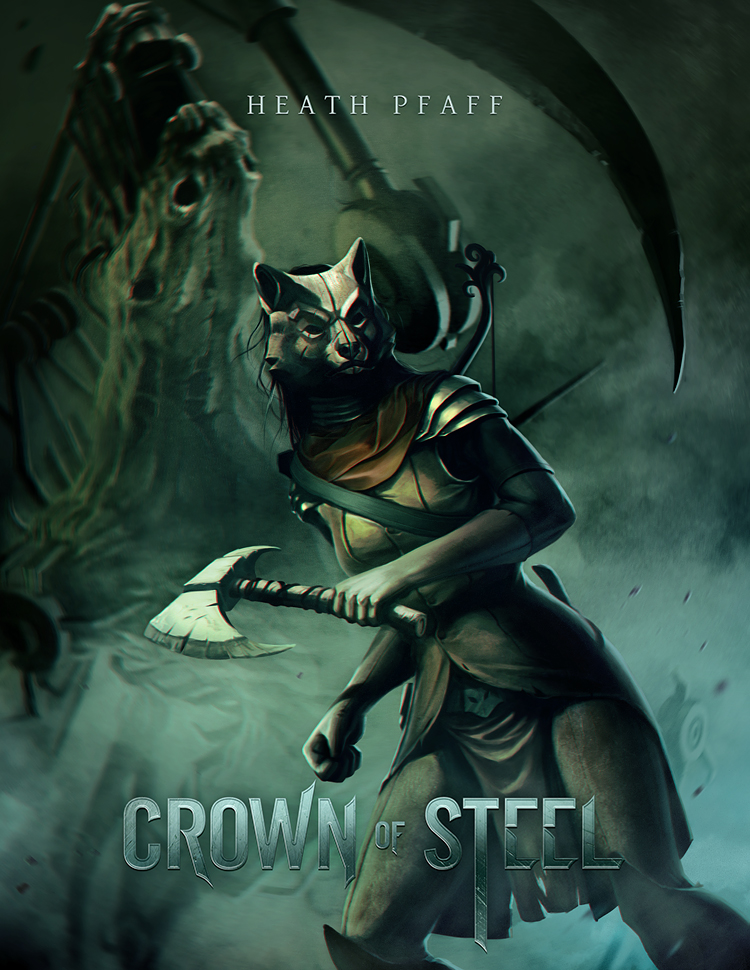
Crown coverMy current project is a three part fantasy series called Chaos Awakens.  Book one, Servant of Steel, and book two, Crown of Steel, have already been published and I’m hacking away at the third book currently (SOMETHING of Steel).  My goal is to have it published by the end of the year.

This series was inspired by my love of dark anti-heroes and epic conflicts.  I really wanted to create a world that was gripped in the late stages of its own demise, and to tell the story of the people who became heroes not out of choice, but out of necessity.

2. What’s your writing process like? Are you a “pantser,” an outliner, or something in between?

I’m the sort of writer who likes to dive right into a project.  I’ve tried outlining in the past, but I find that the process of outlining causes me to fall into formulaic story arcs.  It’s far too easy to become systematic when you’re basically making a list of key elements of your plot.  Instead, I build the story up in my mind, take notes on key points I want to include, and then start writing from the beginning. While I’m working I’ll reference my notes here and there, change them, rework plot details, and often scrap large portions of my original plans.  Everything in service to the story.

When you’re reading one of my books you should never be bored.  If I re-read something and it’s dull, I throw it out.  It’s actually a chaotic process.  I wouldn’t recommend it at all.

3. What’s your favorite kind of story to write?

I’m a huge fan of fantasy, but I really like to throw in elements of horror.  I like to be scared, and I like to scare other people.  It’s intoxicating.

4. Which character from your work do you most identify with, and why?

This is a difficult question.  I’m always tempted to pick the current lead from my long-term project because, at any given moment, that is the one character I need to identify with the most.  For my current series I’ve spent a lot of time in the head of my lead character, Xandrith.  We share a degree of dark humor and bitterness, but he also differs from me in a lot of ways.  The lead from my previous trilogy, The Hungering Saga, was probably closer to my actual personality.  He could be a real bastard at times.   He tended to let his emotions lead his actions, and I have to admit I do that more than I should.  I guess I identify with him, Lowin, the most.

Continue reading “Member Spotlight: Heath Pfaff”

Guest post: “Professionalism Among Furry Writers” by Tarl “Voice” Hoch

Professionalism Among Furry Writers

by Tarl “Voice” Hoch


I was reading a review for Children of Steel and overall the review was well done, but at the end the reviewer had the following to say:

On a final note, and I debated on whether or not to bring this up in my review but decided that it was warranted, the book does need some editing for grammatical issues (apostrophes, commas, etc.). While it wasn’t enough to really detract from the story, it did recur enough that I felt it should be mentioned. (source)

What bothers me about this review, is that the reviewer states that they considered not bringing up that the book had editing issues. In something like the Furry Fandom, in published books (electronic or print) editing should be taken seriously. We as writers and editors in this fandom are responsible to try and present the best material possible, especially when people are paying upwards of $20 for a print copy ($10-$15 for ebooks).

Bad editing should not be expected. Nor should bad grammar and punctuation. Nor should they be glossed over. Yes, there will always be those mistakes that are missed by the author, editors, and publisher. However, an effort should be made to produce the best material possible. If there is a problem with the editing, that should be stated in the review, not debated over. We are no less accountable for our works than furry visual artists are to theirs.

I once did a few My Little Pony pieces of art back when that fandom was young. I was very proud of them, despite the fact that I knew the lines were not as clean as they should have been. Still, I posted them and waited for the responses. What I got were a lot of comments about my line work and how I should have vectored them like the show itself did. So what did I do? I looked up vectoring and applied it the next time I did artwork. Clean lines are equivalent to proper grammar/punctuation/spelling.

There is a large debate over furry fiction becoming mainstream. As the fandom continues to garner more and more public interest, we as writers within the fandom should strive to be as professional as possible. If we want our works to stand out and to be presented as OUR works (not our fursona’s), then we should treat our field as professionally as possible.

Just because we are ‘Furry Writers’ does not mean that we should hold ourselves any less accountable to the quality of our work.


This post first appeared on Tarl “Voice” Hoch’s blog on Goodreads.

Book of the Month: Anthropomorphic Aliens, edited by Fred Patten

Anthro Aliens coverSeptember’s Book of the Month is edited by FWG associate member Fred Patten and includes a story co-authored by member C. Alan Loewen.

Anthropomorphic animals have been imagined for as long as stories have been told. This is especially true of science fiction, where the endless possibilities of alien worlds make fertile ground for creativity.

 Contained in these pages are stories from across the spectrum of science fiction, ranging from 1950 to 2013, and featuring feathers, fur, and scales. Each creature is a unique blend of humanity and the alien. Childlike or savage, independent or autocratic, they come in all sizes and shapes. Some are recognizable as reflections of humanity, while others are strange and wild creatures that defy description. All of them ask the same question: What kind of creatures will we find when we go to the stars?

The anthology features eleven stories:

  • “Mask of the Ferret” by Ken Pick & C. Alan Loewen
  • “The Inspector’s Teeth” by L. Sprague de Camp
  • “Specialist” by Robert Sheckley
  • “In Hoka Signo Vinces” by Poul Anderson & Gordon R. Dickson
  • “Point of Focus” by Robert Silverberg
  • “Novice” by James H. Schmitz
  • “What Really Matters” by Elizabeth McCoy
  • “Kings and Vagabonds” by Cairyn
  • “The King’s Dogs” by Phyllis Gotlieb
  • “A Touch of Blue: A Web Shifters Story” by Julie Czerneda
  • “Fly the Friendly Skies” by Bryan Feir

Cover art by Roz Gibson.

Order from FurPlanet.


Now available: Tales From the Guild: Music to Your Ears

tales coverThe first FWG anthology, Tales From the Guild, Music to Your Ears, is now available from Rabbit Valley!

There are few things in this world that can invoke the range of emotions that music can. It can bring its listeners close together; it can drive its listeners apart. It is a core mechanic in what makes us human, but what about in those that aren’t quite human? Tales From the Guild, Music to Your Ears features a collection of stories from veteran and newcomer authors alike that span several universes but show that no intelligent creature is immune to the power of music.

Featuring stories by Furry Writers’ Guild members:

  • M.H. Payne
  • Mary E. Lowd
  • Huskyteer
  • Sean Rivercritic
  • Mark Neeley

And soon-to-be members:

  • Mars
  • Nathanael Gass
  • Jess E. Owen

Cover by Ifus

Contents:

  • Echoes From the Consort Box – Mark Neeley
  • Deep Down Among the Dagger Dancers – M.H. Payne
  • Sugar Pill – Mars
  • Nocturne – Nathanael Gass
  • Night of a Thousand Songs – by Jess E Owen
  • Turn On, Tune In, Drop Out – Huskyteer
  • Shreddy and the Silver Egg – Mary E Lowd
  • Melody of a Street Corner – Sean Rivercritic

Available from Rabbit Valley.


Guild News: September

New Members

Welcome to our two newest associate members, Isiah Jacobs of FurReview and Jay of Jaffa Books!

Member News

M. C. A. Hogarth released the coloring book Not in Need of Rescue and the audio version of Rose Point.

The print version of Blood Type: An Anthology of Vampire SF On the Cutting Edge, which includes a story from Tarl “Voice” Hoch, is now available from the publisher.

Paul Kidd‘s new book Spirit Hunters Book 1: The Way of the Fox is now available as a paperback from Lulu and an ebook on Amazon.

(Members: Want to make sure your news gets included here? Start a thread in the Member News forum!)

Market News

Deadline is September 30 for submissions to Heat #12 and Hot Dish #2! (More info and links to guidelines at our Paying Markets page.)

Editor Fred Patten has just announced a call for submissions for a new anthology, The Furry Future, to be published by FurPlanet, with a submission deadline of November 1. Full details are here in our forums.

Guild News

Voting is now closed for the Cóyotl Awards, and the winners for both 2012 and 2013 will be announced at the award ceremony later this month at Rainfurrest.

Our first anthology, Tales From the Guild Volume 1: Music to Your Ears, will be available for order soon! Watch this space. 🙂

We remain open to guest blog posts from members! See the guidelines here.

Want to hang out and talk shop with other furry writers? Come join us for the Coffeehouse Chats, Tuesday evenings from 7-8 p.m. Eastern in the forum shoutbox. It’s an informal way to check in with your weekly writing progress and goals.

And if you’ve got something you need a beta for, we have a critique board in our forum (you’ll need to be registered with the forum in order to view it).

That’s all for this month. As always, send an email to furwritersguild (at) gmail.com with news, suggestions, and other feedback, or just comment here.

One last question…

Unicorns or dragons?


Member Spotlight: Dwale

1. Tell us about your most recent project (written or published). What inspired it?

My most recent completed project is a short story called “The Darkness of Dead Stars.” It was inspired by what I’d read about the ultimate fate of the universe and eschatology, though beyond the basic premise, it didn’t start to come together until I’d seen Von Trier’s film “Melancholia.” As with “Melancholia,” mood and atmosphere take priority over realism. This was necessary for my story because there yet remain unanswered questions in physics that make it impossible to determine certain details about the future of the universe; we just don’t have the data right now. However, I hope it will all sound feasible at the time of reading.

2. What’s your writing process like? Are you a “pantser,” an outliner, or something in between?

I usually let an idea bounce around in my head for months, even years before putting down any of it. That shouldn’t be taken for planning, though, as the plot is never more than roughed out when it comes time to write. Once it gets to that point, I alternate between daydreaming and trying to articulate those daydreams. I try to edit as I go as much as possible.

Once a rough draft is completed, it goes through a couple of rounds of editing, then I try to leave it alone for a few months. After that, I decide if the story should be scrapped, edited further, or completely rewritten.

For poetry, I employ automatism at first and clean it up as I go.

In both cases, the germ is usually something retained from hypnagogia.

3. What’s your favorite kind of story to write?

I have the most fun writing things that are completely absurd. Think “Looney Tunes” logic, but sordid, morose and infused with my personal symbology. It’s rare that I venture into this territory, though.

4. Which character from your work do you most identify with, and why?

That would vary, but the easy answer is “Aunty Fjola.” We’re both struggling with afflictions, though her ailment is as much physical as it is psychological, we’ve both also had to readjust from a life that was fairly bustling to one that is more passive and sedentary.

5. Which authors or books have most influenced your work?

Watership Down is the book that made me want to write seriously. I read it when I was eighteen or so, I had been writing poetry for years then and liked to think I knew what I was doing. Nope! I was humbled and resolved that someday I would be able to write something that good. I’ll let you know if it happens.

Orwell’s 1984 was also a big influence, I’ve read it many times. Terry Pratchett is someone I haven’t been reading very long, but he’s already made an impression. Neil Gaiman, William S. Burroughs, HP Lovecraft and Khalil Gibran also deserve mention, as do others I’m forgetting.

6. What’s the last book you read that you really loved?

“Loved” isn’t a word I would normally use, but… Going Postal by Terry Pratchett. It’s rare for a book to make me laugh aloud, but this one did, more than once.

7. Besides writing, how do you like to spend your free time?

Well, I like to spend my free time attended by nymphs in the pleasure gardens, but as this occurrence would be charitably termed “uncommon,” I mostly enjoy reading and taking in movies and music these days. The woods are nice, but we don’t have them here. I will always stop whatever I’m doing to watch rain or windstorms, that’s my favorite.

8. Advice for other writers?

Always strive to improve. Always do! Your art is not so small that you’ll ever want for room to grow.

9. Where can readers find your work?

Has mostly rough drafts, but there are some more polished ones. Persons are also welcome to contact me directly.

10. What’s your favorite thing about the furry fandom?

Furries are some of the most open and accepting people. No one’s worried about the skeletons in your closet, no one’s trying to look cool…or at least, no one’s succeeding! We have our share of unpleasant types, every fandom does, but there are some truly wonderful people who make it all worthwhile.


Check out Dwale’s member bio here!

Guest post: “Writing Furry Speculative Fiction” by Mary E. Lowd

Writing Furry Speculative Fiction

by Mary E. Lowd


My favorite books as a kid were all about talking animals. As I got older, it got harder to find those sorts of books. Sure, there’s the occasional piece of science-fiction with animal-like aliens or off-beat literary novel from the point of view of an animal, but, mostly, talking animals are seen as kid-stuff in our culture. So, when I set out to write a serious, hard science-fiction novel featuring talking otters as the main characters… Well, I was breaking new ground as far as I knew, and I had to make up the rules as I went along.

Since then, I’ve learned that there’s actually a name for the genre of fiction I was craving, and there’s a whole community of readers, writers, and publishers who’ve put a lot of thought into how that genre works. I was ecstatic when I discovered the furry genre. Finally, I wasn’t alone, writing about otters with spaceships.

There are a couple of different kinds of furry fiction. Perhaps the most mainstream is ‘the secret life of animals.’ These stories are usually set in our normal world — talking animals co-exist with humans who are simply unaware of the dramatic tales unfolding around them. (E.g. Watership Down by Richard Adams and Charlotte’s Web by E.B. White.) Animals in these stories are often only slightly anthropomorphic. They can think and talk like humans, but they’re otherwise normal animals.

The other extreme of furry fiction features animals who are so thoroughly anthropomorphized that the differences between different species have become largely aesthetic, possibly metaphorical. Foxes date bunnies; elk work in office buildings with mice. Instead of co-existing with humans in the normal world, these anthropomorphic animals replace humans. In this kind of fiction, the different animal species are merely different flavors, adding texture and color to characters in a simple short-hand.  (E.g. Maus by Art Spiegelman and Save the Day by D.J. Fahl.)

When writing speculative furry fiction, it’s possible to fall into these extremes. You could tell the story of the first colonists on Mars from the point of view of their pet cat. Or, the first colonists on Mars could be cats with no explanation given for their furriness. However, I love the stories that fall in-between, and, I like it best when those stories have an answer to the obvious question: why can the animals talk?

This question has been explored so much by the furry writing community that some people feel it doesn’t matter anymore, much like the question of faster than light travel in mainstream science-fiction. How does the FTL drive work? Who cares? It just does. However, the type of FTL drive in a sci-fi universe determines the sorts of stories that can be told there. Similarly, the type of anthropomorphic animals determines a great deal about a sci-fi universe’s history and culture. So, it’s worth knowing the tropes.

The oldest trope is parallel evolution. See, those golden-furred, feline bipeds who live in family groups with one male figurehead where the females do all the work… Those aren’t lions. They’re aliens. From a different planet. They just happened to evolve to be really similar to lions. (E.g. The Pride of Chanur by C.J. Cherryh.) This is a great trope. It’s easy to use and widely accepted.

Another answer to the question, ‘why can the animals talk?’, is that they were genetically uplifted by humans. (E.g. Startide Rising by David Brin.) This is my personal favorite. Of course, it raises its own question of ‘why?’ Were we designing soldiers, slaves, or simply companions? Are they treated as equals? If so, did they have to fight for their rights? How long did that take? Different answers to these questions lead to wildly different universes. If we were designing soldiers, then the talking animals are probably larger, predatory species. (E.g. Forests of the Night by S. Andrew Swann.) If we were designing obedient slaves, they  might be dogs or a docile species like bunnies. (E.g. Ship’s Boy by Phil Geusz.)

A final possibility is that the animals actually are humans who have drastically modified themselves. (E.g. The Book of Lapism by Phil Geusz.) In this case, the species of animals will be chosen by individual characters for personal reasons. Individuals who choose to modify themselves so extremely are likely to be rich, eccentric, socially outcast, or part of a fringe subculture.

And, of course, all of these answers can be adapted easily to fantasy universes by replacing science with magic and scientists with wizards.

As you can see, explanations have been developed that will fit anthropomorphic animal characters into almost any piece of speculative fiction. And, from fantasy to space opera to near future hard sci-fi, most speculative fiction can benefit from the color and texture added by a few talking animals. Besides, they’re just fun to read.

So, now that you’ve learned the basic tropes, go forth and add anthropomorphic animal characters to your speculative fiction!


This post first appeared on Jester Harley’s Manuscript Page.