Guest post: “Grammar Lesson: Metonymy & Synecdoche” by Anima

Grammar Lesson: Metonymy & Synecdoche

by Anima

Today we’re going to tackle two figures of speech you probably remember from school but may never consciously use in your writing: metonymy and synecdoche.

Metonymy is referring to a noun not by its name, but by something associated with it, whether specifically or just conceptually.

Synecdoche is a more specific type of metonymy in that it uses just a part of something to refer to its whole.

When you say ‘the university would frown upon that’ you’re using metonymy, because you’re really talking about the people who run the place. Similarly, referring to the U.S. government as Washington (a location heavily associated with the government) or reporters collectively as the press (a tool essential to their trade) that’s all metonymy.

As for synecdoche, the most common examples you’ll find are things like ‘all hands on deck,’ but remember it’s not limited to human parts. http://grammar.about.com/od/rs/g/synecdocheterm.htm has some better examples of synecdoche than other sites, including one from Updike, ‘a pair of headlights.’

You may be using synecdoche without thinking about it in situations where your characters can only detect part of something.  ‘The glowing eyes tracked me from the hedge, and more than ever, I wished I’d never clambered out of the carriage.’

Some uses for metonymy or synecdoche include brevity, description, and to help convey a character’s attitude about something. If your character refers to businessmen or investors as ‘suits,’ you can draw some inferences about that. If you add some air quotes or an awkward laugh to the same word, you’ll produce different inferences.

Both can come in handy when working on furry fiction. While even conventional dialogue includes phrases like ‘get your tail in here,’ they’re more relevant in our genre of choice. Don’t be afraid to follow familiar formulas to create new idioms for your anthropomorphic cultures using synecdoche and metonymy; just keep your story’s tone in mind. It can be a fine line to walk between humor and a plausible example of parallel linguistic evolution, and you don’t want one when you intended the other.

Furry characters also offer more visual variety and more opportunities to use synecdoche.  Stripes, spots, antlers, horns, any distinguishing feature can be used as shorthand when referring to respective characters, and can also help convey the fact that the observer only got a vague impression of the character in question, because darkness, motion, or other factors interfered.

These figures of speech help make your writing and dialogue more natural; people use them every day.
Guest post: “Behind Red Stone Walls” by Renee Carter Hall

Behind Red Stone Walls

by Renee Carter Hall


Many readers’ experiences with Brian Jacques’ Redwall books began in childhood. I was in my senior year of high school when I first discovered the books, but as with all of my reading, age never mattered, whether it was my age or the intended audience of the books.

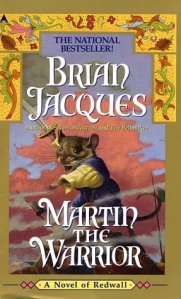
martin coverAt that time, since I didn’t have a good bookstore close to home, I picked up a lot of my casual reading from the book and magazine sections of local grocery stores. One day I found Martin the Warrior on those racks alongside thrillers and romances, and from the first glance at the cover, I was hooked.

It was a while before I realized the book was technically children’s fiction. This paperback edition was mass-market size, not the larger format I was used to for middle-grade fiction, and the bookstore where I bought the later works shelved all of them in the science fiction and fantasy section. To me it just felt like fantasy, with a childlike sense of wonder and its cast of animal characters — some friendly, some fierce — that appealed to me instantly. I’d never read anything quite like it, and as soon as I could, I started tracking down the other books.

Throughout my life, there have been various authors — only one or two at a time — from whom I’m willing to purchase hardcovers without having read the book first. Brian Jacques occupied that honored position for several years. While I quickly caught on to the formula of his plots, I loved inhabiting the world of fairy-tale valor he’d created.

By the time Marlfox was published in 1998, I had recently married and was living in San Diego. While there, I’d had the opportunity to meet more than one of my favorite authors, and I kept hoping for Jacques to visit. I finally got my chance when he came to a children’s bookstore in Riverside, California, in February 1999, while on tour for Marlfox. Because he’d injured his hand at a previous stop, he wasn’t able to personalize books, just sign them, but it was still a chance to say hello — though I think I was the oldest fan there, unless you count the bookstore’s staff.

I’d only ever owned a paperback copy of Redwall, so I bought the hardcover anniversary edition for him to sign. At some point when he was signing the book, either I or my husband mentioned that I’d written a children’s book as well (a middle-grade portal fantasy that remains unpublished and probably always will). He said well, someday he would have to come stand in line for my book. I babbled something inane along the lines of how he wouldn’t read it, though, because I’d heard that he never read other children’s authors. I admit I don’t remember most of the talk he gave that day, but I do remember how much I loved hearing him, how wonderful he was with the children who sat at his feet, and (as I noted in my journal afterward) that “he reminded me of the kind of uncle that all the children look forward to seeing, with stories to tell them and treats hidden in pockets.”

My husband and I left San Diego not long after that, moving back to my home state of Virginia, to an apartment near Dulles Airport. There were planes flying over almost constantly, their contrails marking the daytime skies. And then came a September morning in 2001 when there were suddenly no planes in the sky at all.

Continue reading “Guest post: “Behind Red Stone Walls” by Renee Carter Hall”

Guest post: “Thief of Song Blurb, and Blurbs in General” by M. C. A. Hogarth

Thief of Song Blurb, and Blurbs in General

by M. C. A. Hogarth


Thief of Songs blurbHere’s the blurb for Thief of Songs! Someone on Twitter asked me if I had any tips for blurb-writing, and this seems a good time to talk about that. Particularly since, unlike a lot of people, I actually enjoy blurb-writing. (Yes, I know. I am crazy.) The most memorable advice I ever received on this topic was from agent Don Maass, who gave a short lecture on “the elevator pitch” while promoting his book Writing the Breakout Novel. I don’t remember the book, but I do remember the pointers about pitching. Pitching, he said, is about “capturing interest, not telling the story.” It should include the three essential components: character, setting, and conflict. And it should answer the question: “Why should I care? What’s the emotional appeal?”

So the heart of blurbing, for me, is identifying the central conflict, the character most affected by it, and then ending with a leading question/statement that invites the reader to find out more.

In Thief’s case, the conflict in the story is Amet’s problems with the lowlands. He is the character most affected by that conflict. And the leading question is whether he’ll be willing to set those problems aside to love a lowlander. Easy peasy! But the art of blurbing is making those answers as succinct as possible, while also as exciting and mysterious as possible. Think of movie trailers: they give you only enough set-up to understand why you should care about the outcome, and then tease you by not revealing the ending!

Here’s the fun part of it for me, then: I want the whole thing to fit in 3-5 sentences. Fewer is best!

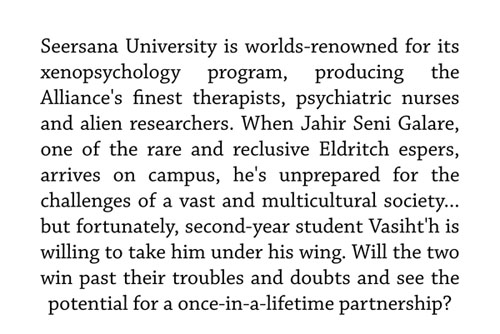
So, some more examples for deconstruction. Here’s Mindtouch‘s:

Mindtouch blurb
Setting: The entire first sentence gives this context.
Character Most Affected: Jahir (who shows up in sentence #2).
Description of Conflict: the second part of the second sentence (“unprepared for… etc.”)
Leading question: “Will the two, etc etc.”
Sentence count: 3

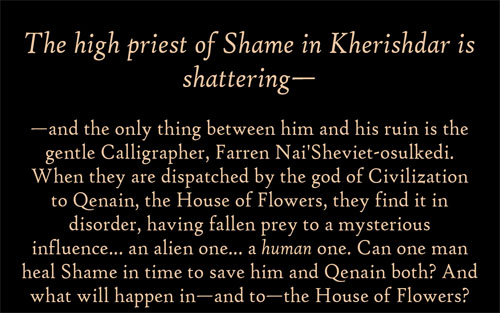
Here was a rough one for me, the Black Blossom blurb:

Black Blossom blurb
Conflict: First sentence!
Character Most Affected (or at least, most prevalent because Narration): “the gentle Calligrapher, etc…”
Setting: The third sentence.
Leading question: The last two sentences.
Sentence count: 4

Now, here’s an interesting exercise. When the sequel to Flight of the Godkin Griffin came out, both Sofawolf (the print publisher) and I wrote blurbs for it without consulting one another. It was a difficult exercise because we’re introducing the final book in a series, which means we have to allude, at least a little, to the first. And we handled it in very different ways! Here’s Sofawolf’s blurb:

Sent to oversee the most recent territorial acquisition in the Godson’s empire, Mistress Commander Angharad finds herself in an unexpected position. Rather than smoothly assuming control from the outgoing governor, she finds herself in opposition to violent factions of the occupying forces, the corrupt governor she is replacing, and unexpectedly even the Godson himself.

No doubt her unplanned adoption as the champion of the conquered province of Shraeven and the chosen vessel of its many native Gods has something to do with her sudden fall from favor.

Certain that Shraeven holds the final key to the empire’s goal of breeding a God of their own, the Godson himself arrives to regain control of the province. Angharad knows that a lasting peace will only come from a diplomatic solution, but with the Godson’s behavior becoming increasingly erratic, she is no longer sure he is capable of reason.

The Godson’s Triumph is the conclusion of the fantasy military adventure started in Flight of the Godkin Griffin, and takes Angharad to the brink of war with her own country on her way to truly understanding the Gods and the empire’s dedication to emulating them.

Meanwhile, here’s the one I wrote:

Mistress Commander Angharad Godkin hates politics… so of course, her ruler the Godson sent her to replace the Governor of barely tamed Shraeven province. She hates religion, so naturally, the native gods began to plague her the moment she arrived. And since she hates both, the gods started playing politics—and the politicians began playing at godhood. In Flight of the Godkin Griffin, Angharad, a creaky old veteran of the Godkindred Kingdom’s many wars of conquest, was dragged out of retirement only to discover her newest assignment—to rule a province in peace—might finally be the death of her. She certainly wasn’t expecting to face off against her own monarch in a battle that will decide not just her own fate, and not just the fate of Shraeven Province… but of the world itself.

The Godson’s Triumph returns us to the world of Angharad Godkin and her comrades and concludes their epic journey. But who will be left standing when the fires burn out?

The last piece of advice Maass gave was to “use one of the following words in your last sentence: love, heart, dream, journey, fortune, destiny.” I don’t follow the letter of this law, but you can see clearly what he’s aiming for with it: you should be pitching a hero’s journey to the reader, a story that really grips your heart. It has, as modern audiences can now say, ALL THE FEELS. If it doesn’t have all the feels, why bother? And if your overall blurb doesn’t operate on that level, it’s not going to connect to as many people as you hope.

So, in short:
1. Keep it short.
2. Keep it punchy—now is not the time to downplay the conflict.
3. Identify the most important conflict and the character grappling with it and put them on center-stage.
4. Give enough setting information that the conflict makes sense/feels urgent.
5. End with a question/invitation to find out more.

I am not the best blurb-writer in the world, but I think I do passably at it, and I enjoy doing it. If you have questions, leave ’em here and we can continue deconstructing the process. Or if you have examples of great blurbs you like, bring them here!

This post first appeared at M. C. A. Hogarth’s blog. The original post can be found here.


Guest post: “Subconscious Themes” by R. A. Meenan

Subconscious Themes

by R. A. Meenan


Let’s start by looking back to the last English class you took… For some of you that’s way back in high school. For some it was a college level class. Some of you might actually be in an English class right now.

Now think of some of the things you did in that class. Chances are, if you analyzed any kind of literature, you looked into the subconscious mind of the author in order to better understand why he or she wrote the literature that they did.

For example, why did Shakespeare write Hamlet? Many people claim it’s because Shakespeare’s own son died young. Or why did Ray Bradbury write Fahrenheit 451? It’s a well known fact that Bradbury feared that technology would take over our way of life and become so ingrained in our culture that we would one day stop learning.

Literature classes often encourage looking into the author’s mind while analyzing their work. But what about our own work?

We often write themes that we didn’t intend. People who read our books or short stories will get things out of the writing that we never thought possible.

When you look a little deeper into it, those themes become obvious. But those are just themes. They are large overlaying elements to a story. They generally take huge chunks out of the story. It’s what the story is “about” if you will.

But what about smaller elements? What about story elements that pop up unexpectedly? How does your subconscious affect your writing?

I learned something about my writing the other day. Let me explain a little.

The other day I was listening to a song that talked about the fantasy of childhood and the reality of adulthood. One line of it really struck home because it spoke about fathers. It said,

“My father said…
Don’t you worry, don’t you worry child,
See heaven’s got a plan for you,
Don’t you worry, don’t you worry now…”

So on and so forth.

I don’t know how many of you know, but my father passed away when I was only 12. My mother, by choice, did not remarry, so I haven’t had much in the way of father figures.

As I daydreamed about the song (I often daydream stories and events from my novels or with my characters while I listen to music) I realized something… None of my major characters have much in the way of father figures either.

Six of my major and important characters without fathers. That’s a lot.

And it got me wondering. Did I do that on purpose? Is my subconscious trying to tell me something? Is this a way for my mind to cope with the fact that my father is dead?

I wasn’t sure, until I took it a step further. Two of those characters above (I’m not saying who) get their fathers back. Is that my mind telling me it wishes my father could come back?

I know I didn’t do that on purpose. My father died a long time ago. I don’t really think about it much, at least on the conscious level. It’s really interesting to see how my subconscious has played a role in my writing. And I know this isn’t the only example of such.

Do you have subconscious themes in your writing? Take a look at your own writing. Look at a novel, a short story, or whatever, and see if you can find your own subconscious working on elements in your story. This could be based on previous experiences, events in your childhood, your preference in writing or reading… all kinds of things.

Good luck!

This post first appeared at R. A. Meenan’s blog. You can see the original post here.


Guest post: “What Can Goodreads Do For Me?” by Huskyteer

What Can Goodreads Do For Me?

by Huskyteer

What it is

Launched in 2007 and acquired by Amazon in 2013, Goodreads is a social network for readers and writers. Like Facebook, but for books. Bookbook, if you will. Users can search for books in the extensive database, for the most part user-created, and add them to their ‘shelves’. If the book you’re after isn’t listed, you can do your part by adding it. There are three default bookshelves, ‘Want to Read’, ‘Currently Reading’, and ‘Read’, but you can add as many custom shelves as you like; ‘Crime’, for example, or ‘Non-fiction’, or perhaps ‘Comfort Reads’ or ‘Really Bad Books’.

It’s strangely satisfying to have a record of what you’ve read, with statistics and word clouds for your shelves. If you feel the need to gameify your reading experience, you can sign up for a challenge like ‘read 50 books in a year’. Every time you log in, Goodreads will tell you how many books you’ve got through and how far behind or ahead of schedule you are. Other bits of fun include literary trivia questions, polls, and daily quotes from writers.

As well as keeping track of what you’ve read, you can follow your friends to see what they’re reading and reviewing, and leave comments. I’ve had many a Goodreads discussion over books I might otherwise never have suspected someone I know had also read.

Looking at your friends’ shelves is one way to find new reading matter, but there are also communities for fans of particular genres, as well as for readers from one particular area or with a common interest. There’s a reasonably active furry community, Furries!, as well as the more general Anthro Fiction group. Goodreads also offers recommendations based on what you’ve read, and lists of the top books in a particular category, which can be as broad as ‘Best Young Adult Books’ or as specific as ‘M/M Cat-Shifters, Feline Aliens, and Other Feline Humanoids’.

When you finish a book, you can add a star rating and a review, tweet the fact that you’ve finished it, and recommend it to friends (Goodreads even suggests friends who might like it, given their tastes). All of this is optional, of course, but if you loved a book, this sort of thing can really benefit the author. Which brings me on to:

Goodreads for writers

Here’s where things get interesting. Once you’re signed up as a Goodreads Author, you have a number of options for promoting your works and interacting with your readership, most of which will cost you nothing but time.

Learn more about your readers and how your books are doing by visiting the page for one of your books. Here you can see who’s read it, who’s marked it as To Read, and any ratings and reviews. Who are those people? What else are they reading? These could be valuable clues to help your marketing strategy. See whether your book is featured on any lists, and what else is on there. Add it to some lists yourself (sneaky!).

Goodreads offers a number of configurable widgets, so you can show off your reviews on your own website, or add a button next to your book so passers-by can add it to their To Read list. They even provide the API if you really want to get down and dirty. And if you don’t mind giving away something for nothing, it doesn’t take much more effort to upload a free sample of your work as an ebook.

Continue reading “Guest post: “What Can Goodreads Do For Me?” by Huskyteer”

Guest post: “The Art of Writing Flash Fiction” by Sarina Dorie

The Art of Writing Flash Fiction

by Sarina Dorie


If a short story falls under a thousand words (1500 words in some markets), it is considered “flash fiction” or “micro fiction.” With a number of new markets out there publishing flash fiction: Penumbra, Daily Science Fiction and Flash Fiction Online being a few among many, it is a plentiful market to send to. Because writing short, succinct stories is a skill I wanted to develop, there is a high demand for flash fiction, and it takes less time to write flash fiction than a long story (in theory), I decided I wanted to take a stab at it. When Daily Science Fiction opened about three years ago, Wordos, my speculative fiction writing critique group in Eugene, Oregon, decided we wanted to dissect flash fiction in order to hone our skills and see what makes a short-short story work. It isn’t surprising that because of our critiques and dissections, quite a few writers from our critique group went on to sell flash to Daily Science Fiction.

What we noticed about these stories is that they were tightly written, limited details, often had an interesting idea, a twist or punch line at the end, and were emotionally powerful or shocking or funny. The format these stories had been written ranged from someone was telling a story to a friend, in the form of a letter or letters in an epistolary fashion, were written like a fable, joke or essay, or used some other unusual writing device to tell a story. Many of these stories weren’t even traditional stories in the sense that there was a character arc, plot or conflict. Still, there was something that happened in each “story” that made it a catchy, edgy or worthwhile. These are just my observations, as well as some that I remember from members of Wordos. My advice to someone genuinely interested in breaking into the flash fiction market is to read and analyze lots of flash fiction and decide what it is about each piece that made the editor choose it.

As a result of studying the market and trying to think in the “short” mindset, I wrote about twenty flash fiction stories in a few months. Some of them I submitted to my critique group and got feedback on, some of them I later turned into slightly longer short stories, and some of them I left unfinished because there wasn’t enough there to create a story—but I didn’t feel guilty about not finishing because they were so short and I considered them experiments. Though I had been submitting stories to magazines for several years, it was my flash fiction stories that first sold. The four pieces I first sold in 2011 were “Zombie Psychology” to Untied Shoelaces of the Mind, “A Ghost’s Guide to Haunting Humans” (which won the Whidbey student choice award), “Losing One’s Appetite” to Daily Science Fiction and “Worse than a Devil” to Crossed Genres. From there, I went on to sell slightly longer short stories as well as more flash. After building up my resume with short stories, I sold my novel, Silent Moon, and then my novella, Dawn of the Morning Star.

Whether it was the short format that enabled me to practice my writing skills more often, or the feedback I got that helped me improve before going on to longer pieces, this process worked well for me. Is your process working for you? Would writing something shorter help you become more succinct in your skills?


Sarina Dorie brings to her writing background experience working as an English teacher in South Korea and Japan, working as a copyeditor and copywriter, and reading countless badly written stories. Sarina’s published novel, Silent Moon, won second place in the Duel on the Delta Contest, second place in the Golden Rose, third place in the Winter Rose Contest and third in the Ignite the Flame Contest. Her unpublished novel Wrath of the Tooth Fairy won first place in the Golden Claddagh and in the Golden Rose contests. She has sold short stories to over thirty magazines and anthologies including Daily Science Fiction, Cosmos, Penumbra, Sword and Laser, Perihelion, Bards and Sages, Neo-Opsis, Flagship, Allasso, New Myths, Untied Shoelaces of the Mind, and Crossed Genres, to name a few.

Her science fiction novella Dawn of the Morningstar is due to be published with Wolfsinger Press next year. Silent Moon is currently available through Soul Mate Publishing and Amazon.

For more story problem remedies, editing tips and short story writing advice, go to Sarina Dorie’s website at: www.sarinadorie.com/writing


Guest post: “Aesop Continues To Inspire” by Carmen K. Welsh, Jr.

Aesop Continues To Inspire

by Carmen K. Welsh, Jr.


Why are we driven to use non-humans in our stories? Why do we create characters based on inanimate objects? Why do we feel the need to personify, or, anthropomorphize ideals and abstractions? Why was I driven to animal cartoons? Why did public TV nature shows become an influence? Why did the struggle between life and death fascinate me as a six-year-old? Why would popular shows such as “Wild America” foster in me the need to tell stories?

My answers came during the formative junior high years, when, isolated from the rest of my classmates for having interests they did not share, and thus, bullied, I found refuge in a collection of Aesop tales in the school library. Yet, the significance of the fables never rang more true than when I spent hours reading the volume each time in my junior high’s library. I was so enthused by these fables on complex human ideas; I immediately created a booklet of my own, penning and illustrating notebook paper before binding the little pages with a stapler.

Now, I was already familiar with the great philosopher of animal fables showcasing human folly. For voracious readers, we will see the same stories pop up, over and over, ‘The Fox and the Grapes’, ‘Dog in the Manger’, ‘Spider to the Fly’, and the ‘Crow who needed to quench his thirst’ as well as ‘The Goose That Laid the Golden Eggs’. There was also ‘The Wolf in Sheep’s Clothing’ and ‘The Shepherd’s Boy and the Wolf’, or what many know as ‘The Boy Who Cried Wolf’. We understand these tales because they tackle moral issues: greed, lust, desire, humility, and arrogance.

Last, but certainly not least, Aesop’s influences continue to surprise me. For several years, I’ve been listening to different East Asian and some South Asian music. Years ago, it was Japanese pop tunes. Nowadays, it’s Korean-pop. While watching a Korean news program, they ended the segment with two music videos. I fell in love with the song called Oops! By G.NA and featuring Ilhoon of BTOB.

Since the news showed the video in the middle and most of the end, my curiosity was piqued and I jumped to YouTube.com to watch it in its entirety.

It is a wonderful song, G.NA is a fun vocalist to listen to, and Ilhoon, the rapper, is fast and furious. While watching the video, I learned from other YouTube commentators that it is the story about a young handsome man who has a silver tiger cat. When he leaves her for the day, the cat crawls under his bed sheets and emerges as a woman (G.NA)!

After luxuriating in her human form, she eventually puts on new clothes and goes clubbing. Her owner is there, and their eyes meet. She sidles up to him, and they touch noses, before she flits home, leaving him dazed and confused.

Once back in the house, she gets back into the nightclothes she first emerged as a human before the owner comes home.

Can’t tell who is more surprised, but, she grins at him like a minx, and he is more than thrilled to find the mysterious girl from the club in his house. The next morning, he’s in bed and his hand is seen stroking the cat.

Wow, this reminds me of an Aesop fable! I thought.

When I shared the video and my comment, one of my Facebook friends sent back that “C, you are special”. But who could blame me? I flipped through my modern edition of Aesop, and found the story I compared to the K-Pop video. It was “Venus and the Cat”!

Another YouTube commentator ‘liked’ my comment and told me she/he enjoyed Aesop fables too. Is it any wonder many of us enjoy anthropomorphic stories? In the act, we create new tales that are updates of ancient myths and weave new lessons for new generations.

In conclusion, I cannot choose a single Aesop favorite, or 10 favorites. I will, however, choose a particular tale that probably has more adaptations and incarnations than many of the other fables, and that is “City Mouse, Country Mouse”, or, originally known as “The Town Mouse and the Country Mouse”. Why this fable? Well, Aesop’s use of animals as symbols appears to have made huge impressions on its readers, or the stories would not have lasted for thousands of years.

A country cousin leaves his rural home to visit his slicker city kin. Mayhem ensues, with the country mouse rushing back to a world that, though no less dangerous, is familiar and makes sense. This appears to run rampant in the amount of ‘fish out of water’ themes prevalent in many films and books. Please do yourself a favor, and read “City Mouse, Country Mouse” in any adaptation. As with this and many other Aesopic tales, you will appreciate its message more with each reading and/or retelling.


Guest post: “Sniffing Out An Agent” by Huskyteer

Sniffing Out An Agent

by Huskyteer


Everyone seems to be a writer, these days, and everywhere – at least, every town in the UK – seems to be having a Literary Festival. The second week in September, it was the turn of Battersea, in South London, and among the many events offered to readers and writers in the area was an ‘Agent-Led Dog Walk’.

Approaching a literary agent can feel intimidating. It’s a relationship that may last the whole of an author’s writing career, so it’s important to get things off to a good start. Yet agents are busy people who may not have time to spare for answering questions while they’re at work, and may not feel like it during their leisure hours. Nobody wants to come across as pushy, or be That Writer who backs an agent into a corner at a party and shoves a manuscript under their nose, but many of us have things we’d like to find out.

The dog walk was a chance to chat with an agent in a less formal environment, while also getting some exercise and having some fun. There’s nothing like a dog for creating an informal atmosphere and a topic of lively conversation. The £5 event fee would go to Battersea Dogs & Cats Home.

As a dogless writer, I’d happily have signed up for a charity dog walk even without the additional carrot (or bone) of chatting with an agent. Besides, perhaps dog-friendly agents would be more receptive than the average to my talking-animal stories? I went along to find out.

The Sunday of the walk turned out to be a beautiful morning, and a couple of dozen literary hopefuls gathered in Battersea Park. We were introduced to the four dogs and their agents, then we split into groups for an hour of walking and talking.

I had checked the agents’ websites beforehand, but none of them stood out as the perfect match for my writing, so I went by dog. My pick was Maisie, who had brought Jo Unwin of the Jo Unwin Literary Agency. She (Maisie) was a medium-sized brown dog with setterish ears who looked like a bundle of high energy fun. Sure enough, I was to spend much of the next hour throwing an increasingly soggy and ruptured tennis ball and remembering every now and then that I probably ought to be networking or something.

Jo very fairly made time to talk to each of us individually, and we also sat down as a group to drink coffee, ask questions and receive advice. I also seized the chance to bestow some scritches on Maisie, who was initially glad of the rest after jumping in and out of the duck pond but quickly grew bored with all this talking.

Some of what we were told was familiar to me from my obsessive reading around the submissions process, but it made a big difference hearing it in person. I might not be able to reproduce that experience, but here’s what we learned:


  • Be professional. Find an agent who works with your genre, and address them by name in your cover letter.
  • Identify what’s unique about your book. Imagine you’re in the pub, talking about a book whose title you can’t quite remember; what’s your book’s “that one with the…”?
  • Sell yourself – but be relevant. List publications, prizes, and any background information that shows you’re especially qualified to write the book you’ve written, but don’t talk about your lifelong dream of being a writer, or how much your kids loved the book.
  • Should you say your book has series potential? That depends if it does; is what you’re planning a true sequel, or are you too lazy to think of a new scenario, or too fond of your characters to let them go?
  • Only submit when you think your manuscript is as good as it can be. It won’t be, but don’t send a draft you know is flawed and expect an agent or editor to leap at the chance of sorting it out for you.


As well as a deeper knowledge of what agents might be looking for, and how they like to be approached, I’ve gained an opening should I ever have a project I feel would be a good fit for Jo (“It was so lovely to meet you on the Battersea dog walk. I was the one who threw the ball for Maisie over and over and over again”). It was also lovely to swap notes with other local writers on works in progress and how far we’d come.

You might not be lucky enough to find a similar event in your own neighbourhood, but if you’re involved in a local arts festival, why not try setting one up? And if you’re a literary agent with a canine friend, consider turning your daily dog walk into an opportunity to help up and coming authors while also publicising your agency. The writers will thank you, and so will your dog.


Guest post: “Common Mistakes Among Writers” by Sarina Dorie

Common Mistakes Among Writers

by Sarina Dorie


When we go to a job interview, we wear our best suit, come with a list of references, and might even remember to put on deodorant. At least, we do if we want the job. When we format a manuscript, self-edit a novel, or polish a book before sending it off to an agent or editor, we strive to present it as though we are professional writers who know what we are doing. At least, we do if we want to be published. Whether a seasoned writer, or someone just starting out in the writing process, there are weaknesses we don’t always recognize in our skills. We get into ruts with grammar, formatting or stylistic “rules” we learned early on in high school writing classes that are bad practices in professional writing. Learn the common mistakes so you can recognize when you make these in your writing so you can avoid them.


Five Common Mistakes

  1. The manuscript isn’t in manuscript format

Short stories have a particular format and novels have different requirements. Additionally, some publishers have very specific variations from the standards that a submitter must be aware of. The number one cause listed on editor, agent and magazine websites for writing to be rejected is not reading the guidelines.

2. Grammar errors and inconsistencies

Sometimes a simple spell check will suffice. Other times, one needs to look up rules that are unfamiliar. Some rules of grammar are meant to be broken, but it is important to start with foundational knowledge and break a rule consistently if one chooses to do so. Classes, critique groups, peers and beta readers can help.

3. The mechanics of the story are broken

Sentence structure is unvaried, past and present tense rules are not consistently followed, or there are various typos not covered under grammatical errors that make the manuscript a chore to read. It is common to find long sections of dialogue without dialogue tags, setting information lumped together, chunks of unbroken interior monologue or sensory information in one section, and long expanses of exposition in others. The story might be all, or large sections of, telling.

4. The story itself is broken

The premise is unbelievable, the idea is trite or overdone, or the plot has no story arc. Maybe the characters are so unsympathetic the reader can’t get into the story or the writer has gotten a vital piece of information wrong that affects the story. This can be pretty important if an author is writing a paranormal romance with werewolves and the characters and plot don’t reflect accurate, wolf-like traits.

5. The story is boring

This usually means it lacks conflict. It might also be because there is no hook in the beginning, or it could be because the reader doesn’t understand or care about the characters’ motivations, feelings or situation. The reader needs to be emotionally invested. Sure, it might just be because the reader isn’t the author’s target market, but even romance readers can be persuaded to read a mystery if they care about the characters or a mystery reader can read a romance if they are invested in the plot.


Sarina Dorie brings to her writing background experience working as an English teacher in South Korea and Japan, working as a copyeditor and copywriter, and reading countless badly written stories. Sarina’s published novel, Silent Moon, won second place in the Duel on the Delta Contest, second place in the Golden Rose, third place in the Winter Rose Contest and third in the Ignite the Flame Contest. Her unpublished novel Wrath of the Tooth Fairy won first place in the Golden Claddagh and in the Golden Rose contests. She has sold short stories to over thirty magazines and anthologies including Fantasy and Science Fiction Magazine, Daily Science Fiction, Cosmos, Penumbra, Sword and Laser, Perihelion, Bards and Sages, Neo-Opsis, Flagship, Allasso, New Myths, Untied Shoelaces of the Mind, and Crossed Genres, to name a few.

Silent Moon is currently available as an ebook through Amazon and will be released in print next month.

For more story problems remedies, editing tips and short story writing advice, go to Sarina Dorie’s website at: www.sarinadorie.com/writing

Guest post: “Anthropomorphic Diversity” by Lauren Rivers

Anthropomorphic Diversity

by Lauren Rivers


When writing anthropomorphic fiction, one of the major elements is determining the species and the variety of your cast members. One of your first decisions is should they all be of the same race. While it may be to your fancy to have an entire cast of foxes, the positive side to this is that you can delve into the variations of the species. You can discuss the habits of different types of foxes such as fennecs versus the red fox, as well as highlight cultural differences much in the way that science fiction does with aliens and racial situations. An example would be a story where fennec foxes are considered exotic and used for slave labor, or a case where arctic foxes are racially profiled and perhaps have a unique ability the others do not, such as the creation and manipulation of ice. This also comes with a downside for people that don’t like how foxes tend to be overused within the fandom.  They could be turned off by the fact that your characters are all variants of the same species. Additionally, one should consider that in a situation where the entire cast ‘looks the same’ from a general perspective, individual characters may have a harder time standing out.

Another possibility is centaurs or any characters with a humanoid torso and animal lower half. The positive side to this addition is that you can more or less make up your own rules as to the species and what they are like. For one, they are capable of more physical action than most normal anthropomorphic characters, though most of the issues with centaurian species are logistical. If you include centaurs, then cars, furniture, group travel, everything must be modified for the existence of centaurs. Adding an extra two feet to some of your characters can slow you down if you do not have a plan in mind for your four-footed cast members.

Let’s not forget about humans themselves. The plus side to the involvement of humans in furry stories is that non-furries may enjoy the story simply for its own merits. Humans are easiest for people outside of the fandom to understand, and logically so. If you want your story to be more broadly accepted, consider a partly human cast. Be wary of using the humans only on the side of evil though, as the ‘evil humans versus good anthropomorphic characters’ plot line is a frequent staple in furry fiction. It may be seen as ‘one of those stories’ in the same way that comas on soap operas are often not taken seriously.

Finally, a species-diverse cast is yet another option. If you have every cast member a different species, or at least no more than two of any one type, you maximize the chances that every reader will find at least one species they enjoy. Additionally, it gives you more variety in descriptions. For example, if there is only one bovine character in your story, they will be easily recalled and will more quickly establish themselves in the reader’s mind. The pitfall with this approach is that you may have more characters than you can handle, if you attempt to fit too many species into your zoological odyssey.

As a writer, you clearly have many choices for how to populate your world. The choice is of course, up to you. However, bear in mind that you must know what kind of story you want to tell before you begin the casting process. Being aware of this will often do most of the work for you. Think of the characteristics each type of anthropomorphic being will add to your story and then decide if they’re the right one for you. If you’ve done your planning properly, it should seem as if most of the decisions have been made all by themselves.