Member Spotlight: T. S. McNally

1. Tell us about your most recent project (written or published). What inspired it?
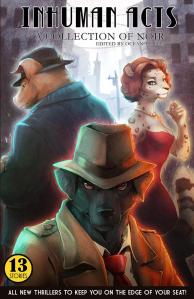
By the time this is released, the most recent published work will be “Vermin’s Vice”, a short story in the anthology Inhuman Acts: A Collection of Furry Noir, released at Rainfurrest this year.

I’ve always felt that noir is supposed to show the shadows of life to the reader, and I’ve also felt that a lot of times those that put up a show of prosperity tend to use those material things to either hide or distract themselves from the fact that we are, at heart, animals.

So my wish was to show that the seedy elements of society, while seedy, are probably just more honest than those we consider more wholesome, who tend to see external expressions of base desires as undesirable. But in the end, those desires are still there, waiting to be unlocked.

Also having a hand in part of the main anthology’s final name was pretty cool. It was a challenge to think of a word that would project something furry, while sounding more grim and not so fluffy. I only got half of the final answer as my suggestion for the title was “Inhuman Avenue” based on other noir titles with street names. I do like the current title better, both the word inhuman and acts hold double meanings. Basically it could be read as “Furry (inhuman) Stories (acts)”, but it has that dark edge to it.

2. What’s your writing process like? Are you a “pantser,” an outliner, or something in between?

Oddly I’ve done both from time to time. However, the thing that seems to be consistent with me is that I know how I am going to start a story, and the ending I want to see happen. Usually those details are outlined. It is the in-between parts that are more fluid.

I may outline scene orders, but not too much more than that.

3. What’s your favorite kind of story to write?

The genre I seem to write the most is Action/Adventure type. I’ve been bleeding into narrative based social commentary here and there. Usually the later ends up better when an event triggers the need for it.

For instance, Travis McCuddy’s suicide inspired, I feel, one of my better of these types: “Passing with Failure”. In it a computer reinterprets the Turing Test in a most disturbing way based on how the life story surrounding Mr. Turing himself. As a warning though, it’s not a furry piece.

It is tough to write good social commentary pieces without being too preachy, and when it happens it can be quite stirring. So I consider doing them when I feel like particularly challenging myself.

4. Which character from your work do you most identify with, and why?

I don’t quite identify with any in particular. Usually most characters I create are exaggerations of particular characteristics that I am capable of. All in all though, I tend to be a bit boring, as watching a man type on a screen doesn’t make for entertaining narrative in its own right.

Unless you have a psycho fan holding you captive and pressuring you to via Misery of course.

5. Which authors or books have most influenced your work?

Stories happen all around, and I feel it’s important not to try and get too caught up with trying to emulate specific items. However, we were all young once and for some odd reason I was a Sonic fan. I liked the Saturday AM arc in particular and I created fan fiction based on it, so I think the late Ben Hurst could be seen as a major influence.

Exaggerated and colorful character development I always feels are great ways to hold stories together, and that is something those old Sonic cartoons did very well (barring the throw away half-episodes). It also holds true to many furry fiction, and the creatures we use help solidify this. It is also why I am stronger at character development than at setting development.

6. What’s the last book you read that you really loved?

In a recent podcast of Fangs and Fonts I noted that I haven’t been a reader of books as much as I should be. I read articles, blogs, and such, but fictional novels have been few and far between. I also have a tendency of to not gush too much over things and works an always looking with a bit of a critical eye toward them. I find that’s what makes me more creator than consumer.

I do have one thing going for me, and that’s retention. I can remember details about things long after they have passed.

That being said the last story I loved that I read was Fredrick Douglas’s autobiography An American Slave as Written by Himself. My favorite thing about this story was how you could see he had to hold back a raging peeve he had that occurred throughout his life when the institutions of Christianity were used to preach the justification of slavery. The bittered passion Douglas felt over this, you could feel rising up, but him having to hold it back to keep himself distracting from the narrative. You come to find the reason he felt so strongly over that is, as a man of God himself, it tore him up to see the very beauty of his religion being used as a tool to cage black people.

At the end he added an epilogue where he finally lets all that emotion go.

I feel those furs within the minority who identify as Christian (or gays who do so as well) will find echoes of themselves in there. It’s amazing that as much as things seem to change, how constant certain things really are. And thus, the story, while over 100 years old, is still very relevant to this day.

7. Besides writing, how do you like to spend your free time?

If I really have not much else to do, I will read some news articles here and there. I don’t game as much as I used to, I seem to find that my job keeps my mind stimulated and engaged to the point where I don’t feel I need to escape to feel influential or important as I one did. I’m in a rare position of feeling empowered and essential in my workplace, and ironically I’m applying many lessons I learned in my virtual tenures of leadership to my real world ones.

Other than that I’m also working on non-fiction items. There are the Flayrah articles, but that’s technically technical writing. However I also want to share some of the lessons and problems I’ve solved in my spare times that I feel will help individuals and society as a whole. I plan on calling it “The World in Rooview”. The pilot will be about sometime in the future, or it could be one of those projects I start and never fulfill.

8. Advice for other writers?

If there is a universal trait about humanity it is this: We are a creature of narrative. All conflict can be drawn to simply a competing of narrative. We all want to write our own stories and have endings we want to see.

Conflict or “drama” is what arises when two endings cannot exist in the same narrative desires of two groups/individuals.

9. Where can readers find your work?

I have a Goodreads profile here: https://www.goodreads.com/author/show/8578080.T_S_McNally

I have free stuff up on SoFurry here: https://www.sofurry.com/browse/user/stories?uid=164657

I would advise against buying my novel of Light right now. I plan on releasing a new version with “bug fixes” later in the year and will be doing a promotion at that time.

10. What’s your favorite thing about the furry fandom?

Above all else, our perseverance. We deal with a lot of garbage from others in this world. And when Nuka released his statistics on furries and their history with bullying, it shows we seem to have always had to in some shape or form.
Many have taken this bitterness of others and allow it to fester within them, consuming them to the point where they themselves become bitter. Many have done so, and continue to do so. As we hear stories about needless violence, death threats from the shadows, we see the negative sides of anonymity.
However, in opposition to that stands this fandom, ones who use anonymity not to spread fear, anger, or disgust. Instead we try to spread happiness, joy, and creativity.
My hope, if anything, is that is a foundation that will not change.


Check out T. S. McNally’s member bio here!

Member Spotlight: Ocean Tigrox

1. Tell us about your most recent project (written or published). What inspired it?InhumanActsCover

The project I’m most excited for is Inhuman Acts which is an anthology of anthropomorphic noir stories set to be published by FurPlanet and released at Rainfurrest 2015. Anthropomorphic literature has an interesting ability to spin any genre, and I wanted to see a variety of different noir stories seeing how they change when you add animals to the mix. Noir and mystery are some of my favourite genres so I’m happy to bring some of that love into this project. It’s been a big challenge to step up and be a lead editor, but it’s been a lot of fun too.

2. What’s your writing process like? Are you a “pantser,” an outliner, or something in between?

I used to be a heavy outliner but would find myself bogged down on trying to figure out the story and never sitting down to write it. Now I like to start with a central concept, a main conflict, or a twist and go from there. From the initial idea, I set up some characters, point them towards some plot points and a goal or a climax, then let them fill in the rest. I still like the loose structure of knowing where the story is going, but by allowing the characters to lead me there, the story becomes more organic and real. Sometimes they get to the end I set for them and they replace it with something better!

3. What’s your favorite kind of story to write?

A story filled with twists and mysteries. I love creating interesting and smart characters, tossing them in dangerous situations or traps, and watching them find a way out. When a reader comes back and tells that an ending took them by surprise, it always puts a grin on my face.

4. Which character from your work do you most identify with, and why?

There’s a story I’ve written that I’m trying to publish about two teens in small town Saskatchewan. It’s really a love letter to what it was like growing up in such a small rural community and the two main characters are a reflection of my experiences and thoughts. There’s something about such a small community and a simpler life that creates a world view most people don’t see and you appreciate the small things in life.

5. Which authors or books have most influenced your work?

One book that changed my outlook on literature was Douglas Adams’s Hitchhiker’s Guide to the Galaxy. Most sci-fi I had read up to that point came from Arthur C. Clarke and others, and when I was looking for a book for a grade twelve book report, I stumbled upon Hitchhiker’s Guide. Here was a book that took everything I knew about stories and literature and turned it on its head. A ridiculous tale of world building and hilarity while still telling a fantastic story. It showed me that there’s no real rules to writing and you shouldn’t be afraid to try new things.

6. What’s the last book you read that you really loved?

In preparation for editing Inhuman Acts, I brushed up on some classic noir titles. One of them was The Maltese Falcon. It was great to see the foundation of a lot of hardboiled crime and noir elements before they were even tropes. I’m still a sucker for reading the classics and you’ll often find there’s more than one crowding up my reading pile.

7. Besides writing, how do you like to spend your free time?

TigroxDeskI enjoy playing games of all types: video games, board games, table top RPGS, card games (I’m even a level one Magic judge), and even just any kind of puzzle I can get my paws on. There’s usually a pair of headphones or ear buds near me at any time so I can listen to my music. I’ve also taken up poi spinning to dance along with my music. When the weather’s nice (AKA not winter), I like to take my motorcycle out to the mountains to go soak in the hot springs.

8. Advice for other writers?

“Write now! Edit later!” is my writing mantra. It’s something I often have to chant it to myself over and over while writing up a first draft. Otherwise I’ll want to go back and edit what I’ve written and worry too much about if it’s right when the story isn’t even written yet. I’ve seen too many beginning writers get stuck in this editing loop, worried if their first chapter or first scene is good enough before they’ve even written more. Finish writing the story first! There’s always time for editing later and you’ll have the accomplishment of having written a full first draft.

9. Where can readers find your work?

Check out Inhuman Acts when it’s released and let me know if you liked it! While at the FurPlanet table, you can find my stories in some anthologies like Roar 6, The Furry Future, and the latest Rainfurrest charity anthologies. I also have a story in Rabbit Valley’s Pulp! and occasionally I post stories on my SoFurry account: ocean.sofurry.com. You can listen in on the bi-weekly writing podcast I co-host called Fangs and Fonts (fangsandfonts.com). It’s put on by myself and my local furry writing group. We talk about writing techniques and the writing culture in the fandom.

10. What’s your favorite thing about the furry fandom?

The fact that you can be whoever you want to be in this fandom. The furry fandom is very open and friendly, and it’s great to see so many people get along without caring about gender, race or sexual orientation. You wanna be a purple tiger fox or a orange elephant or a green wolf? Cool! I hope it continues to be a place where people can be themselves and happy with who they are.


Check out Ocean Tigrox’s member bio here!

Member Spotlight: Kevin “Rikoshi” Frane

1. Tell us about your most recent project (written or published). What inspired it?

My latest project is a new novel that I’m working on called Stargazer, the sequel to my 2013 novel Summerhill. In the course of writing Summerhill, the nature of the setting kept expanding and growing more complicated, and I realized I’d need more than one book to fully explore it. This time around, I’ve flipped the dynamic a bit: this is the story of Katherine, one of Summerhill’s traveling companions from the first book, and now he’s her sidekick, which will hopefully let me tell a fun story that’s sufficiently different to its predecessor. I’m posting the first draft to Patreon (for free!) as I’m writing it, too, so readers can follow along as the story takes shape.

2. What’s your writing process like? Are you a “pantser,” an outliner, or something in between?

For me, it depends on whether I’m working on a novel or a short story. For novels, I tend to have a central theme and central conflict in mind, I start writing a first draft, and about halfway through I stop to outline the rest (and after I complete that draft I look at the whole thing and re-outline it so that it makes better sense). When it comes to short stories, usually those ideas are simple and self-contained enough that I can just hop onto the page, play around with them, and see where they go (which sometimes winds up being ‘nowhere,’ but that’s thankfully pretty rare!).

3. What’s your favorite kind of story to write?

I suppose I’m quite fond of writing stories where I really get into someone’s head, for better of for worse, and show the reader what makes them tick. Even the nicest person you know has issues they’re dealing with and sometimes thinks nasty thoughts about certain things, and even a complete jerk can be relatable or sympathetic on some level, and so I think it’s fun to explore that sort of thing, and to leave the reader with some thoughtful insights. That, and I like to use fantastical backdrops to explore otherwise mundane, everyday issues, because then you’re giving the reader something fun and different while also giving them something they can personally relate to.

4. Which character from your work do you most identify with, and why?

This is a tough one! If I had to pick one, though, I’d probably have to say Arkady Ryswife from my novel The Seventh Chakra — not because I’m an artificially augmented super-spy ferret, but because his entire core conflict is doubting his own capabilities and putting too much pressure on himself for fear of letting down others, and those are both things I can personally identify with a whole lot.

5. Which authors or books have most influenced your work?

I drew a lot of inspiration early on from the works of David Weber, particularly his Honor Harrington series, when it came to laying out large, convoluted plots and interweaving setting and story without having to resort to info-dumping on the reader. Nowadays my style doesn’t really resemble his at all, but I learned a lot about long form structure and plotting from those books. Kazuo Ishiguro’s wonderful novel The Remains of the Day was a great example of how feature an unreliable narrator in addition to showing how a slow and subtle buildup can still reach a devastating conclusion, and David Mitchell’s Cloud Atlas was just monumentally inspirational for how diverse one single author’s writing can be within a single work.

6. What’s the last book you read that you really loved?

David Mitchell again, with The Bone Clocks. It’s a masterful look at an individual’s life from so many different perspectives, and a story that goes from banal to surreal in a way that’s hard not to be impressed by.

7. Besides writing, how do you like to spend your free time?

My big hobbies include tabletop roleplaying, amateur photography, wine, and Star Wars (honestly a lot of my time goes to Star Wars in some form or another).

8. Advice for other writers?

Read. Read, read, read. Read things that you like, read things that are outside your normal area from time to time, read things by your peers and by people who inspire you, but read. It’s such a fundamental part of being a good writer that it can often be too obvious, and it’s something I see get ignored all too often. You can’t be a good concert pianist if you don’t listen to music, and you can’t be a good writer if you don’t read stories. So read. Read short stories twice; you’d be amazed how much different the experience can be, even if it’s only been a day. Learn to identify what you like and what you don’t like, and then try to discern why you do and don’t like those things.

9. Where can readers find your work?

My novels are all available on Amazon if you search for me by my people-name, and of course directly from the furry publishers themselves: FurPlanet and Sofawolf Press. My short stories are available on FurAffinity, where my username is ‘Rikoshi,’ and I’ve had stories published in numerous anthologies, such as New Fables from Sofawolf Press and ROAR from FurPlanet.

10. What’s your favorite thing about the furry fandom?

Honestly, just the sheer amount of creativity that this fandom has bundled up in with itself, and I think it’s important for people to not lose that spark of imagination. We’re not all writers or artists, but we’re all here because we’ve got a fantastic propensity for make-believe and suspension of disbelief; sometimes it’s serious, sometimes it’s silly, but it takes all kinds and I’ve never come back from a convention not feeling energized to write something, whether it was a larger project or just some quick thing.

Check out Kevin “Rikoshi” Frane’s member bio here!

Member Spotlight: Tempe “Tempo” O’Kun

1. Tell us about your most recent project (written or published). What inspired it?

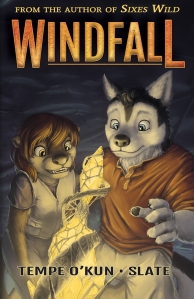
windfall coverWindfall – debuted at Anthrocon 2015

It’s a cosmic-horror romantic-comedy starring an otter named Kylie who’s fallen in love with her best friend, a husky named Max. The two of them used to be minor characters on a supernatural cable TV show. After the series ends, he comes to visit for the summer and she has find a way to confess her feelings to him as they discover their TV show was actually real.

Previews:
https://www.furaffinity.net/view/10973174/
https://www.furaffinity.net/view/12950193/
https://www.furaffinity.net/view/12278672/
https://www.furaffinity.net/view/14827336/
https://www.furaffinity.net/view/14467401/

I also have Nordguard: Tribes of the White Land that came out at Anthrocon 2015. It’s an expansion to the Nordguard card game, with all-new art from Blotch and Chromamancer. A very different means of telling stories, but it certainly helps to have a writing background.

I’m also working on an interactive children’s sci-fi novel called Allison & The Cool New Spaceship Body to teach kids about transhumanism and artificial intelligence. Working on it with me are world-class interactive fiction experts from Ball State University and Gamebooks.org, as well as actual AI scientists from the Machine Intelligence Research Institute. It also has talking space dolphins who fly around with jet-packs!

You can play through the book-in-progress here:
https://www.furaffinity.net/view/16159961/

2. What’s your writing process like? Are you a “pantser,” an outliner, or something in between?

Somewhere in between, I suspect. I toss ideas into “pool” files in Scrivener as they come to me. Sooner or later, enough ideas coalesce to make a plot I can’t resist writing. I use that to develop my outline, then make successive passes at expanding it until it turns into a story. Often I write all the dialog first, much to the despair of my editors.

3. What’s your favorite kind of story to write?

One with a kooky central idea — some bit of trivia or motif that clicks into place with a plot. Love stories are also a plus, since I’m a total sap.

4. Which character from your work do you most identify with, and why?

Each of my characters has a shard of my personality. In Sixes Wild, Blake has my tendency to be a square while Six has my defiant side. We all constructed of contradiction.

5. Which authors or books have most influenced your work?

James Gurney’s Dinotopia has been the biggest influence on my personal philosophy. I’m a big believer in the power of peaceful cooperation, science, and art to improve the world. This optimism pervades my stories.

6. What’s the last book you read that you really loved?

I’m hooked on Steven Brust’s Vlad series (which feature a sorcerer assassin chef). Technically, the most recent book I read that I’m excited about was the new Dungeons & Dragons 5th Edition Players Handbook. : ) D&D is actually a really cool way to practice storytelling—you get immediate feedback. I’ve used tabletop RPGs before to test out worlds I later write about.

7. Besides writing, how do you like to spend your free time?

I teach writing classes at Bismarck State College — my fursona was the instructor of the semester there last winter. I have skied the longest run in North America. I also enjoy when friends or my girlfriend take me for walks.

8. Advice for other writers?

Write the story you’d want to read. Your enjoyment will show through in the final product.

9. Where can readers find your work?

https://www.furaffinity.net/user/tempo321/
https://tempo.sofurry.com/
https://www.weasyl.com/~Tempo

My published works are available from Sofawolf Press and Furplanet Press, as well as on Amazon.

Heat #7https://www.sofawolf.com/products/heat-7
Heat #8https://www.sofawolf.com/products/heat-8
Heat #9https://www.sofawolf.com/products/heat-9
Heat #10https://www.sofawolf.com/products/heat-10
Heat #11https://www.sofawolf.com/products/heat-11
Heat #12https://www.sofawolf.com/products/heat-12
Sixes Wild: Manifest Destinyhttps://www.sofawolf.com/products/sixes-wild-manifest-destiny
Nordguard: The Card Gamehttps://www.sofawolf.com/products/nordguard-card-game
Nordguard: Tribes of the White Landhttps://www.sofawolf.com/products/nordguard-card-game
Windfallhttp://furplanet.com/shop/item.aspx?itemid=798

10. What’s your favorite thing about the furry fandom?

How it brings people together. In the furry fandom, it doesn’t matter where you’re from or what you look like — what matters is your talent, enthusiasm, and good cheer. In the past month, I’ve been interviewed by furry journalists from Canada, Brazil, South Africa, and Mexico. World peace looks a lot like the furry fandom.

Check out Tempe “Tempo” O’Kun’s member bio here!

Member Spotlight: Mars

1. Tell us about your most recent project (written or published). What inspired it?

I can’t go into too much detail about my most recent project, as it’s in the midst of being published and I don’t want to say something I shouldn’t! What I can say is that it is the first adult piece I’ve ever written, and thus coincidentally the first adult piece of mine to ever see publication. The piece wasn’t necessarily inspired by any one thing, it started off as a personal exercise — trying something new and seeing what I could do with it — and evolved from there.

2. What’s your writing process like? Are you a “pantser,” an outliner, or something in between?

I generally don’t have a specific writing process, so I’d say I’m mostly an in-betweener. If I am specifically writing for an anthology or a certain theme, my process would more reflect an outliner, whereas if I’m writing a story I was personally inspired to write, I more or less build the story as I go. It may not be the most efficient, but it’s what works for me!

3. What’s your favorite kind of story to write?

It’s hard to say with the (what I consider) limited experience I’ve had, but as of now I definitely have enjoyed writing sci-fi the most. It’s also the genre I want to explore more, and rightfully so considering how unpolished I’ve felt my previous work in that genre has been.

4. Which character from your work do you most identify with, and why?

The work itself is long gone from the public eye, as it hasn’t met my standards I set for myself in a long time. But, I most identify with the character Garrett from one of my older pieces since taken down from FurAffinity. He was very much an amalgam of my own life experiences with a healthy dose of fantasy mixed in. Some of his struggles were things I dealt with, and some were inspired by things I’ve dealt with.

5. Which authors or books have most influenced your work?

Outside the fandom, the work of Philip Pullman and his His Dark Materials series was one of the earliest works I can recall that drew me into the concept of anthropomorphic characters. Within the fandom, the work of Kyell Gold was what showed me what could be done with adult scenes in a story, and how they could matter to the plot. Some other books (in no particular order) that have influenced me were: The Society of S by Susan Hubbard, Blasphemy by Douglas Preston, and Roadside Picnic by Arkady and Boris Strugatsky.

6. What’s the last book you read that you really loved?

I’m currently in the process of reading John Dies at the End by David Wong, which is a really refreshing read for me. Horror is something I generally don’t read (thought that’s starting to change!) so something so incredibly odd is an incredible departure from what I typically read.

7. Besides writing, how do you like to spend your free time?

These days, my time is mainly occupied with school. When I do have free time, it’s either occupied relaxing with video games or squeezing in some writing. I’ve also recently developed an interest in origami!

8. Advice for other writers?

It might not mesh well with what other writers will suggest, but my personal opinion is be willing to NOT write. The worst thing to ever happen to my writing was when I forced myself to write a story I didn’t want to write. Don’t get caught up in the idea that you MUST write for x amount of anthologies, or write x amount of stories. Write what you want, not what you must. I tried the whole “I’ll write for this anthology and that one and this one and this one too!” spiel, and it got old, quick — and in the end none of those stories got accepted. My heart wasn’t in the words, and they ended up poor quality. So that’s my advice, don’t force yourself to write a story you don’t want to.

9. Where can readers find your work?

At the moment, you can find my story “Sugar Pill” published in Tales From The Guild, Music to Your Ears, published by Rabbit Valley and edited by AnthroAquatic. As I said, I also have a story being published that I can’t get into too much detail about at the moment, but I’ll be sure to make an announcement when I can!

10. What’s your favorite thing about the furry fandom?

My favorite thing has been what it has done for me, honestly. Were it not for certain people in the fandom, I would not be where I am in life or anywhere near the life I live now. And honestly, I don’t know if my life would be nearly as enjoyable if that were the case.


Check out Mars’ member bio here!

Member Spotlight: Slip-Wolf

1. Tell us about your most recent project (written or published). What inspired it?

I just finished final edits on “Unfading”, which will be in Heat issue 12 coming out at Anthrocon in early July. It’s about a wolf who discovers she’s a different creature on the inside, and begins an arduous physical and mental transition to becoming who she feels — or rather knows — she really is.

While imagining we’re something or someone else is part of every furry’s life in a way, the idea first grew out a private joke I had with myself in which I’d mulled over changing my fursona. I figured rather than just pick another species and twiddle with my name I’d actually get pretend plastic surgery, do an in-between icon that was just a head wrapped in bandages, and tweet in mumbles for a week. While that never happened, I did wonder about the kind of calamity one would have to go through changing species, the surgical stuff, the hormones, the diet. This then elevated to matters of the heart and mind, how one would evolve in the process of adapting to their new selves, how their family would react and how the outer world would see them in their struggle.

The story just evolved from there into a metaphorical look at the plight of transgendered individuals, dealing with obstacles most of us will never face, namely a world that actively resists the person who they know they are. In exploring some of these questions, I found “Unfading” a very satisfying story to write.

2. What’s your writing process like? Are you a “pantser,” an outliner, or something in between?

Something in between. I do like general outlines to give me a sense of direction, but halfway through writing I’ll break away from them as often as I’ll stay the course. Whatever keeps me going without stopping.

3. What’s your favorite kind of story to write?

I try switching it up as often as I can because I get bored of trying the same things. I really love sci-fi and horror as genres, but have messed around with fantasy, mystery and a little bit of satire. The last one is the hardest to do I think.

4. Which character from your work do you most identify with, and why?

I’d have trouble picking just one character, as I try to identify in some way with everybody who gets a voice, the villainous jerks no less than the heroes or every-furs. I find right now it’s a tie between Amar from the story above, who represents the need in all of us to be the person we know we can be and a character from an upcoming tale named Earlan, an eager, enthusiastic explorer in a novella-length piece set to come out in an anthology later this year. He’s seeking to understand his place in the universe and test the boundaries he feels foisted upon him. Can’t say much about that story yet.

5. Which authors or books have most influenced your work?

There are too many to count, really. When I was younger I devoured Stephen King as a horror buff, fantasies and sci-fi’s by Larry Niven, David Gerrold, Arthur C. Clarke, Allan Dean Foster (who introduced to me literary furry with Spellsinger), read classic fantasy from the Narnia novels of C.S. Lewis to the Homeric myths, snacked on Hardy boys, Sherlock Holmes, Phillip Marlowe mysteries and Star Trek novels. Lately I’ve been going to the well of classic twentieth-century authors to learn their tricks and get the feel for different eras. I try really hard to learn little bits reading everything, fiction or fact, in and out of this fandom.

6. What’s the last book you read that you really loved?

I just finished a non-furry classic book with an unintentionally furry name, Rabbit Run by John Updike, another famous author whose work I have just gotten around to. It’s a testament to his prowess as a writer that he can thoroughly engage you with a main character who is an insufferable bastard on so many levels. I wish I could write with such skill, compelling readers to take interest in characters and situations who we can barely stand or see ourselves identifying with, but stick with because their experiences are made so compelling.

7. Besides writing, how do you like to spend your free time?

I love writing as a form of recreation itself, but I also collect records and movies, watching films at the drive-in where I grew up and visiting the gym often for runs or weightlifting. More than anything though, I love reading. I shrivel and die if I go too long without a good book.

8. Advice for other writers?

Don’t be afraid to fail. Be terrified to discover you never tried. Also, listen to your beta readers. The worst thing they can give you is exactly what you want — cold hard honesty. Criticism from betas and your editors will toughen you up for when people are paying for your work and have every obligation to point out where a story is weak, so cherish that.

9. Where can readers find your work?

I’ve got stories in Heat issues 11 and 12, Trick or Treat Volume 2, Roar Volume 6 and Fang Volume 6 (all of which should be out by Anthrocon in July). There are several more anthologies coming out in the next year or so that I will also be featured in but dates aren’t set.

10. What’s your favorite thing about the furry fandom?

It’s a hub of pure creativity with no discernible limits or end game, a place for really friendly people who I keep getting to meet and a great way to get in touch with the ‘other’ inside one’s self. There’s something about being furry that can make us warmer, more open, accepting human beings, and I love that about it.


Check out Slip-Wolf’s member bio here!

Member Spotlight: M. C. A. Hogarth

1. Tell us about your most recent project (written or published). What inspired it?

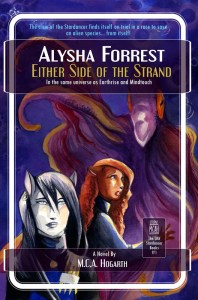
mcah cover alyshaMy most recent book just went up in May! Either Side of the Strand is the first book in a series I’ve been planning for a long time about the career of Fleet captain Alysha Forrest, who has previously appeared in short fiction for years now (one of those stories, “In the Line of Duty,” won an Ursa Major, even). I’m very excited to get Alysha’s first full-length novel out there. It’s a space adventure, and my homage to Star Trek: The Original Series, with its slightly campy but high-minded stories. Also it’s got space octopuses in it, and all the characters are female, so it’s sort of like a pajama party with military uniforms and aliens.

2. What’s your writing process like? Are you a “pantser,” an outliner, or something in between?

For the most part, I’m a pantser. I know the beginning. I know the ending (hazily). I know one or two scenes in the middle. All the rest of it is gelatinous, and I write to find out what’s next. I like that; it keeps me interested! When I write serials, I am often as curious as my readers about what’s about to happen! I post an installment, and everyone comments, “Wow, I wonder–” And I am sitting there at the keyboard, thinking, “Oh my gosh, I do too!” *laugh*

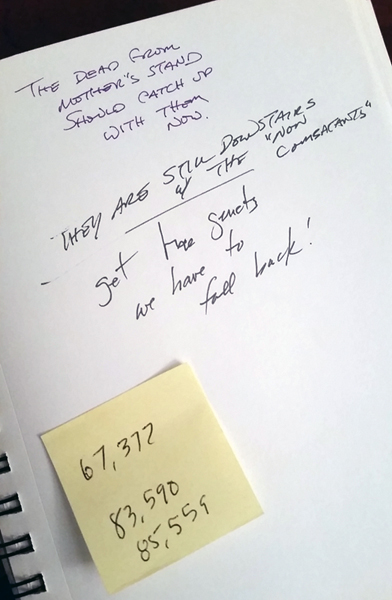
Sometimes, though, my subconscious coughs up 3-4 scenes in a row, and then I obediently jot down a quick flowchart-like thing. This almost inevitably happens in the car. It usually looks something like this:

mcah jottednotes

(Notes are from forthcoming epic fantasy trilogy. Post it is tracking daily word count changes.) I don’t recommend this style of note-taking, no matter how long the lights take to change. Also, please don’t try to analyze my handwriting based on my car scribble. >.>

3. What’s your favorite kind of story to write?

A long time ago, Watts Martin — who is one of fandom’s best writers, I think — said that most of my work revolves around epiphany. He said this to me, mind you, when I was all of 18 or 19 years old? That was… ah, longer ago than I like to think of, but I still think he’s right. No matter what I’m writing, there’s a psychological aspect to everything: people coming to better understandings of themselves, or learning that one thing that galvanizes them to make life changes or momentous choices. It doesn’t matter to me whether that choice is small in the great scheme of things–like Vasiht’h’s choice of major in college in Mindtouch — or enormous, like Asrial’s decision to help stop the literal Apocalypse in A Rosary of Stones and Thorns. What matters to me is how people grow, and how they come to that place where they are vulnerable to life, and feel safe enough in that vulnerability, to be open to change.

4. Which character from your work do you most identify with, and why?

All of them? I give them all a little, vital piece of me, and let them grow around that piece the way a pearl begins with a grain of sand — and a lot of irritation.

It seems to work that way in real life too. The good and polished parts are born from a tiny seed and a lot of discomfort.

5. Which authors or books have most influenced your work?

I’ve had so many influences it’s hard to list them all. But among specifically furry sources, Steve Gallacci’s Albedo and Vicky Wyman’s Xanadu made a big impression.

6. What’s the last book you read that you really loved?

I haven’t been reading as much new work as I wish! But I picked up Castle Hangnail, by Ursula Vernon, and my daughter and I greatly enjoyed that. (I would recommend it for children above 10, probably — the sentences can get a little complex for younger kids.) We loved the message that it’s good to be kind to people, and that kindness is rewarded. I also got to read A Shard of Sun, the latest installment in Jess Owen’s epic Summer King Chronicles, and I kind of want a Kjorn plush of my very own.

7. Besides writing, how do you like to spend your free time?mcah selfie-for-fwg-spotlight

I don’t actually have a lot of free time, since I work two jobs and have a young child! But I read a lot, and do some painting to relax, and when I have free time I try to do things that are beneficial to my health, like sit in a dry sauna, or go to Church, or take a walk. If I ever arrange my schedule properly, I’d also like to return to fencing, which was my favorite sport.

Also, I like sleep. Sleeping is a fine use of my free time.

8. Advice for other writers?

I think writers need different advice for every stage they pass through, so it’s hard for me to know what to say. When I was a new writer, I needed to hear ‘you’re good, but you need to work hard and write a lot and practice, practice, practice!’ When I was a slightly older writer, I needed to hear ‘you need to read broadly, think critically about your work, and pare down your stories to the bare minimum you need to get your idea across, and you have to work hard and meet your quotas!’ A few years later, I needed to hear, ‘you need to let your stories breathe; there’s nothing wrong with using style as a tool to achieve your ends; and yes, different kinds of stories need different narrative strategies and styles. And you need to practice and write a lot and work, work, work!’

These days, I need to hear, ‘slow down’ and ‘live your life, because your life is what gives your art the authenticity of your experiences.’ And ‘you don’t need to sacrifice your health to meet your deadlines; your readers don’t want your next book more than they want you to de-stress from a toxic level of industry.’

These are all good bits of advice. I received them from others, and for the most part, they came at the right time. It’s matching the advice to the right stage of a writer’s development that’s the sticky bit.

9. Where can readers find your work?

My work’s available where most books are found: Amazon, B&N, the e-book retailers like Kobo and Apple’s iBookstore, and you can get it in most formats (e-book, print, and audio). I believe FurPlanet and Sofawolf are also carrying some of my work to cons in the form of anthologies. I have a nice guide on “where to start” for people who want to figure out how to tackle my catalog, which is over 20 books strong if you count only the novel-length works, and 40+ if you want all of it. You can find that here: http://mcahogarth.org/where-do-i-start/

10. What’s your favorite thing about the furry fandom?

Oh, it would be hard to pick a single thing. I “grew up” in the fandom, having discovered it when I was very young, and it’s always been there in the background for me. There’s a familiarity there that’s comforting. But I think if I had to go with a single thing, it would be that we don’t take ourselves too seriously. There’s a playfulness in furry fandom that I don’t often see in other places. It’s good to have fun, now and then…!


Check out M. C. A. Hogarth’s member bio here!

Member Spotlight: Tony Greyfox

1. Tell us about your most recent project (written or published). What inspired it?

It’s not published as yet, but my most recently accepted piece is an as-yet-unnamed (well, to-be-renamed) story that will appear in the upcoming noir-themed anthology from FurPlanet. It was actually my second try on that particular project – I’d started a piece and had a few thousand words down before I realized I had a start, a finish, and no way of connecting them, so I scrapped it. Brandon Sanderson’s podcast “Writing Excuses” helped me get the next one started: it advised that you should feel free to drop a project if it’s not working, and try something new. So I did – kicked around ideas for freshening up the genre and wound up combining noir with dieselpunk for a very cool style. And, as I often do, I had some help from music – in this case, the slightly obscure Canadian band Hemingway Corner. Their song “Annabelle” caught in my head during a lunchtime walk at work and propelled me into creating several characters, some plot points, etc. I love it when that happens.

2. What’s your writing process like? Are you a “pantser,” an outliner, or something in between?

Rarely do I have more than a rough idea of plot points when I sit down to write. I find that to be liberating, actually: it means that the story is written organically, rather than being pushed to this bullet point or that twist. One of my favorite exercises is to write something from random prompts. Occasionally I go to Twitter and ask my followers for three things, which I then write a story around. Two pieces published this year started from those random prompts, so it works well! I’m also often a first-draft writer, which comes from ten years of writing for newspapers on tight deadlines. Larger projects get multiple editing sessions and test reads, of course!

3. What’s your favorite kind of story to write?

The kind that draws me in emotionally – when my characters start “talking” to me about where they should be going and what they should be doing, or when they share their emotions with me. If I make myself tear up, it usually guarantees that story’s going to be excellent.

4. Which character from your work do you most identify with, and why?

Oh boy. Most of my characters have a piece or two of me included in them, but probably the closest would be from some of my earliest works. Back in the Usenet days I started posting stories based around a skunk named Erik and his partner, Colin, a raccoon. Erik’s a journalist, kind of laid back, not super self-confident, not sure about where he fits in life but determined enough to make his way forward with the help of his friends. I think that’s kind of where I’m at.

5. Which authors or books have most influenced your work?

I’ve been reading anything and everything since I was 3 or so, vast amounts of fantasy and SF along with some mainstream fiction, comics, and so forth. Along the way I stumbled across a collection of Raymond Chandler’s Philip Marlowe novels and fell in love with his work – it was one of the first times I realized that a good ending doesn’t necessarily have to be a happy ending. John Varley’s Titan series made that point as well, as did a relatively obscure series of military SF novels by Allan Cole and Chris Bunch (the Sten series – highly recommended).

6. What’s the last book you read that you really loved?

Book is hard to pick, so series: Mercedes Lackey and James Mallory’s Obsidian Trilogy is one of my favorites. I recently reread it because I really enjoy it. Jim Butcher’s Codex Alera series is pretty awesome too.

7. Besides writing, how do you like to spend your free time?

Photography’s a big one; I’m an avid shooter, with a penchant for birds and airplanes among other things. I also play a fair blues guitar and enjoy various video games. Con running is a big part of my free time lately; I’ve been working with VancouFur since it started, and am currently the President of the (soon to be officially registered as a non-profit society) BC Anthropomorphic Events Association.

8. Advice for other writers?

Write. Just write. Don’t have ideas? Ask for a prompt. Writer’s block? Change to something else and start again. Paint pictures with your words, whether they’re a stick figure or a Renoir – because every word painting you produce is valuable in some way, whether it’s just to you or to your readers.

9. Where can readers find your work?

This year, everywhere! I’ve got stories in, or scheduled to be in, The Furry Future, the noir anthology, Heat #12, and the Rainfurrest charity anthology – so far. If that’s not enough, most of my web-posted pieces (which are largely adult-themed, so be advised) over the years are on FurAffinity (tgreyfox) and Sofurry (Tony Greyfox).

10. What’s your favorite thing about the furry fandom?

This fandom is friendly, pretty chill, and allows me to write stories about two-legged animals boinking. What else could you ask for?


Check out Tony Greyfox’s member bio here!

Member Spotlight: Nathanael “Friday” Gass

1. Tell us about your most recent project (written or published). What inspired it?

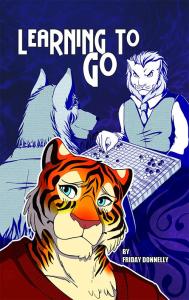
learning coverMy most recent project is Learning to Go. It’s a story about a tiger coming to terms with the idea that his relationship isn’t as healthy as it seems, and that maybe it’s time for him to move on. It asks the difficult question of “Whose responsibility is your happiness, and what’s okay to sacrifice for it?” It’s a story for people who are kind and maybe being taken advantage of, a way of helping them process that and give them an argument for putting themselves first sometimes. They deserve it, after all.

2. What’s your writing process like? Are you a “pantser,” an outliner, or something in between?

I generally have a good idea of where I want my story to go. When I have a novel burning in my brain, I tend to write 2-3 times a day and think about it during the rest. I pull in little experiences I have, little anecdotes and insights. I generally have a good idea of an outline in my head, but I’m not afraid to diverge from it if the story demands it.

3. What’s your favorite kind of story to write?

Anything with determined, manipulative (or sociopathic) characters. They don’t have to be the main character or the antagonist, but those sorts of characters tend to be the most fun to write and tend to give the plot the most fuel. They tend to make stuff happen.

4. Which character from your work do you most identify with, and why?

I identify with all my characters to some extent, and if any author tells you they don’t, I’d say they’re either lying or have some boring characters. You have to understand the points of view of a character to effectively portray them. That being said, the one I most identify with is Logan, a pig from an upcoming novel. To me, he’s the most bland major character I’ve written, which is a pretty good sign he’s the most like me.

5. Which authors or books have most influenced your work?

The Redwall series is probably the number one, since that’s what made me realize I liked furry material, but that’s so obvious I’ll give another answer. Life of Pi really hit home for me and made me realize just how beautiful and inspiring a medium text can be. I strive for that level of absurd realism used as a tool to expand the philosophical depth of my stories… and fail miserably. But I keep trying!

6. What’s the last book you read that you really loved?

At the risk of sounding narcissistic, I’ll say the work I’m editing right now tentatively titled Tempest In a Bottle. It’s not that I think it’s anything particularly special, it’s just… it’s exactly what I want to read. That’s why I wrote it, after all. If you want to know the last book someone else wrote that I really loved, then I’d have to go with Kyell Gold’s Out Of Position. It’s what got me back into both reading and writing.

7. Besides writing, how do you like to spend your free time?

Playing too much Dota 2.

8. Advice for other writers?

Listen to other people’s advice and thoughts about writing, understand why they recommend what they do, and know when to ignore it. Don’t be afraid to make mistakes… you should have beta readers to catch those. Listen to them and interact with them with respect and appreciation!

9. Where can readers find your work?

My non-published works can be found on FurAffinity, as can samples of published material (http://www.furaffinity.net/user/dandin/). News on upcoming publications can be found at my Twitter (https://twitter.com/FridayDandin).

10. What’s your favorite thing about the furry fandom?

Easily how open and friendly it is. I wish more communities learned from it!


Check out Nathanael “Friday” Gass’ member bio here!

Member Spotlight: Bill “Hafoc” Rogers

1. Tell us about your most recent project (written or published). What inspired it?

My most recent published work is “Squeezer,” a story in the Rabbit Valley anthology Trick or Treat II: Historical Halloween.

Lately, for whatever reason, I’ve been reading and writing a lot of detective stories. I had a series of crime stories involving a modern-day character named Derrick Clydesbank. I had also read a fair deal about the Jack the Ripper case. When the call went out for stories about historical Halloweens, those things percolated and produced my story, “Squeezer,” set in “Vixtorian” London.

Of course this is a century and a half before Derrick’s day, in another country, so I couldn’t use my modern characters. I did still slip in a Father Clydesbank, an “Anglican” priest. He is probably one of Derrick’s less dangerous relatives.

The story is also a horror story, and as usual in horror stories I go with whatever horrifies me myself. Some people think horror writers are monsters for being able to think up such cruel and terrifying stories, but I think most of them are just poor fools who are easier to scare than normal.

2. What’s your writing process like? Are you a “pantser,” an outliner, or something in between?

When I’m on the trail of something really big I go by the seat of the pants. I follow the characters where they lead, and when they show me where they are going I am at least as surprised by it as any reader would be.

The interesting thing about such seat of the pants writing, for me, is that it is always clear that the characters clearly knew where the story was going all along. I never need to go back to put in hints, clues, or foreshadowing; they’re all there already. The story was complete, hanging out there somewhere, and all I did was write it down the way it happened. I’m not sure whether this is more delightful or creepy.

Of course, as I said, I’ve done crime and mystery stories lately, and those are different. To the extent that a story is a mystery, it is more a puzzle than a piece of literature. Puzzles need clues, forms, shapes, and frameworks. The pieces all have to fit, and you have to decide where the detective and the reader will find them. Mystery stories I plan out in my head in advance, although I don’t write formal outlines for them. A few notes are sufficient.

3. What’s your favorite kind of story to write?

The big sweeping adventure tale within which I can get lost. Hopefully my readers will too!

4. Which character from your work do you most identify with, and why?

I don’t identify with any of them too much, although of course all of them incorporate parts of me.

Probably the character I can come closest to identifying with is Dean Lansen, one of the protagonists in Hilltown, a science fiction/fantasy novel published by Melange Books. In a way this is vain because Dean is something more or less than human, almost godlike within his limited range. However, he feels set apart from humanity, as I sometimes do. Above all else, Dean was a character in some of my dreams and lives in a dream version of a town well known and very dear to me. He may not be me, but he is a close neighbor and I know him well.

5. Which authors or books have most influenced your work?

Robert A. Heinlein’s classic teen science fiction novels, such books as Starship Troopers; Have Spacesuit, Will Travel; Tunnel in the Sky; Rocket Ship Galileo (space Nazis!) and of course his various short story collections of the era. I don’t think they have influenced my style all that much, but they lined one shelf in a library where I went as a kid, and I read them all at least once. They got me going in science fiction, which led me to fantasy and furry lit.

In fact, my approach to the furry fandom was via science fiction. I wrote and enjoyed stories with alien characters who were more than just small men in green face paint. Good aliens act and think differently because they aren’t human. Good furry characters do too.

6. What’s the last book you read that you really loved?

One Corpse Too Many by Ellis Peters. It is a mystery set in England during The Anarchy, as I believe it is called. It stars her pious clergyman, good detective, and fine human being, Brother Cadfael.

7. Besides writing, how do you like to spend your free time?

I enjoy those furry conventions I visit. I enjoy reading SF, fantasy, and history, messing around with AM radios to see what comes in at night, and sightseeing and all the usual tourist stuff.

8. Advice for other writers?

Read.

Do what works for you. To make people groan, I like to say “There’s no way to do it wrong, that’s why they call it writing.”

Another piece of advice someone gave me (unfortunately I forget whom) also comes into play. Everyone has a certain amount of bad writing in them. Some more, some less, but everybody has at least some bad stuff. You have to write all that out before the good stuff starts coming out. Get to it.

Have fun. It will keep you going.

9. Where can readers find your work?

My stories appear in Rabbit Valley’s anthologies Trick or Treat, Trick or Treat II, and Pulp! I have a story in the FurPlanet anthology Abandoned Places. My novel Hilltown was published by Melange Books, you may find it at http://www.melange-books.com/authors/billrogers/hilltown.html. I had several stories in the online magazine Anthro, at anthrozine.com. That magazine hasn’t had any activity in a long time but the archived stories are still in place, including mine.

10. What’s your favorite thing about the furry fandom?

The creativity. Other fandoms are creative and dedicated in following their fantasy worlds of choice, be it Trek, comics, or whatever. They create their own characters to explore those worlds. But in the furry fandom, most of us create the worlds too.

Check out Bill “Hafoc” Rogers’ member bio here!