Member Spotlight: Bill Kieffer

1. Tell us about your most recent project (written or published). What inspired it?

The Goat: Building a Perfect Victim is both one of my most recent and my one of my oldest works. I lost the original files during the decade of hiding. Phil Geusz, always a supportive creature, reminded me that there was a copy in the archive of TSA Talk, an email-based group of writers.

I had an online friendship with a Fur I’ll call My Goat as I haven’t gotten his permission to talk about him in relation to this novella. It was quite intimate and heartbreaking as he’d found his true self in Furry Fandom… and there just wasn’t a way to get that in real life. I’d been sorta slumming in Furry before I met him. He was like a stubborn classical Greek Hero. Eventually, he had to give up Furry to build his life back. I was one of the things he had to give up, too.  And I had to let him go. In real life, I could never be the master he needed (besides the
fact that I was in a committed RL relationship). As I started to let him go, I tried to imagine what type of master would make him happy.  Frank was a very wrong answer; but I felt some sympathy for him.

2. What’s your writing process like? Are you a “pantser,” an outliner, or something in between?

I’m a “pantser,” except when I do a mystery or crime story.  I outline mysteries and crimes so I don’t cheat, trying to be witty. Otherwise, I let my characters pull me along. Last fall, I tried writing two pieces for Munchkin’s Fragments of Life’s Heart… both contained a lot more death than I had planned. Seriously, I write the worst love stories.

3. What’s your favorite kind of story to write?

I like writing TF (transformation) stories.  I like exploring form and function. I like writing Metamor Keep stories, even if most of the Keepers think I’m trying to break the MK universe when I do so.

4. Which character from your work do you most identify with, and why?

Greyflank, from the Tales of the Blind Pig, is a Mary Sue, so he doesn’t count. Wheeler and Clay, from my Metamor Keep stories, are two halves of my soul. Wheeler, the seasoned fighter and former sex slave, represents the part of me that knows what he wants and is looking for. Clay is younger and sheltered, his whole world shattered about him, forced to be the stronger partner. He represents that part of me that only suspects what he wants and how he is to fit that into his life.

5. Which authors or books have most influenced your work?

Piers Anthony. Stephen King. Phil Geusz, Charles Matthias. Alan Dean Foster. Richard Matheson. Alan Moore. I don’t think I write like any of them; but I know I stole some good moves from each of them. From Anthony, I learned sex and attraction needs no moral compass. Actions will tell. From King, I learned the threat of a bludgeoning was more frightening than the bludgeoning itself.  From Geusz and Matthias, I learned how to build serial characters that readers will care for. From Foster, I learned a well-written character can stomp out any plot hole. From Matheson, I learned a living character can explode the slightest story concept into living art. From Moore, I learned to build on the past, twisting it as we go. I also may have picked up a great deal of wordiness from Moore, too.

6. What’s the last book you read that you really loved?

Mindtouch by M.C.A. Hogarth was the last novel to floor me. It put asexual relations in perspective for me and changed my outlook.

7. Besides writing, how do you like to spend your free time?

I like food. I cook, I eat, I stalk the aisles of Trader Joe’s and Whole Foods. I’m a tubby pony.

8. Advice for other writers?

Write.  Write about people. Don’t write, except for kicks, to please anyone. Be pleased when you do. Don’t feel rejection when you are rejected. 9/10 of this stuff is timing. And you’ll never ever see the clock.

Yes, even if you’re writing about badgers and foxes building a better tomorrow, write about people. Hide a statement in your piece. Make Easter eggs for your readers. Give them something they can claim as their own.

9. Where can readers find your work?

The Goat: Building a Perfect Victim is a naughty m/m novella that will be available this summer or fall from Red Ferret Press. This takes place in my “2×4” universe where a few of my stories take place. If I can remember how to build a website, those other stories will be on Xepher.net in a few months. “Brooklyn Blackie and The Unappetizing Menu” appears in Inhuman Acts from FurPlanet. This takes place in a universe I call Aesop’s Planet.  Except for Captain Carrot fan fiction, this is the only published work in that universe. My Metamor Keep stories can mostly be found at the Metamor Keep Story Archives, although my Ursa Major Award nominated short story “The Good Sport” was recently reprinted in An Anthropomorphic Century, also from FurPlanet.

10. What’s your favorite thing about the furry fandom?

I like how it transforms people. I like how it transformed me. It helped me to accept that I’m bisexual. I like that being a horse gave me a framework to hang my anxieties on. I like, most especially, the acceptance that I receive. It’s not universal, but it’s enough.

Check out Bill Kieffer’s member bio here!
Guest post: “The Critique Masochist” by Frances Pauli

The Critique Masochist

by Frances Pauli


As an art school veteran, I am no stranger to criticism. When I create something, I not only expect critique, I immediately crave it. Critique is necessary, it’s useful, it is required. And the more brutal the better. In essence, I have become a critique masochist. How could this have happened? Let me explain.

Art majors at the college level spend their week something like this… Monday through Thursday are filled with studio classes–three hour sessions of drawing and/or painting in the classroom. Sometimes, it’s a clever arrangement of old knickknacks, vases, and Styrofoam balls and sometimes an assortment of nude models which is not nearly as exciting as you might imagine when you’re trying to get the lines right.

Friday, however, is critique day. On Friday, you gather your week’s work, tack it to a wall, and wait for the guns to start firing at you. You learn to love Fridays or you aren’t going to be in art school very long. Freshmen feared the week’s end. Those with tenuous egos invented reasons to be ill on Friday. You could try to dodge, but no matter how clever you were, eventually, it was your work on the wall.

There were only two rules in a peer critique and they are very good ones. First, you must remain absolutely silent while your work is being trashed–er, examined. Second, a critic may not say “I like it” or “I don’t like it” unless the statement is immediately followed by a detailed explanation of “WHY”.

Fridays were fun days in the school of art. If someone wasn’t crying in the halls between classes, it wasn’t Friday. I’m serious. People fled critique day, people sobbed. Some stomped straight to administration and switched majors. But, no matter how you look at it, Friday was a good day. It was Friday that turned me into a critique masochist.

So, back to writing…and critique. Critique is a good thing. It is the single most vital tool to becoming the best at any creative endeavor. We cannot be our own critic. We can try, and please do try. It’s required, you HAVE to learn to look at your work objectively. On the flip side, you will never, ever be as objective as your reader in Connecticut who’s never met you. Seek out the guns. Please. As you do, remember a few things to nurse a happy relationship with criticism. It will find you eventually anyway. If not before publication, then after.

DETACH: Your work may be your baby, but it’s not your baby. Any discussion of your work is not a personal attack. It is not your job to protect it. It is your job to let it be ripped to shreds and reassembled into something better, and golden, and closer to perfect.

EGO AWAY: Put it in a box, lock it in its room, whatever. Your ego will be needed later (when the rejections roll in and make you want to quit) but while receiving and giving criticism, it’s dead weight and will only botch up the whole process.

LISTEN: With both ears and the whole mind. Listen and consider the slim possibility that the critic may be right. Don’t waste time disagreeing or mentally arguing, listen. Listen and pretend they’re a genius–just for now.

SALT: When you have listened, considered and absorbed, THEN remember the grain of salt. This is an opinion–one person’s opinion or a whole class’ opinion, but still an opinion. Do you agree with it? Try. If not, stick to your guns and trust that you know your own goals. Don’t ever think that a suggestion is a rule, that you must change and adapt to every criticism or you will never stop fixing and changing things back and forth. Do change what you agree with. Do give serious thought to any suggestion that comes up more than once, or over and over again from different sources. But in the end, you decide.

Remember the two rules–they are good ones. Don’t interrupt. Never argue during the critique. If anyone ever says, “I like it” or “I don’t like it” insist on a detailed “why.” Embrace the horror–that is, the process– and learn to love it. Laugh at your mistakes and yourself often. Eventually, you might find yourself craving it, needing it. Personally, I’m suspicious of anyone who reads my work and doesn’t pick it apart, at least a little. Don’t trust the “I loved it” or the “It’s great” without further discussion! With a little practice, you too can be a critique masochist.


This post first appeared on Speculative Friction.

Member Spotlight: Jakebe Jackalope

1. Tell us about your most recent project (written or published). What inspired it?

Right now I’m working on a serial story for Patreon, told in weekly installments, then bundled up once a month or so and posted to various websites. I’m really excited about the opportunity and challenges presented in telling a story in these episodic bursts; I think it really allows you to experiment with the plotting and structure in ways that maximize the impact of how things roll out.

This first serial is something I’ve been developing for a while, called “The Cult of Maximus”. Two mismatched police officers — a large, gentle wolf and a small but aggressive rabbit — are investigating the disappearance of various homeless people within their jurisdiction of Fog City. The discovery of what’s been happening to them pulls them both into a sprawling conspiracy that has designs on guiding the kaleidoscope of sapient species to the next stage of evolution. Now, this pair has to find a way to discover just how deep this cult goes and how to stop them while being in over their heads every step of the way.

I hope that the serial will give me the ability to arc out a deep exploration of these characters and how their experience with this mystic, impossible problem changes them — both inside and out. Of course, those changes manifest in ways that affect the people around them, and this serial will explore that as well. I’m really fascinated by how personal changes become community changes, and how those become bigger socio-political changes given enough time and momentum. We don’t exist in a vacuum, and I’m really jazzed about the opportunity to show that step by step.

All of this will be taking place in the context of a story with an erotic nature, which is also exciting and really tricky. I’m going into this with the idea that erotic stories can discuss serious and interesting topics; they can be arousing, thrilling and thoughtful at the same time.

2. What’s your writing process like? Are you a “pantser,” an outliner, or something in between?

Definitely “something in-between”. I’ve found that it really helps me to pull through a story if I have signposts that can lead me to the next big thing, so I really love having an outline that allows me to see the rough shape of a story. However, the story almost never turns out to match the shape of the outline I’ve given it.

When a story “grows legs”, it’s a sign that you’ve really tapped into something but it can also throw all of your plans out of the window. Characters end up doing things you’d never expect, pulling new characters from the ether that you never planned for; or a character will resist a certain plot point because there’s something about their personality that makes a necessary action impossible for them to take, so you have to back up and get to know this person in your head a little better.

So while the outline is definitely a big help for determining the joints of the story where things pivot, you might find that you need to reconstruct it on the fly fairly often.

3. What’s your favorite kind of story to write?

I think I really love telling stories about outsiders. People who resist type a little, perhaps, or feel that they don’t belong for one reason or another. I love digging into a character to figure out how they work, what makes them feel disconnected from their environment, and then writing the story that moves them a little closer to the world they inhabit.

Most of the stuff that I end up showing is erotic in nature, just because I’m a big fan of macro/micro stories as well. There’s something about the way physical transformation necessitates a shift in your mentality that I love exploring too; when you gain or lose physical power, it changes the way you see yourself and your place in the world. It’s more than simply lording power over someone else, it’s also dealing with this real, physical difference that separates you from your world and what that does to your psyche.

4. Which character from your work do you most identify with, and why?

This might just be because it’s what I’m working on now, but Officer Tom from “The Cult of Maximus” is someone I’m having a lot of sympathy for right now. He’s this sort-of average guy who holds strong beliefs without necessarily voicing them, who feels in over his head with his job most of the time, who is trying to balance the demands of this difficult profession with his home life. And just when he feels like he’s getting his feet under him, something else comes along to pull the rug out from under him! It happens all the time in life, and I think that’s what makes it such a fun story to write. Continue reading “Member Spotlight: Jakebe Jackalope”

Guest post: “RAWR: Year One Review” by Skunkbomb

RAWR: Year One Review

by Skunkbomb


Earlier this year, I paid to stay up late critiquing roughly 1,500 words a night from talented writers while teetering toward a panic attack as I wrote my first sex scene. I loved every minute of it.

rawr logoThis was the first year of the Regional Anthropomorphic Writers’ Retreat (RAWR) led by Kyell Gold (Out of Position, Green Fairy) with associate instructor Ryan Campbell (God of Clay, Koa of the Drowned Kingdom) and facilitated by Chandra al-Alkani. After an icebreaker dinner, the next five days would begin with lectures from Kyell, Ryan, Watts Martin (Why Coyotes Howl, Indigo Rain) and Jeff Eddy of Sofawolf Press. They covered world building, setting, character, structure, and publishing while some of the attendees were still drinking coffee in their pajamas. It was helpful advice to keep in mind as we moved into critiques.

Critiques swallowed up most of my time at the retreat whether I was critiquing the work of my peers or writing notes on the feedback the other writers provided for my stories. Listening to the other writers point out what’s working and what isn’t in my stories was both intimidating and exhilarating, but that may be my inner masochist (that explains why I applied for this retreat). Despite my fears, getting that feedback was invaluable. Not only could I trust the other writers to give me honest feedback, they always had something positive to say. Above all, RAWR is all about helping writers grow.

Each writer got two critique sessions. Some of us edited the first story and submitted it to be critiqued a second time after revisions. Some of us had two different stories to be critiqued. One of us even submitted a long story in two parts. I went with option two after I told Kyell about the second story I was working on and he encouraged me to submit it despite not being halfway done with the first draft. If you ever need a kick in the pants to finish a story, having a deadline due in less than 24 hours works wonders. There are times when I want to procrastinate, but being in such an environment got me to work on more writing than I’d done in a month.

One of the highlights of the retreat was the opportunity to meet one-on-one with Kyell and Ryan to ask them anything I wanted. I brought a paper with questions to mask the fact I was essentially word vomiting whatever came to mind. This ranged from serious discussion of my writing (How often should I put out new writing to grow my audience?) to the self-indulging (What tips do you have about writing anthro skunks?)

It wasn’t all work. We’d eat together at the private residence where the workshop was held … while finishing a draft before the submission deadline for critiques. We’d watched movies … while critiquing stories. Okay, so work bled into our downtime, but at least we weren’t bringing our laptops to restaurants when we ate out.

By the time the final day of the retreat arrived, I didn’t have peers. I had friends who I would root for whenever they submit work for publication. I had a renewed resolve not only to improve my writing, but also give back to the furry community. This was one of the most exhausting five days of my life that I wouldn’t trade for a spot on the bestseller list.

Book of the Month: Claw the Way to Victory

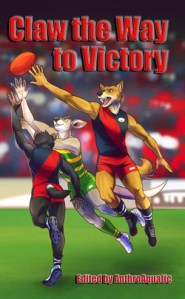
claw coverFebruary’s Book of the Month, Claw the Way to Victory, is edited by Sean Rivercritic of AnthroAquatic and includes stories from several FWG members.

We’ve all watched sports played by humans, or have participated in sports with our human limbs and senses.

What would happen if the sporting events we loved were played by animal people?

Claw the Way to Victory looks to answer that question with a variety of stories, each showcasing a different sport and just how the instincts of an animal matched with the intelligence of a human can help or hurt a player.

Scratching? Biting?

Against the rules?

Not this time.


Cover art by Pac.

Parental rating General/Mature (possible violent content). Available from Jaffa Books.

Guild News: February 2016

New Members

Welcome to our newest member Frances Pauli!

Member News

Book news: Fred Patten’s latest anthology, Cats and More Cats, was released at Further Confusion and will soon be available for order from FurPlanet‘s website. The first furry anthology from Jaffa Books, Claw the Way to Victory, was released at Anthro New England and is edited by Sean Rivercritic of AnthroAquatic. Bill Kieffer’s novella The Goat: Building a Perfect Victim is forthcoming from Red Ferret Press.

Short stories: You can read Madison “Makyo” Scott-Clary’s story “Milkshakes and Foxes” in the Further Confusion conbook, and Mary E. Lowd’s flash fiction piece “Dealership with the Devil” is online at Theme of Absence. (Check out their interview with her as well.)

Rechan has been accepted as an Associate Editor at EMP Publishing, for their online horror magazine, and in crowdfunding news, Joel Kreissman has begun a Kickstarter campaign to fund illustrations for his novel.

Congratulations, everyone!

(Members: Want your news here? Start a thread in our Member News forum!)

Market News

Upcoming deadlines: The second issue of A Glimpse of Anthropomorphic Literature is reading through February 15, and Fur the ‘More is seeking “Cubicle Jungle” submissions for its conbook until February 15 (maximum 2000 words, full info here). FANG Volume 7 and FurPlanet’s science fiction horror anthology both close on March 1; see guidelines for both anthologies here.

Remember to keep an eye on our Calls for Submissions thread and our Publishing and Marketing forum for all the latest news and openings!

Guild News

We’re seeking an editor for the next volume of our Tales From the Guild anthology! See this post in our forums for more information, and if you’re interested, please get in touch by February 21.

Want to hang out and talk shop with other furry writers? Come join us in the forum shoutbox for the Coffeehouse Chats, Tuesdays at 7 p.m. Eastern and Thursdays at 12 p.m. Eastern. More info on the Coffeehouse Chats is here. (Remember, our forums are open to everyone, not just FWG members. Come register and join the conversation!)

Elsewhere on the Internet, we have a Goodreads group with a bookshelf featuring books by our members. Feel free to add any members’ books we’ve missed so far (see the instructions here on how to do that). We also have a Telegram group, and you can find more info on that and a link in this thread.

Remember, we’re always open for guest blog post submissions from FWG members — it’s a great way to help out fellow writers. See our guidelines for the details.

Have a happy and creative February! If you have news, suggestions, or other feedback to share, send an email to furwritersguild (at) gmail.com or leave a comment below.