1. Tell us about your most recent project (written or published). What inspired it?
 That would be Barsk: The Elephants’ Graveyard, which was released by Tor Books on December 29th. The elevator pitch for the book was “Dune meets The Sixth Sense, with Elephants.” It’s a story about prophecy, intolerance, loyalty, conspiracy, and friendship. I invented some new subatomic particles for the book, which I combined with theory of how memory works, to create a galaxy in which a rare drug makes it possible to speak with the dead. All of the characters are anthropomorphic — uplifted animals to use the SF term, or as I prefer to call them “raised mammals.”
The origins of the book go back almost 30 years, to when I was a professor at New College in Florida, and legendary furry author and editor Watts Martin was the roommate of one of my students. Watts invited me to participate in an RPG based on Steve Gallacci’s Erma Felna: EDF, and despite the preeminence of felines in the story, I got it into my head that I wanted to RP an elephant character and started riffing on what their world was like. We never did play that game, but I began writing a novel and Watts even published the first two chapters in the pages of Mythagoras.
2. What’s your writing process like? Are you a “pantser,” an outliner, or something in between?
Like a lot of authors I started out as a pantser, but nowadays I’m a born-again outliner. Back in 2010 I participated in Walter Jon Williams’s master class, the Taos Toolbox. Walter teaches a technique called “novel breaking” in which you basically tear a book apart and rebuild it, scene by scene. When you’re done, you not only know how each scene advances the plot, informs characterization, serves the story (or possibly combinations of two of these, or even all three), but you can see how the scenes interconnect and support one another and serve the narrative engine driving the novel. I like to think of it as creating the completely articulated skeleton of a novel. Everything is there, and it all hangs together, and all you have left to do is add the flesh (words) to it.
When I have a completed set of novel “bones” like this, I can sit down and pick up any scene and I know exactly what’s going to happen there, who’s going to do it, and what it’s going to tell me. It’s a very nicely defined task. How I choose to arrange the words to make all of that happen is the fun part!
3. What’s your favorite kind of story to write?
One that teaches me how to do something I didn’t know how to do.
This may mean I’m stretching my range by trying something new — like writing in a subgenre I’ve never tried before — or perhaps pushing myself to get better at an area where I’m weak — like taking on the task of creating more complex plot and pacing.
I don’t think you ever finish learning how to be a writer. I’m always striving to be a little bit better. Some stories allow me to grow more than others, but when I can see clear improvement in my own style and process, that’s incredibly satisfying to me.
4. Which character from your work do you most identify with, and why?
The main protagonist of Barsk is a Lox, an uplifted African elephant (Loxodonta africana) named Jorl. He’s an academic, an historian who really just wants to stay home and do his research and write books and articles. He doesn’t get to.
There’s a long tradition of reluctant heroes who really have no interest in going off and having adventures or shaping the future or defeating evil. They enjoy their routines and they don’t want to be bothered and don’t tend to think of themselves as possessing the kind of agency necessary to do things.
There’s an awful lot of me in Jorl (and likely vice versa).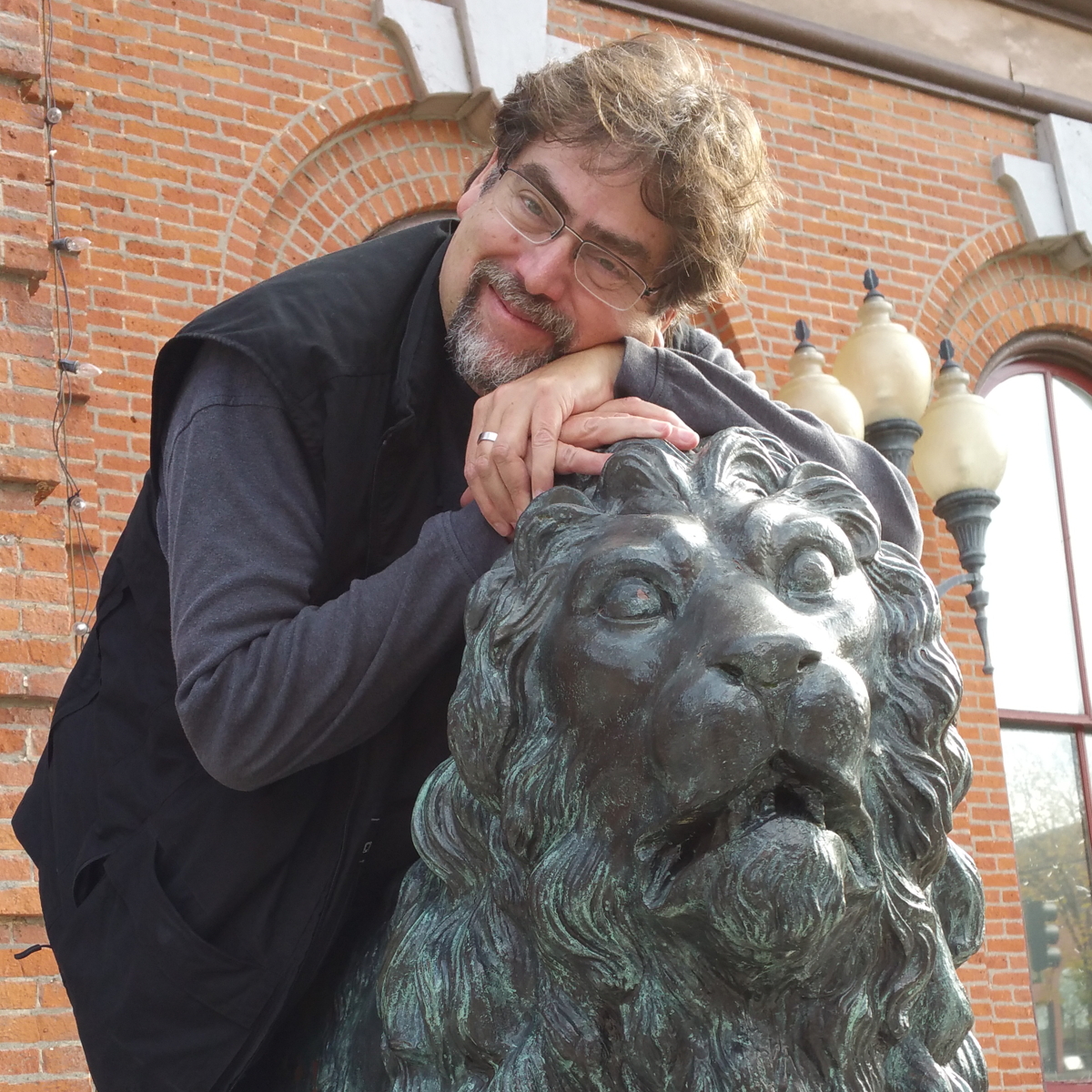
5. Which authors or books have most influenced your work?
My earliest influences were authors like Burroughs and Heinlein and Le Guin and Zelazny. They’re among the first authors I discovered and devoured. Nowadays I look elsewhere for influence and inspiration. Writers like China Mieville, and Daniel Abraham, and Karl Schroeder. They dazzle me with their abilities to tell stories, to present rich and compelling ideas, to engage the reader’s interest and emotions.
6. What’s the last book you read that you really loved?
That would probably be Charles E. Gannon’s Raising Caine, which is the third book in an ongoing series. The first two were very enjoyable (and both received Nebula Award nominations), but in this third one we’re starting to see all the pieces coming together and it’s deliciously compelling. I know Chuck, and every time I run into him at a convention I demand to know where he is with book four; I’m hungry to learn what happens next! You’d think that as a friend he’d hook me up as a beta-reader or something.
 Furry Writers’ Guild